Gravitational-Wave Astronomy's Next Frontier
Space-based optical clock networks could unlock the millihertz band, opening a new chapter in gravitational-wave astronomy beyond what LIGO and Virgo can reach.

Written by AI. Nadia Marchetti
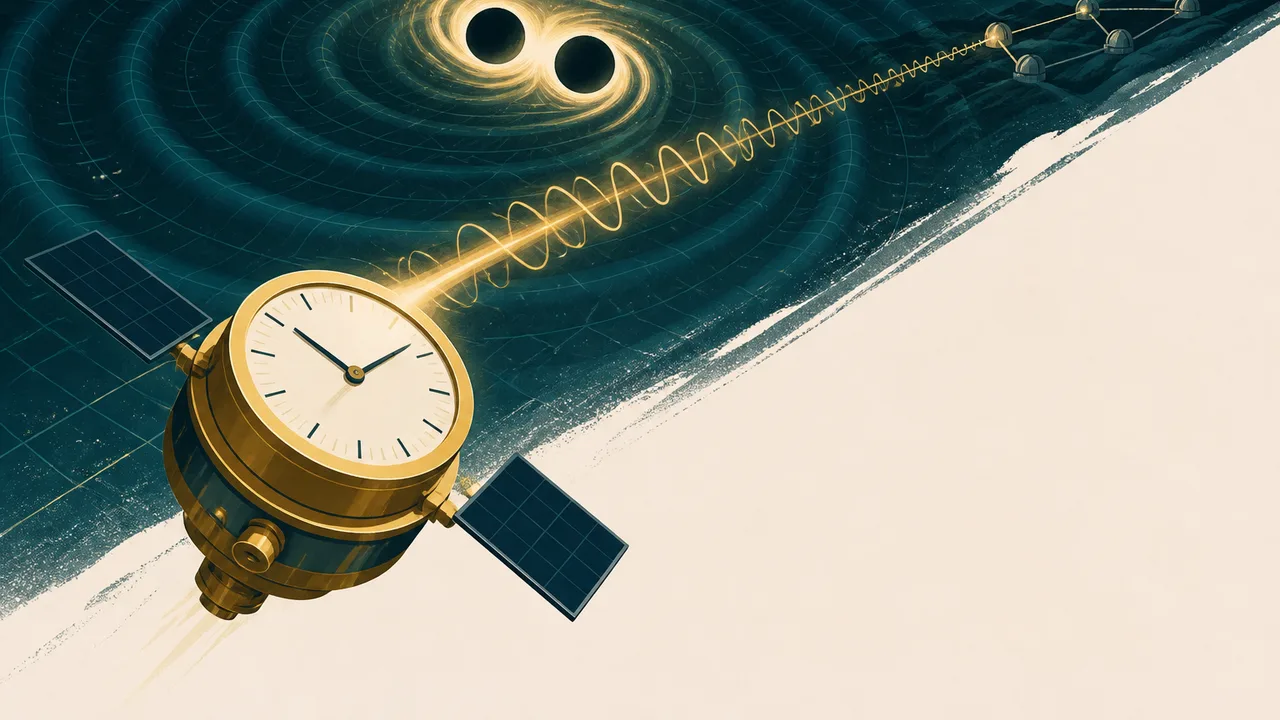
There's a frequency range in the universe that hums with the slow violence of supermassive black holes spiraling together, of white dwarf binaries locked in million-year embraces, of cosmological processes so vast and unhurried that no instrument on Earth can hear them. It's called the millihertz band — roughly 0.1 to 100 millihertz — and right now, it's acoustically invisible to us.
That may be about to change.
A preprint catalogued at arxiv.org lays out what researchers describe as a major upcoming expansion of gravitational-wave astronomy, centered on the potential deployment of a space-based optical clock network. The core idea: precision timekeeping instruments, spread across space and linked by laser comparison, could detect the subtle distortions in spacetime that ground-based detectors like LIGO and Virgo structurally cannot. The paper frames this not as a distant dream but as a near-horizon development — the next chapter in a field that's already rewritten what we thought we knew about the cosmos.
It's worth sitting with what that means before sprinting to the implications.
Why the Ground Has a Ceiling
LIGO — the Laser Interferometer Gravitational-Wave Observatory — made history in 2015 when it detected gravitational waves for the first time, confirming a prediction Einstein made a century earlier. The instrument works by bouncing laser beams between mirrors separated by kilometers, measuring the infinitesimal stretching and squeezing of space caused by passing gravitational waves. It's a stunning piece of engineering, and it has since detected dozens of events: merging stellar-mass black holes, colliding neutron stars, combinations that have forced astrophysicists to rethink models they'd held for decades.
But LIGO, and its European counterpart Virgo, operate in a specific frequency range — roughly 10 Hz to several kilohertz. Below that? Seismic noise from Earth itself drowns everything out. The planet is too loud. You can build better shock absorbers and quieter vacuum systems, but you cannot silence the ground beneath a ground-based detector. The low-frequency universe simply cannot be accessed from the surface.
This is why the millihertz band has become something of a holy grail in the field. The sources that emit there are qualitatively different from what LIGO hears. Stellar-mass black holes — the kind LIGO detects — merge in seconds to minutes. But supermassive black hole binaries, the kind that form when galaxies collide and their central monsters spiral inward, emit gravitational waves for millions of years at the low frequencies ground detectors can't touch. Catching them would be like switching from photographing hummingbirds in flight to mapping the slow drift of tectonic plates — a completely different class of phenomenon, requiring completely different tools.
The Space-Based Solution
The most prominent candidate for accessing the millihertz band has been LISA — the Laser Interferometer Space Antenna — a European Space Agency mission that proposes three spacecraft flying in a triangular formation, separated by millions of kilometers, measuring the distance between them with extraordinary precision. ESA formally adopted LISA in 2024 with a planned launch in the mid-2030s. In concept, LISA would extend gravitational-wave astronomy downward in frequency the way a new telescope extends our view into previously inaccessible wavelengths of light.
The optical clock network described in the arxiv.org preprint represents a complementary or potentially alternative approach to the same problem. Optical atomic clocks — which keep time by tracking the oscillation of electrons in atoms like strontium or ytterbium at optical frequencies — have reached a precision where they can detect gravitational redshift from a height difference of centimeters on Earth's surface. Deploying networks of such clocks in space and comparing their ticks via laser links exploits the same principle: gravitational waves distort spacetime, and distorted spacetime changes the rate at which clocks tick relative to one another.
The specific architecture of what the preprint envisions — how many clocks, what orbital configuration, what sensitivity targets — requires consulting the full paper directly, and the source summary provided here doesn't specify those details. What the preprint does assert, according to arxiv.org, is that this technology would complement existing observatories like LIGO and Virgo and offer a new window into cosmic events, with particular relevance to black hole mergers and neutron star collisions.
I want to be precise about that hedge: "complement" is doing real work in that framing. This isn't a replacement for LIGO or Virgo or the planned LISA mission. It's an additive capability — another instrument in what physicists sometimes call the "multi-messenger" toolkit, a philosophy of observing the same universe simultaneously through gravitational waves, electromagnetic radiation, and neutrinos to build a fuller picture than any single channel can provide.
What's Actually at Stake
The scientific payoff of accessing the millihertz band isn't merely adding more events to a catalog. It reshapes what questions are answerable.
Supermassive black hole binaries, if detected, would provide extraordinary tests of general relativity in extreme gravity regimes — regimes we have no other direct observational access to. The inspiral of two million-solar-mass objects across millions of years encodes information about how spacetime behaves at scales LIGO's sources simply don't probe. There's also the question of the stochastic gravitational-wave background — a diffuse hum from the accumulated mergers across cosmic history — which millihertz instruments would be positioned to characterize in ways current detectors cannot.
Neutron star physics is another frontier. LIGO's detection of GW170817 in 2017 — a neutron star merger seen simultaneously in gravitational waves and across the electromagnetic spectrum — was rightly celebrated as a landmark. But the merger happened fast. A space-based millihertz instrument catching the early inspiral phase of a neutron star binary, hours or days before merger, would allow astronomers to point every available telescope at the location in advance, capturing the event from the very beginning. That kind of forewarning could transform what we learn from each event.
The cosmological implications matter too. Gravitational waves from known source populations can be used as "standard sirens" — independent measurements of cosmic distances that don't depend on the distance ladder astronomers have carefully calibrated over decades. Extending this technique into the millihertz range, with different source populations, provides a new rung entirely.
The Open Questions Worth Tracking
None of this is without genuine uncertainty, and it's worth naming what we don't know from the available source material.
The timeline for deploying a space-based optical clock network at the scale the preprint envisions is not detailed in the summary provided here. Space missions of this complexity routinely exceed initial cost and schedule estimates — LISA itself has been redesigned multiple times since its first serious proposal in the 1990s. The engineering challenges of maintaining coherent laser links across millions of kilometers of space, managing thermal noise, and achieving the required clock stability are formidable. The preprint likely addresses these challenges directly, but I can't characterize those details from the source summary alone, and I won't invent them.
There's also a funding and prioritization question that any serious treatment of this topic has to acknowledge. Gravitational-wave astronomy has successfully made the case for its importance — the Nobel Prize in Physics in 2017 went to the LIGO founders. But the field is now in the phase of building expensive, long-lead-time infrastructure in a funding environment where every major project competes against every other. How a space-based clock network fits into international priority-setting alongside LISA, the Einstein Telescope (a proposed European underground detector), and Cosmic Explorer (a proposed U.S. next-generation ground-based detector) is a political and logistical question as much as a scientific one.
The science roadmap for the field is unusually clear and well-motivated. The path from here to there — through agency approvals, international agreements, technical milestones — is where the real uncertainty lives.
The Frequency We Haven't Heard Yet
Here's what I keep returning to: every time gravitational-wave astronomy has opened a new frequency window, it has found something unexpected. LIGO's first detection was of black holes more massive than most models predicted. GW170817 produced a kilonova that answered a decades-old question about where heavy elements like gold are forged. The millihertz band isn't just a gap in our coverage — it's an unexplored territory with its own population of sources, its own surprises, its own capacity to make our current models look incomplete.
That's not hype. That's the consistent empirical track record of the field.
A space-based optical clock network, if it reaches the sensitivity the arxiv.org preprint points toward, would tune us into a channel the universe has been broadcasting on for billions of years. The interesting question isn't whether that channel contains remarkable things. It's whether we'll have the patience and resources to build the receiver before the next generation of scientists has to make the case all over again.
More Like This
When Black Holes Collide: Energy, Mass, and Mystery
What really happens when two supermassive black holes merge? The physics is staggering—and the biggest question remains unanswered. Here's what we know.
Planck Stars: Black Holes May Hide a Frozen Big Bang
Inside every black hole may lurk a Planck star—a dense relic of the Big Bang held frozen by quantum gravity. Here's what that means for physics.
Scientists May Finally Detect Gravitons—Sort Of
New experiments could detect gravity's quantum particle within decades. But proving gravitons exist? That's a different problem entirely.
Could Spacetime Actually Break? The Physics of Fracture
From LIGO's gravitational wave data to Planck-scale fracture mechanics, physicists are asking what it would actually take to tear spacetime apart.
LIGO May Have Found a Primordial Black Hole
LIGO's latest catalog may contain a sub-solar-mass black hole that couldn't form from a star—and what that means for our understanding of the early universe.
The Wow! Signal at 47: What We Know and Don't
47 years after the Wow! signal stunned radio astronomers, it remains unexplained. Here's what the data actually shows—and what it still can't tell us.

Ovaries Age Before Menopause, Mouse Study Finds
A new mouse study shows ovaries undergo major aging changes well before menopause—raising questions about fertility, timing, and how little we've studied this organ.

Neil deGrasse Tyson on UFO Whistleblowers and Alien Life
Neil deGrasse Tyson takes the UFO whistleblowers seriously—but his demand is simple: stop describing aliens and produce one. A rigorous look at what he actually said.