Ovaries Age Before Menopause, Mouse Study Finds
A new mouse study shows ovaries undergo major aging changes well before menopause—raising questions about fertility, timing, and how little we've studied this organ.

Written by AI. Nadia Marchetti
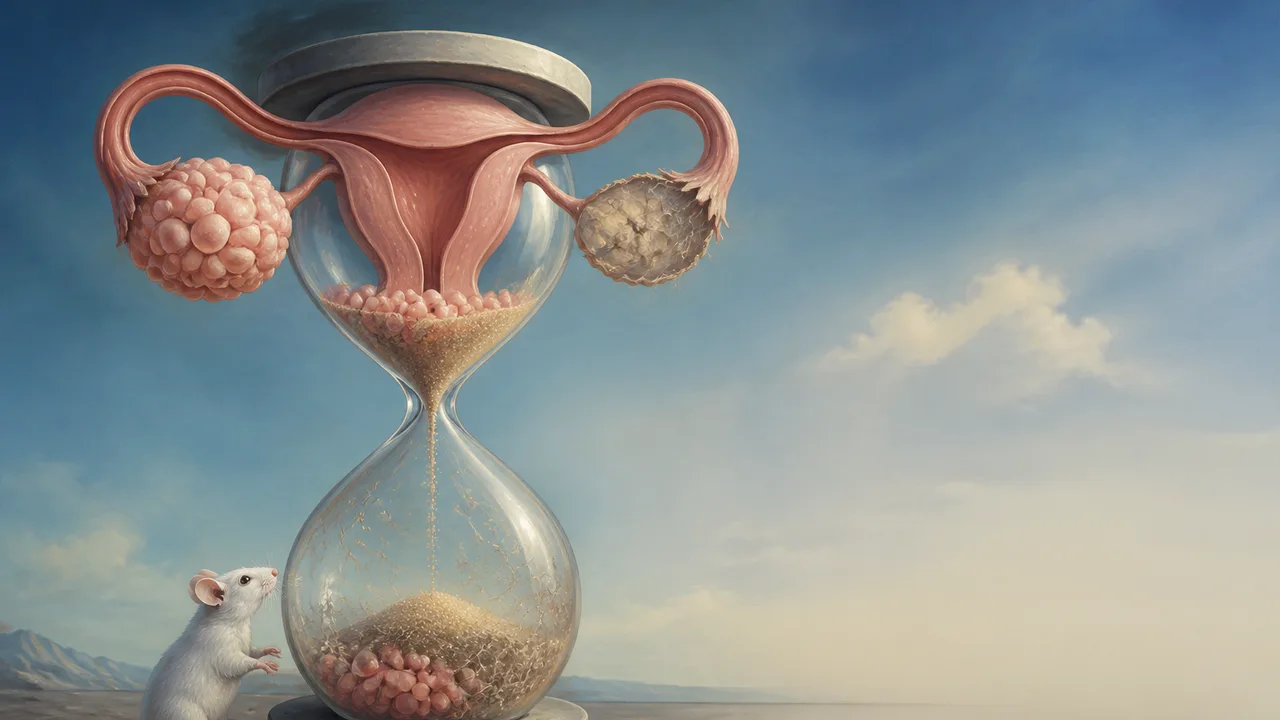
The number is quietly staggering: according to Healthline, humans are born with somewhere between one and two million eggs. By the time menopause arrives, Medical News Today reports that only around 1,000 typically remain. That's a loss measured in the hundreds of thousands — and the question researchers are only beginning to take seriously is: what exactly is happening to the ovary during all that time?
A new study published in Science suggests the answer is more dramatic, and earlier-arriving, than most people assumed. The research team analyzed ovarian tissue from mice across different ages and different stages of the reproductive cycle, and what they found was not a gentle, gradual wind-down. According to ScienceAlert, the long-understudied female reproductive organ undergoes major age-related changes long before menopause arrives — in mice, at least.
That qualifier matters. But so does the context that makes the mouse model worth taking seriously.
Why mice, and why now?
Mouse reproductive biology isn't identical to human reproductive biology. Anyone who tries to sell you a simple one-to-one translation is glossing over real complexity. As the abstract published on PubMed plainly states, "the mouse is a tractable model for human ovarian biology; however, its utility is limited by incomplete understanding of how transcription and signaling differ interspecifically and with age."
The researchers didn't ignore that limitation — they designed around it. The Science paper, available via science.org, used three-dimensional imaging and single-cell transcriptomics to build what amounts to a side-by-side comparative atlas of human and mouse ovaries across age. The goal wasn't to prove mice are humans in miniature. It was to map where the parallels hold and where they diverge — which is a more honest and ultimately more useful scientific project.
One of the more striking findings from that comparative work: the research team identified neurons and glia within the ovaries themselves, and examined their role in folliculogenesis — the process by which follicles develop and mature. According to science.org, that neural component may be relevant for human fertility as well. It's the kind of detail that tends to get lost in headline-level coverage, but it matters. If the ovary has its own embedded nervous system activity, that changes how we think about interventions. You're not just targeting hormone pathways — you may be targeting a more complex regulatory network.
As mindbodygreen and Yahoo Health both note, mice share many of the same basic biological pathways involved in ovarian aging, making them a valuable model even when the timescales and precise mechanisms differ. The convergence across two independent outlets covering the same underlying science is worth noting — it's not one team making a bold claim in isolation.
The understudied organ problem
There's a pattern in reproductive medicine worth naming directly: for an organ this central to human biology, fertility, and long-term hormonal health, the ovary is remarkably understudied. Part of this is historical — female reproductive biology was underfunded for decades, a fact that shows up in the sheer thinness of mechanistic research compared to, say, cardiac aging. Part of it is methodological: the ovary is dynamic in ways that make snapshot studies hard to interpret. Its cellular composition shifts across the menstrual cycle, across reproductive years, and across the menopause transition. Getting clean data requires tracking those shifts carefully, across multiple timepoints.
This is exactly what makes the current work notable. Rather than a single-age comparison, the research team analyzed tissue across different ages and different stages of the reproductive cycle — a design choice that captures the organ's complexity rather than papering over it.
That design philosophy echoes work published in Nature Aging, which constructed a single-cell atlas of the aging mouse ovary. The Nature Aging study acknowledged its own limits directly: it used virgin mice, which doesn't account for how pregnancy alters ovarian aging dynamics. It also noted that examining additional timepoints after reproductive senescence would provide critical insights into what happens after the reproductive window closes — a phase that, hormonally and systemically, has major implications for cardiovascular health, bone density, and cognitive aging. The candor about those gaps is reassuring. Science that knows what it doesn't know tends to be more reliable than science that doesn't admit the question.
What "early aging" actually means here
It's worth pausing on the phrase "major signs of aging before menopause" and asking what that actually means mechanistically, because the phrase can land differently depending on your frame.
In one reading, it's alarming — the ovary is failing prematurely, fertility windows are shorter than we thought, intervention needs to happen younger. In another reading, it's simply accurate biology: of course the ovary changes across the reproductive lifespan. That is its job. The question isn't whether change happens — it's whether the changes observed represent a pathological process that could be interrupted, a normal developmental trajectory that's been misread as decline, or some mixture of both.
The research, as currently reported, points more toward the first reading than the second. The changes documented aren't just the expected drawdown of follicle count. They involve deeper cellular and transcriptional shifts — alterations in how genes are being expressed in ovarian cells across age. That's a more fundamental kind of change, and it's the kind that could theoretically be influenced by external intervention if the mechanisms are well enough understood.
The practical implication, flagged by ScienceAlert, is about timing. If significant ovarian aging is already well underway before the hormonal signals of perimenopause become clinically visible, then the conventional window for fertility preservation — typically framed around a woman's 30s — may be too conservative a starting point for research, even if it's a reasonable clinical heuristic for now.
That said, the translation from mouse to human remains genuinely uncertain, and the researchers themselves are clear that additional human studies are needed. The comparative atlas published in Science is designed partly to make those future human studies more interpretable — by establishing which mouse findings are likely to carry over and which are species-specific artifacts. That's unglamorous, foundational science. The kind that doesn't generate many headlines but makes the headline-generating breakthroughs possible.
The gap between what we measure and what we know
What strikes me most about this research landscape isn't any single finding — it's the shape of the ignorance it's mapping. We have detailed data on how the ovary fails at menopause. We have extensive clinical literature on infertility interventions. What we have comparatively little of is mechanistic understanding of the decades between birth and menopause: the molecular choreography of how follicles are selected and lost, how the ovarian environment shifts across the reproductive lifespan, and what distinguishes normal aging from accelerated aging in this organ.
The mouse models being built now — the cell atlases, the three-dimensional imaging, the transcriptomic comparisons — are filling that gap. Slowly, carefully, with appropriate uncertainty about how much transfers to humans.
Whether the findings ultimately point toward pharmacological interventions, lifestyle factors, or simply better diagnostic tools for assessing ovarian reserve in younger patients, the prerequisite is the same: understanding the organ well enough to have a real conversation about it.
We're getting there. It just took longer than it should have.
More Like This

Ten Scientific Failures That Reshaped Modern Research
From thalidomide to cold fusion, ten scientific failures that caused real harm—and forced the protocols that protect us today.

The Hard Ceiling on Human Lifespan, Explained
Can science push humans past 115? From longevity clinics to cellular reprogramming, here's what the evidence actually says—and what it doesn't.
The Most Sensitive Dark Matter Detector Might Find Nothing
LUX-ZEPLIN sits a kilometer underground, waiting for dark matter. But success might look like silence—and that would tell us something huge.
Heavy Spoilers Builds an Office, Ditches the Algorithm
YouTube creator Paul from Heavy Spoilers explains why he built a garden office, changed his logo, and chose depth over views in content strategy.
Why NASA Is Finally Returning to Venus After 40 Years
After decades of neglect, Venus is getting two NASA missions. Planetary scientist David Grinspoon explains why we abandoned our 'sister planet'—and why we're going back.
Space Is Accelerating Brain Disease Research on Earth
UC San Diego researcher Aline Martins explains how brain organoid experiments aboard the ISS are generating new leads for Alzheimer's, Rett syndrome, and aging.

Neil deGrasse Tyson on UFO Whistleblowers and Alien Life
Neil deGrasse Tyson takes the UFO whistleblowers seriously—but his demand is simple: stop describing aliens and produce one. A rigorous look at what he actually said.

Cold War Flashes and Alien Technosignatures
Astrophysicist Beatriz Villarroel's VASCO project found mysterious flashes in 1950s sky photos linked to nuclear tests. Here's what the evidence actually shows.