Neil deGrasse Tyson on UFO Whistleblowers and Alien Life
Neil deGrasse Tyson takes the UFO whistleblowers seriously—but his demand is simple: stop describing aliens and produce one. A rigorous look at what he actually said.

Written by AI. Nadia Marchetti

Photo: AI. Ines Cienfuegos
There's a particular kind of intellectual honesty that sounds, on first pass, like a dodge. Neil deGrasse Tyson has spent years fielding the alien question, and his answer hasn't really changed—but the ground around it has shifted enough that what used to read as polite skepticism now reads as something more interesting.
In a recent appearance on The Diary of a CEO, Tyson sat down for nearly two hours with host Steven Bartlett and covered ground from black holes to simulations to the geopolitics of lunar ambition. But the portion that's already bouncing around feeds—the part that gave the video its headline—is Tyson's position on the congressional whistleblowers. His take is more nuanced than either UFO advocates or chronic debunkers would like, which probably means it's worth taking seriously.
"Bring Out the Alien"
Tyson's argument about the whistleblowers isn't that they're lying. It's almost the opposite: he thinks the quality of the sources has crossed a threshold that demands a different response.
"No longer can you discount the testimony the way you might have done so before with the farmer in the back 40 who saw something and is talking about it but didn't take a picture of it," he said. "Now, when official government people are doing it—former intelligence officers, former military folk, sworn testimonies in Congress—then all right, it's time to take it up a notch."
But taking it up a notch, for Tyson, means one thing: produce the evidence. His framing is worth sitting with. "No one has ever asked me, do I believe in elephants. Why? Because we've shown elephants. We have elephants. We've seen elephants." The whistleblower testimonies—claims of recovered craft, biological material, reverse-engineered technology—are, to him, the most compelling prompt he's had to say: fine, then show me. Not because he disbelieves the witnesses, but because testimony without physical confirmation is still testimony. That's not dismissal. That's methodology.
The distinction matters because the video's title frames Tyson as validating the whistleblowers, full stop. What he's actually doing is more careful: he's saying the credibility of the sources has earned the claims a serious investigation, not that the claims are confirmed. These are different things, and collapsing them is how we end up with bad epistemics masquerading as open-mindedness.
The Numbers Argument
Separate from the disclosure question—and Tyson is careful to keep them separate—is the probabilistic case for extraterrestrial life, which he finds close to self-evident.
The scaffolding he builds is worth tracing. Life on early Earth emerged within the first hundred million years after conditions allowed it—roughly 5% of Earth's total timeline. "Almost as fast as it could possibly happen," he noted, organic molecules became self-replicating life. That speed, combined with the catalog of roughly 6,000 confirmed exoplanets drawn from a comparatively tiny search radius, and a galaxy containing hundreds of billions of stars, produces a prior so large that skepticism starts to look like the eccentric position.
"I don't see why they wouldn't be given the size of the universe and the age of the universe and the ingredients of the universe," Tyson said flatly when asked about intelligent life. "I have no reason to doubt it."
That's not a mystical claim. It's a numbers claim. The universe is 13.8 billion years old, contains at least 100 billion galaxies, each with hundreds of billions of stars, most of which appear to host planets. The chemistry that produced life here—carbon, nitrogen, oxygen, iron—is distributed across all of it, forged in the same stellar furnaces. If life is possible at all, the probability that it happened exactly once strains credulity more than the alternative.
Where Tyson stays honest is on the civilization question. He layers his terms: there's life, then intelligent life, then civilization, then technology capable of interstellar communication. The Roman Empire was intelligent but wouldn't have received an alien radio signal, let alone returned one. The operational definition of "intelligence we could detect" is narrower than it first appears. And the nearest star—Alpha Centauri—would take our fastest spacecraft fifty thousand years to reach. Which leaves open, quite seriously, the possibility that the universe teems with life that simply cannot reach us, or has no reason to try.
Obama, Trump, and the Misread Transcript
One of the more useful segments in the conversation involves Tyson correcting what he sees as a consistent misreading of Barack Obama's now-famous remarks about aliens.
When Obama said something to the effect of "they're real, but I haven't seen them, and they're not being kept in Area 51," the ambient culture heard confirmation of government concealment. Tyson's reading is different: Obama, he argues, was simply saying what any scientifically literate person would say—that given the size of the universe, extraterrestrial life almost certainly exists. "That's exactly what any scientifically literate person would say," Tyson argued. "What people did with that information" was the problem.
Trump's response—implying Obama had revealed classified information—did the opposite: it seeded the idea that there was something classified to reveal. From there, the Pentagon disclosure announcements followed. Tyson's reaction to those: "Sure, great. Bring them out. I love it." Not because he expects them to contain smoking-gun evidence of visitation, but because transparency about what the government does and doesn't know is straightforwardly better than opacity.
The Moon Isn't About Science Either
Tucked into the same conversation is a thread that receives less attention in the headline economy but is, frankly, more consequential: Tyson's read on the lunar race.
He's unambiguous. America returned interest to the moon when China announced it wanted to put taikonauts there—not before. "Don't delude yourself into thinking we ever went to the moon for science then or now," he said. The Artemis program, he argues, is geopolitical ego management, the same dynamic as Sputnik in reverse. China lands on the far side of the moon, and suddenly Congress is asking what they know that we don't. "This is the competitive urges that we have."
The economic case for the moon is, in his view, downstream of the political one. NASA's in-situ resource utilization branch is genuinely exploring lunar water ice and surface minerals, but that work follows the flag rather than the other way around. Space law, meanwhile, remains what Tyson calls "a wild west"—no binding framework for who owns what, no settled jurisdiction over resources extracted from asteroids or claimed on the lunar surface. The working answer, he jokes, is just: whoever gets there first. Which isn't entirely a joke.
What the Footage Actually Shows
On the released UAP footage—including the now-famous tic-tac video—Tyson lands somewhere between engaged and unimpressed. "Was any of it compelling to you?" he was asked. "No," he said. Then, after a pause, he walked it back a fraction. "I like the tic-tac. Tic-tac is fun... I don't know what it is. I'm a scientist. We are attracted to things we don't know or understand."
That's the honest position. Unknown is not the same as alien. Unknown means we should keep looking. The footage is interesting precisely because it hasn't been explained—not because explanation has been found. The distinction that Tyson keeps returning to is between "we don't know what this is" and "we know what this is and it's extraordinary." The former is where we are. The latter is what people want to hear.
The Question the Conversation Keeps Circling
Underneath the alien discourse, the simulation argument, the moon geopolitics, and the black hole physics is a single question that the conversation keeps orbiting without quite landing: what would it actually take for the institutions that govern human knowledge—scientific, governmental, journalistic—to process a genuine first-contact scenario?
Tyson thinks we're ready. "Hollywood has prepped us for decades," he says, only half-joking. What would surprise him most, he adds, is if the alien were humanoid—because that would suggest our imagination is the template, not biology.
That's a point worth sitting with. The alien archetypes—grays, tall whites, insectoids—all emerged from human minds, in human cultural contexts. English-speaking countries report vastly more alien sightings than others, a data point Tyson flags as telling. Either extraterrestrials prefer certain zip codes, or the phenomenon is shaped more by the observer than the observed.
Neither answer rules the other out completely. That's what makes it worth watching.
More Like This

Danny Goler's Laser Experiment and the Code of Reality
Danny Goler turned a cheap red laser and DMT into a years-long experiment on the nature of reality. Here's what he found—and what remains genuinely unresolved.
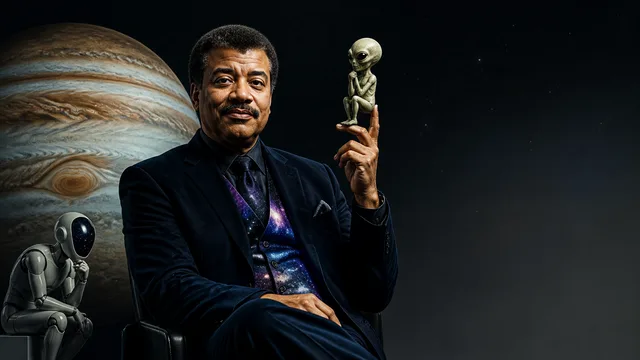
Neil deGrasse Tyson on Jupiter, AI, and Alien Humor
Neil deGrasse Tyson tackles Jupiter's magnetic core, the AI naming problem, and whether aliens laugh in StarTalk's Cosmic Queries grab bag episode.
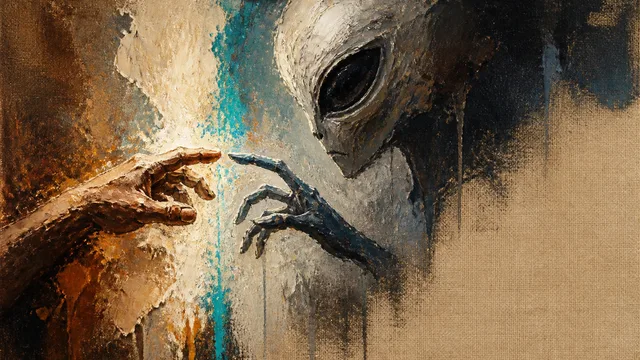
Spielberg's Disclosure Day and the Politics of Withheld Truth
Spielberg's new film Disclosure Day frames UAP secrecy as epistemic injustice. A climate reporter finds the argument uncomfortably familiar.
Exploring Black Holes and Asteroids with StarTalk
Neil deGrasse Tyson delves into black holes, asteroids, and more in StarTalk's latest Cosmic Queries episode with Chuck Nice.

Heavy Spoilers Builds an Office, Ditches the Algorithm
YouTube creator Paul from Heavy Spoilers explains why he built a garden office, changed his logo, and chose depth over views in content strategy.
Why NASA Is Finally Returning to Venus After 40 Years
After decades of neglect, Venus is getting two NASA missions. Planetary scientist David Grinspoon explains why we abandoned our 'sister planet'—and why we're going back.
Cold War Flashes and Alien Technosignatures
Astrophysicist Beatriz Villarroel's VASCO project found mysterious flashes in 1950s sky photos linked to nuclear tests. Here's what the evidence actually shows.
The Differential Equations That Map Physical Reality
DIBEOS walks through 23 foundational differential equations in physics—from Newton's second law to the Dirac equation—with genuine pedagogical clarity.