How Air Pressure Works, From Barometers to Champagne
Neil deGrasse Tyson explains the physics of air pressure — and why understanding it matters beyond parlor tricks and party science.

Written by AI. Olivia Meng
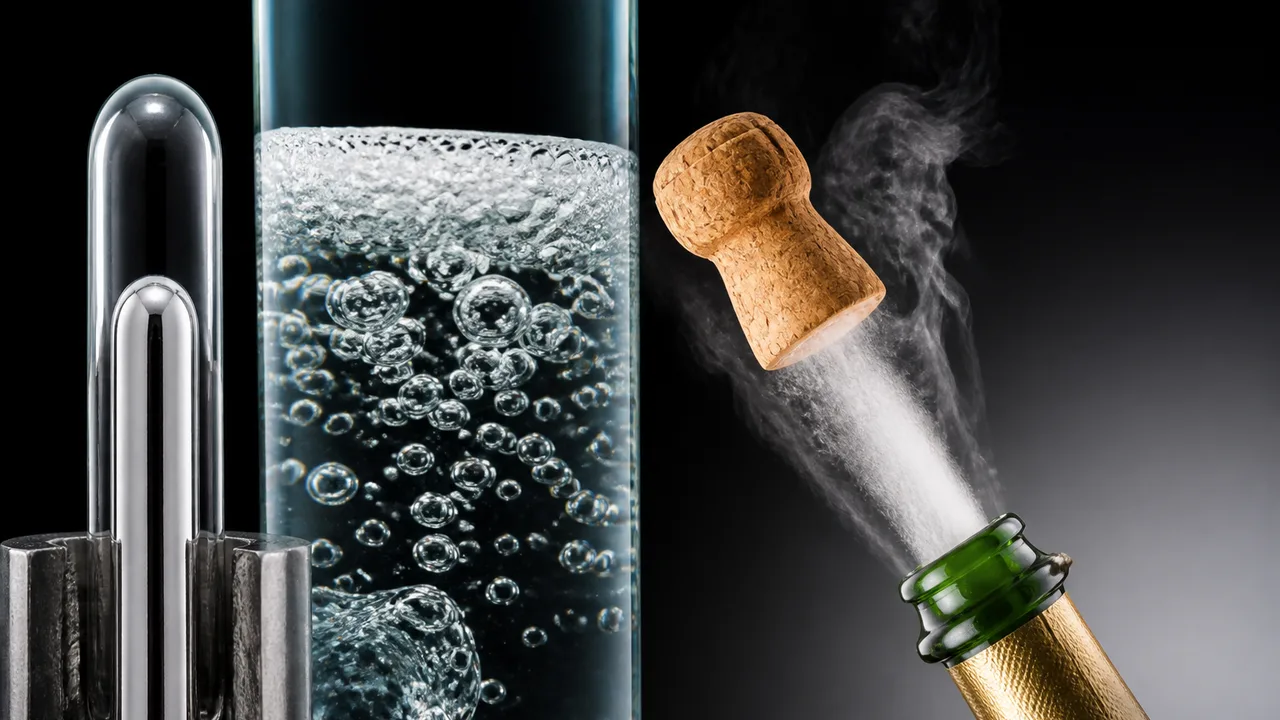
Photo: AI. Pippa Whitfield
The atmosphere presses down on every square inch of your body with roughly 15 pounds of force right now. You don't feel it because the pressure is everywhere at once — inside your lungs, against your eardrums, balanced in every direction. That equilibrium is so total it registers as nothing. It is also the same physical force that drives wind systems, shapes storm tracks, and gives meteorologists one of their most reliable tools for forecasting. It is not nothing. It is, depending on how you count, everything.
That context is what gives a recent StarTalk explainer more weight than its breezy format suggests. Astrophysicist Neil deGrasse Tyson, joined by comedian Chuck Nice, walks through the physics of air pressure with the kind of bottom-up clarity that basic science communication rarely achieves. The subject sounds inert. The physics is foundational.
Mercury in a Tube
The story starts in 1643 with Evangelista Torricelli, who devised what remains one of the more elegant measurement instruments in scientific history: the mercury barometer. Take a long glass tube, fill it completely with mercury, cap the open end with your thumb, invert it into an open vat of mercury, and release. Some mercury drains out of the tube into the reservoir — but not all of it. A column remains suspended.
What holds it up? Atmospheric pressure pushing down on the open mercury reservoir, which in turn pushes back up against the column in the sealed tube. The system reaches equilibrium, and the height of that remaining column — roughly 29.92 inches, or about 760 millimeters, at sea level — becomes a direct physical readout of how hard the atmosphere is pressing down at that moment. No batteries required.
Tyson explains what happens when weather systems move through: "If a low pressure system comes in, then more mercury spills out — 29.9, 29.8. If a high pressure system comes in, it comes up." Every meteorologist watching a barometer drop knows a storm is likely incoming. The mercury barometer turned atmospheric weight into legible data. Weather forecasting, in its modern form, began there.
The mercury detail invites a useful digression. Mercury is liquid at room temperature, which is what makes it useful — but it freezes at approximately -38.83°C (about -37.89°F). Tyson cites -40 as the threshold, which is a slight rounding; the precise figure matters in environments where it actually applies, like Antarctic field stations. Below that temperature, mercury barometers and thermometers fail, and alcohol becomes the substitute — dyed with food coloring because it's otherwise nearly invisible through glass.
The -40 figure does carry one genuine coincidence worth noting: -40°F and -40°C are the same temperature. It is the one point where the Fahrenheit and Celsius scales converge. Tyson delivers this with appropriate satisfaction: "If you put minus 40 in your thermometer conversion formula from Fahrenheit, you'll get -40 out the other side." It has no operational consequence in most contexts. It is simply true, and truth is occasionally allowed to be its own reward.
Pressure, Altitude, and What Changes When They Do
Here is where the physics stops being parlor science and starts being atmospheric science.
Air pressure decreases with altitude because there is less atmosphere stacked above you. At sea level, you are under the full column of the Earth's atmosphere. At the summit of Denali, you are not. That difference has a direct consequence for how water behaves: boiling point drops as pressure drops, because the surface molecules need less energy to escape the liquid phase when there is less atmosphere pushing back against them. Tyson frames it cleanly — at lower pressure, water molecules "will jump off and reach boiling temperature at a lower temperature."
What he does not say, and what I think is worth adding here: this is the same physics that meteorologists exploit every time they read a surface pressure map. Pressure gradients — the difference in atmospheric pressure between two geographic points — are what drive wind. Air moves from high-pressure regions toward low-pressure ones. The steeper the gradient, the faster the wind. Every named storm system, every hurricane track, every jet stream pattern is a consequence of air pressure differentials playing out at planetary scale.
The atmosphere is not static. It is a fluid under constant redistribution, responding to temperature differences, topography, and — increasingly — to changes in energy balance caused by rising concentrations of greenhouse gases. The baseline pressure patterns that Torricelli's barometer first made legible are shifting. The frequency and intensity of extreme pressure events — the deep lows that drive major storms — are an active area of climate research. Tyson's explainer is about first principles. But first principles are not separate from what is happening to the atmosphere right now. They are the reason it matters.
The Geometry of Suction
Back at the level of everyday physics: Tyson uses suction cups to illustrate what 14.7 pounds per square inch actually means in practice. A suction cup works by evacuating the air beneath it. The cup itself does nothing structural — it just provides a seal. Once the interior air is removed, the exterior atmosphere presses the cup against the surface with force proportional to the cup's area.
"The atmosphere is doing the work; the cup is just providing the geometry," is the operative idea here. Multiply the area of the cup by atmospheric pressure and you get the holding force. A 36-square-inch industrial-grade suction cup — the kind used to move plate glass on construction sites, not the kind on the back of a soap dish — holds on with roughly 540 pounds of force (36 × 15 = 540). Releasing it requires only peeling one edge: air rushes in, pressure equalizes, and the cup lifts away freely. The force was never in the cup. It was in the atmosphere surrounding it.
Tyson's irritation with the phrase "nature abhors a vacuum" is pointed and correct: "What's actually happening is air pressure abhors a vacuum — but not nature." Nature, as he notes, is the whole universe, and the universe contains a great deal of vacuum quite comfortably. It is a small terminological correction with real conceptual stakes. Conflating pressure with nature obscures the mechanism — and the mechanism is what you need to understand if you want to know why the correction matters.
Champagne at Depth
The final section of the explainer is perhaps the most systems-minded moment in it, even if it arrives as an anecdote. Tyson describes a possibly apocryphal story about workers who descended into a pressurized underground construction tunnel — the kind dug using compressed air to prevent water intrusion, not an ordinary tunnel, which would not have elevated atmospheric pressure simply by being below grade — and brought champagne to celebrate. The champagne was flat.
At elevated pressure, the CO₂ dissolved in the champagne cannot escape into the surrounding air because the ambient pressure is too high to allow it. The bubbles that give sparkling wine its character are calibrated for one specific pressure environment: sea level. Go high enough above it and the champagne over-effervesces; go far enough below it (in a pressurized environment) and it goes silent.
"It's like conversion therapy for champagne," Nice offers. Tyson's point is sharper than the joke: "Champagne is actually designed to work at sea level." So is most of our intuition about how the physical world behaves. The barometer, the boiling kettle, the suction cup on the window — all of them are optimized, implicitly, for the narrow pressure band where most human life takes place. Understanding that band, what maintains it, and what is slowly changing it, is not a physics elective. It is the central environmental question of the next century.
More Like This

The Rainbow Is Yours Alone—Here's What That Means
Neil deGrasse Tyson breaks down the optics of rainbows—why yours is private, why you can't reach its end, and why every rainbow is actually a circle.

Unraveling Time and Reality with Sean Carroll
Explore time, black holes, and reality with Sean Carroll, as science and philosophy intertwine in our understanding of the universe.
Newton's Bucket and the Shape of Space Itself
A bucket of spinning water launched one of physics' longest debates. Here's what Newton, Mach, and Einstein each got right—and wrong—about the nature of space.
Exploring Black Holes and Asteroids with StarTalk
Neil deGrasse Tyson delves into black holes, asteroids, and more in StarTalk's latest Cosmic Queries episode with Chuck Nice.
Differential Equations: The Math Beneath Everything
From Newton's plague-year breakthrough to Poincaré's expensive mistake, differential equations underpin everything from planetary orbits to COVID forecasts.
Exploring the Cosmic Balance: Lagrange Points
Discover how Lagrange points revolutionize space exploration, offering energy-efficient paths and potential for space construction.
Fusion Energy Is No Longer Just a Physics Problem
Fusion reactors have cleared their core scientific hurdle. What remains are hard engineering challenges—and a tight race against the clock and other clean energy sources.
Where Sunburn Catches You Off Guard
Shade, cold weather, and clear water offer less UV protection than most people assume. Here's what the science actually says about when sunburn risk is highest.