Could Spacetime Actually Break? The Physics of Fracture
From LIGO's gravitational wave data to Planck-scale fracture mechanics, physicists are asking what it would actually take to tear spacetime apart.

Written by AI. Amelia Nwofor
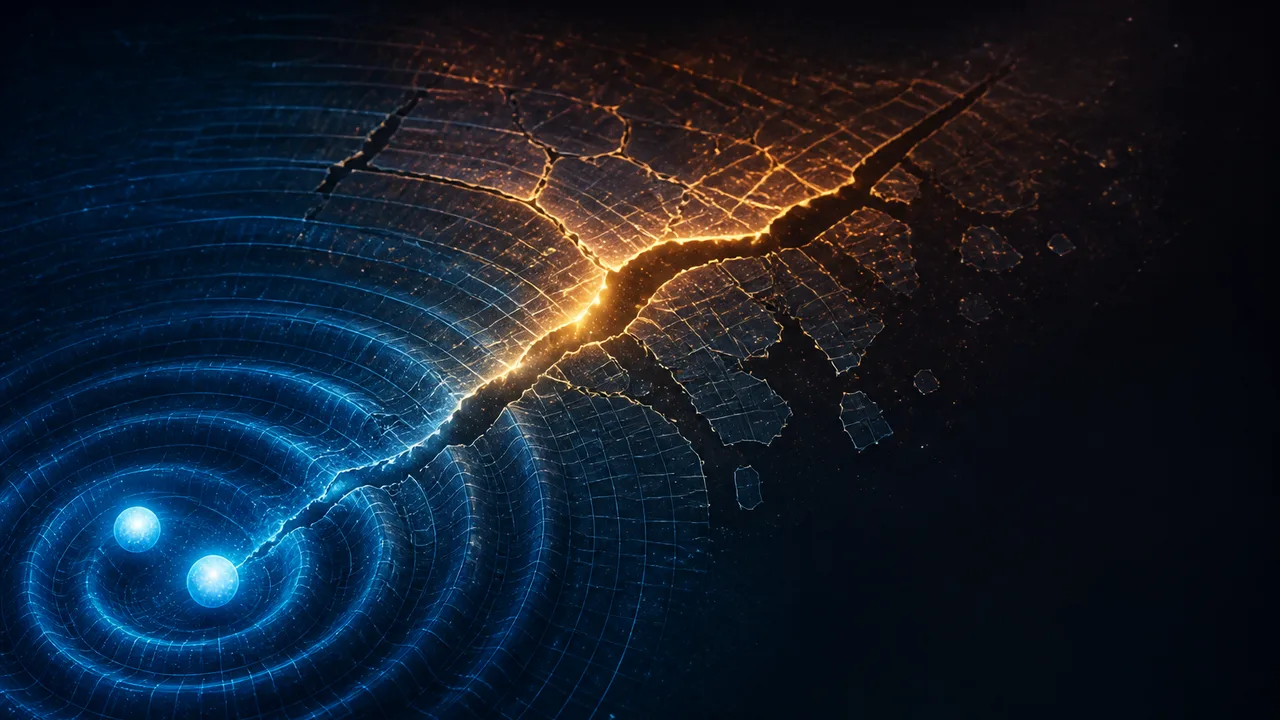
Photo: AI. Dante Nwosu
On September 14, 2015, LIGO's 4-kilometer detector arms flexed by a distance smaller than a thousandth of a proton's diameter. Two black holes had collided 1.3 billion light-years away, and the geometry of space itself had trembled faintly in response. We noticed. That is still, when I stop to actually think about it, one of the most remarkable sentences in the history of science.
But LIGO's detection opens a question that sounds unhinged until you follow the math: if spacetime can ripple, can it also break?
That's the thought experiment that physicist and educator Physics Explained lays out in a recent video, drawing on a 2025 paper by Tello and Strong in European Journal of Physics titled, with appropriate bluntness, "Breaking Spacetime." The paper is explicitly a pedagogical speculation, not a claim about what nature actually does. That distinction matters. But the speculation turns out to be the kind that tells you something real—not about spacetime's fragility, but about where our current physics quietly expects to stop working.
First, a stiffness
Before you can break something, you need to know how stiff it is.
The analogy the video uses is Young's modulus—the materials science measure of how much stress a substance can absorb per unit of strain before it deforms. Steel sits at around 10¹¹ Pascals. Diamond is close to 10¹². Spacetime, treated as though it were an elastic medium carrying gravitational waves, works out to something in the neighborhood of 10³¹ Pascals at LIGO frequencies.
That number was actually stated publicly by Rainer Weiss—Nobel laureate and LIGO co-founder—at the end of a 2018 lecture by Kip Thorne, when an audience member asked him about the Young's modulus of spacetime. Weiss's answer: it depends on the frequency of the gravitational wave, but at around 100 Hz, spacetime behaves roughly 10²⁰ times stiffer than steel.
The video derives where that number comes from. The logic is cleaner than you'd expect. Gravitational wave energy density scales with the square of both frequency and strain. If you equate that to the elastic energy density formula (½ × Young's modulus × strain²), the strain cancels—and what's left is an effective stiffness that depends only on frequency and fundamental constants: c²f²/G. Sub in 100 Hz and you recover Weiss's figure.
What this does not mean: that spacetime is literally elastic, that it has restoring forces in any microscopic sense, or that the analogy maps cleanly onto reality. What it means is that if an ordinary material transported gravitational waves with the same energy density and strain as LIGO detected, that material would need a stiffness of ~10³¹ Pascals. The number is a way of quantifying the wave's properties using familiar units—not a claim about spacetime's constitution.
That distinction is worth holding onto, because the fracture argument leans on it hard.
Then, a crack
Alan Griffith worked out the physics of brittle fracture in 1921. His insight was that the energy balance between crack surface creation and elastic energy release determines whether a crack grows or stops. The critical stress for fracture scales as the square root of (Young's modulus × surface energy / crack length). Long cracks are more dangerous than short ones, because the elastic energy release scales with crack area while the surface creation cost scales with crack perimeter.
The video applies this framework to spacetime. The moves required:
Young's modulus: already estimated from gravitational wave data.
Crack length: the Planck length (~10⁻³⁵ m), the scale at which general relativity's smooth-continuum description is expected to fail—the smallest physically meaningful length. Choosing this gives the maximum fracture stress within the model.
Surface energy: unknown. But here's where it gets elegant: when you plug the Griffith criterion into the elastic energy stored in a Planck-sized cube at the onset of fracture, the Young's modulus cancels entirely. The energy stored at fracture reduces to simply: γ × l_P², where γ is the surface energy per unit area and l_P is the Planck length. The stiffness we spent so long calculating drops out of the answer.
This makes physical sense. Stiffer materials store more elastic energy for a given strain—but they also require higher stress to drive crack growth. Those two effects exactly cancel. Fracture energy ends up depending only on surface energy, not on stiffness.
Since the surface energy of spacetime is not something we can measure or calculate from first principles, the argument pivots to bounding it. The natural upper energy scale for a Planck-sized region is the Planck energy—the point at which concentrating more energy would form a gravitational horizon. Using Planck power (c⁵/G ≈ 10⁵² watts) acting over one Planck time, the maximum energy deliverable to that region is indeed the Planck energy.
Setting that equal to the fracture energy gives a constraint: the characteristic "tearing force"—surface energy times Planck length—cannot exceed c⁴/G. That combination of constants is the Planck force, approximately 10⁴⁴ Newtons. And the Planck force already has a name in general relativity: it's the scale associated with the maximum force conjecture, the idea that classical GR may not permit arbitrarily large tensions. Geometry intervenes; horizons form.
As the video puts it: "The plank force is sometimes discussed as a fundamental limiting scale in general relativity. A bit like the speed of light is a fundamental limiting speed in special relativity."
What the analogy earns—and what it doesn't
The result of all this is an upper bound, not a measurement. The argument tells us that if spacetime has something like a surface energy—which it may not—and if the fracture analogy has any physical meaning—which it may not—then the tearing force is bounded above by ~10⁴⁴ Newtons. Spacetime's actual resistance to fracture, if such a thing exists, could be orders of magnitude smaller.
The one genuinely striking payoff comes when you ask at what frequency the elastic stiffness scale becomes comparable to the surface energy scale. The answer—derived by substituting the maximum surface energy estimate back into the Young's modulus expression—is the Planck frequency: ~10⁴³ Hz. LIGO detects gravitational waves at roughly 100 Hz. These are not adjacent scales.
The video is admirably honest about what this chain of reasoning actually establishes: "The entire fracture model is an analogy, but it's a revealing analogy because when we push it as far as it can reasonably go, the different parts of the analogy meet consistently at the Planck scale."
That consistency is interesting precisely because it wasn't guaranteed. Nothing in the setup required the elastic stiffness approach and the fracture energy approach to converge on the same scale. The fact that they do—and that the scale they converge on is exactly where physicists independently expect general relativity to break down—suggests the analogy is tracking something real about the structure of the theory, even if it isn't tracking anything real about spacetime's material properties.
There's a version of this that could be oversold significantly. Spacetime has no atoms, no crystal lattice, no chemical bonds, no microscopic structure in the sense materials science requires. Griffith's theory describes energy competition between surface creation and elastic release in systems with actual surfaces and actual stored energy. Applying it to spacetime requires borrowing the mathematical form of the argument while discarding almost everything that makes it physically meaningful.
The paper Tello and Strong write is explicit about this. This is pedagogical speculation—using a known framework to probe a question about scale, not to make a testable prediction.
Why this is worth your attention anyway
The reason to care about this argument isn't that spacetime is about to crack. It's that dimensional analysis and order-of-magnitude reasoning—tools that feel like approximations—can point consistently toward the places where our theories expect to need replacement. The Planck scale keeps emerging as the boundary not because we engineered it to, but because the constants of nature conspire to put it there whenever you push any relativistic or quantum argument hard enough.
That's not proof of anything. It's a clue about what a theory of quantum gravity would need to explain: why these independent lines of reasoning keep washing up on the same shore, and what, if anything, actually lives there.
General relativity gives us extraordinarily smooth, continuous spacetime. Quantum mechanics gives us discreteness, uncertainty, minimum scales. Both theories work extraordinarily well in their respective domains. Neither tells us what happens when they meet. The fracture analogy doesn't resolve that—but it does illustrate, with unusual clarity, exactly where the question lives.
More Like This
Neil Turok's Case for Quantum Gravity Without Strings
Neil Turok argues quadratic gravity—a 1970s idea—may solve quantum gravity without strings or extra dimensions. Here's what that claim actually rests on.
How Maxwell Unified Electricity and Magnetism
A compass needle twitched in 1820 and set off a chain of discoveries that now powers every wireless signal in your life. Here's the physics behind it.
The Quantum Twin Paradox and the Nature of Time
A new trapped-ion experiment may finally reveal whether time is a quantum property—bridging the long-standing gap between quantum mechanics and general relativity.
When Black Holes Collide: Energy, Mass, and Mystery
What really happens when two supermassive black holes merge? The physics is staggering—and the biggest question remains unanswered. Here's what we know.
Why Light Beams Seem to End: Physics Explained
Discover why searchlight beams appear to stop and how physics and atmospheric conditions contribute to this phenomenon.
Scientists May Finally Detect Gravitons—Sort Of
New experiments could detect gravity's quantum particle within decades. But proving gravitons exist? That's a different problem entirely.

Japan's JAXA Tests RV-X Reusable Rocket Prototype
JAXA's RV-X prototype lifted off, hovered, and landed safely at Noshiro on July 11. Here's what the test actually showed—and what it didn't.

Measuring the Sun's Temperature Without Touching It
How 19th-century physicists used spectroscopy and radiation laws to calculate the Sun's temperature from Earth—no probe, no contact, no vaporized instruments required.