Measuring the Sun's Temperature Without Touching It
How 19th-century physicists used spectroscopy and radiation laws to calculate the Sun's temperature from Earth—no probe, no contact, no vaporized instruments required.

Written by AI. Amelia Nwofor
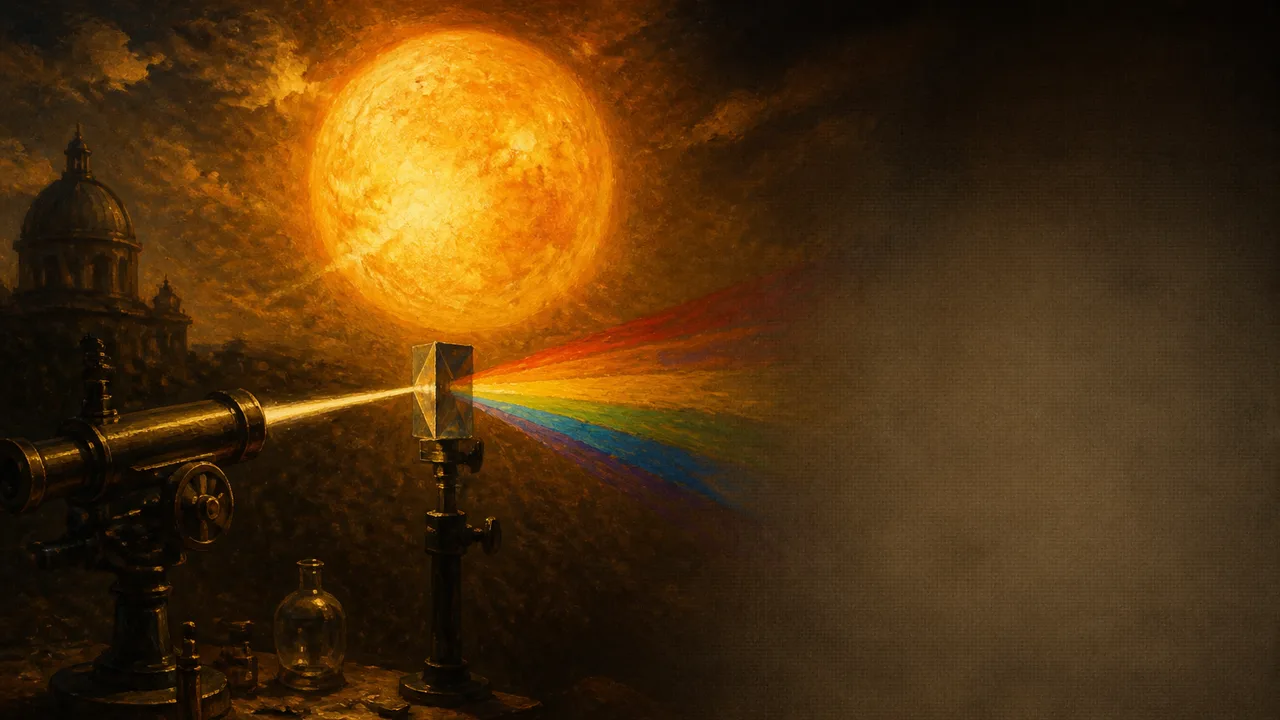
Photo: AI. Henrik Solberg
In 1838, a French physicist built an instrument to measure how much solar energy struck one square meter of Earth per minute. His measurement was reasonable. His temperature estimate — derived by running that data through a cooling formula designed for moderate temperatures — was not. He got a surface temperature somewhere between 1,461° and 1,761°. Both were wrong, and not subtly: according to the Wikipedia history of climate science, estimates from that era ranged from under 2,000° to nearly 10 million degrees depending on which physicist you asked and which radiation formula they trusted. Same sun. Same incoming light. Answers that differed by a factor of 7,000. That's not a measurement problem. That's what happens when you apply the wrong theory with complete confidence.
The story of how we actually cracked it is usually told as a triumph of instrumentation — better tools, better data. That framing is wrong, or at least incomplete. What changed wasn't the quality of the measurements. It was the conceptual framework underneath them. Three physicists, working across six decades on entirely different problems, built the theoretical architecture that made a solar thermometer possible. None of them set out to measure the sun.
The Man Who Found the Lines He Couldn't Explain
Joseph von Fraunhofer's entry into science is one of those biographical facts that sounds too cinematic to be true. Orphaned at eleven, apprenticed to a mirror maker in Munich who gave him no time for mathematics, Fraunhofer was fourteen when the building he worked in collapsed. He was pulled from the rubble alive, an event that drew the attention of Prince Elector Maximilian of Bavaria, who funded his release from his apprenticeship. A privy counselor named Joseph von Utzschneider supplied him with books on mathematics and optics. That rescue is, quite literally, the reason astrophysics exists.
By his late twenties, Fraunhofer was the finest optical instrument maker in Europe. In 1814, his problem wasn't the sun — it was chromatic aberration. When glass bends light, different colors bend by different amounts, which means telescope lenses focus red and blue light at slightly different distances, blurring the image. To correct for this, Fraunhofer needed to measure the precise refractive index of different glass types at specific wavelengths. He needed reference points. He used sunlight.
He passed sunlight through a narrow slit, then through a precision prism of his own making, and looked at the resulting spectrum through a small telescope. He expected a smooth rainbow. What he found was a rainbow cut by hundreds of sharp, pitch-black lines — fixed, positional, reproducible. They didn't move when he rearranged the apparatus. They were in the sunlight itself.
The English chemist William Hyde Wollaston had glimpsed a few of these lines in 1802 and assumed they were natural boundaries between colors. He wrote them off. Fraunhofer didn't. According to Encyclopedia.com's entry on absorption spectra, he mapped hundreds of them with extraordinary precision, labeling the most prominent ones with letters still standard in astrophysics today. He pointed his spectroscope at Sirius, at Venus, at Mars, and found that each had a different arrangement of dark lines — different patterns, different fingerprints. He had no explanation. He died at 39, most likely from heavy metal exposure accumulated during years of glass smelting, without ever learning what the lines meant. They bore his name anyway.
Their meaning waited 45 years.
Kirchhoff's Afternoon in Heidelberg
Gustav Kirchhoff wasn't studying the sun in 1859. He was at the University of Heidelberg, watching his colleague Robert Bunsen work. Bunsen had designed a burner — nearly colorless, very hot, clean — specifically to eliminate the luminous background noise that made flame color analysis difficult. Put a sodium salt in the flame and you'd see yellow. Lithium burned red. Potassium burned lilac. Every element had a characteristic color, but nobody had looked closely at what "characteristic color" actually meant.
Kirchhoff's suggestion was simple: instead of judging the color by eye, pass it through a prism. What they saw when they did that with sodium wasn't a smear of yellow. It was two sharp, bright lines on a completely dark background. Sodium emitted light at exactly two specific wavelengths and nowhere else. Every element they tested had its own precise set of lines — its own spectral fingerprint.
Then Kirchhoff did something nobody had tried. He placed a continuous white light source behind the sodium flame and passed the combined light through the prism. The two yellow sodium lines were still there — but instead of brightening, they darkened. The sodium gas was absorbing from the continuous source at exactly the wavelengths it had been emitting.
He pulled out Fraunhofer's old drawings. The prominent dark lines Fraunhofer had labeled "D" sat in the yellow region of the solar spectrum. Kirchhoff measured his laboratory sodium lines. They matched the D lines exactly.
The inference was immediate and airtight: the sun's outer atmosphere contains sodium. Cooler sodium gas, sitting above the hotter solar surface, absorbs those exact wavelengths before the light reaches Earth. Fraunhofer's dark lines weren't boundaries. They were shadows — the chemical signatures of elements written in absence. By 1861, Kirchhoff had published a detailed map of the solar spectrum, matching dark lines to sodium, iron, magnesium, calcium, and nickel. No one had ever read the chemical composition of a star before.
But knowing what the sun is made of still isn't a thermometer.
Josef Stefan and the Fourth Power
Josef Stefan became director of the Physical Institute at the University of Vienna — a fact worth noting because his most important discovery didn't come from original experiment. It came from sitting with someone else's numbers.
In 1879, Stefan was working through published experimental data on heat radiation when he encountered measurements made by the Irish physicist John Tyndall, who had studied how much radiation a heated platinum wire emitted at different temperatures. According to Nature's account of Stefan's radiation law, Stefan noticed a precise mathematical relationship buried in Tyndall's data: the energy a hot object radiates scales with the fourth power of its absolute temperature.
The fourth power is not a polite exponent. Double the temperature and radiation increases sixteenfold. Triple it and you get an eighty-onefold jump. The relationship is ferocious — and it meant that small temperature differences produce enormous differences in radiated energy. More importantly for anyone studying stars: if you can measure the energy, you can run the equation backward to find the temperature.
Stefan's student Ludwig Boltzmann later derived the law theoretically. Together, the Stefan-Boltzmann law gave physicists something they'd never had before: a reliable, physically grounded connection between temperature and the light an object emits. Stefan applied it to published solar flux measurements, correcting qualitatively for the fraction of sunlight absorbed by Earth's atmosphere before it reaches the ground, and arrived at a solar surface temperature of approximately 5,700 Kelvin.
After centuries of estimates ranging from 1,500° to 10 million°, he landed within roughly 80° of the accepted modern value of 5,778 Kelvin. Not because he had better data. Because he finally had the right theory.
Planck's Trick That He Didn't Believe
Stefan's law told you the total energy a hot object radiates. It said nothing about how that energy was distributed across specific wavelengths — which is a different question, and a harder one. When physicists in the late 19th century tried to calculate that distribution using classical physics, they got a result that was not merely wrong but absurd: the equations predicted that energy emitted at short wavelengths should increase without limit, implying that any hot object should radiate infinite energy in the ultraviolet. Obviously, nothing does that. This became known as the ultraviolet catastrophe — not a colorful metaphor but a genuine theoretical collapse.
Max Planck spent years trying to fix it using every tool classical physics offered. Nothing worked. In 1900, he admitted as much in terms that deserve to be read carefully:
"Briefly summarized, what I did can be described as simply an act of desperation. A theoretical interpretation, therefore, had to be found at any cost, no matter how high. I was ready to sacrifice every one of my previous convictions about physical laws."
His fix was to assume that energy wasn't emitted continuously but in discrete packets — quanta — each with a size proportional to its frequency. That assumption perfectly reproduced the observed radiation curves. It also happened to be, as Planck himself called it, a mathematical trick rather than a physical reality. He didn't think quanta actually existed. He thought he'd found a useful computational shorthand.
Here's the genuinely uncomfortable part: Planck was wrong about his own discovery. The mathematical trick turned out to describe something real. The foundation of quantum mechanics — the framework underlying semiconductors, lasers, MRI machines, and every modern computation — began as a fudge factor introduced by a physicist who explicitly did not believe it. Science doesn't always announce its most important moments. Sometimes it slips them in through the back door, dressed as an approximation.
Fraunhofer mapped the lines without knowing what they were. Kirchhoff decoded them without setting out to. Stefan found the temperature law in someone else's published data. Planck quantized energy as an act of desperation and accidentally ended classical physics.
The greatest obstacle in measuring the stars was never the distance. It was realizing that the light falling on our faces was a language we just hadn't learned to read.
More Like This
How Maxwell Unified Electricity and Magnetism
A compass needle twitched in 1820 and set off a chain of discoveries that now powers every wireless signal in your life. Here's the physics behind it.
The Deeper Geometry Behind the Pythagorean Theorem
Explore why the Pythagorean Theorem appears in unexpected places, from geometry to relativity.
How the Speed of Light Became a Definition
The speed of light wasn't just measured—it was defined into existence. Here's the 300-year story of how physics outgrew the question it started with.
When Basic Physics Secretly Rewrites the World
Don Lincoln explains how Maxwell's equations revealed the speed of light — and why what we ignore in physics today may determine our climate future.

Why Light Beams Seem to End: Physics Explained
Discover why searchlight beams appear to stop and how physics and atmospheric conditions contribute to this phenomenon.

How Newton Calculated Pi With Calculus
Newton didn't set out to calculate pi—he built a universal method for finding areas under curves. Pi was just what came out when he tested it on a circle.

Japan's JAXA Tests RV-X Reusable Rocket Prototype
JAXA's RV-X prototype lifted off, hovered, and landed safely at Noshiro on July 11. Here's what the test actually showed—and what it didn't.
Could Spacetime Actually Break? The Physics of Fracture
From LIGO's gravitational wave data to Planck-scale fracture mechanics, physicists are asking what it would actually take to tear spacetime apart.