How Newton Calculated Pi With Calculus
Newton didn't set out to calculate pi—he built a universal method for finding areas under curves. Pi was just what came out when he tested it on a circle.

Written by AI. Amelia Nwofor
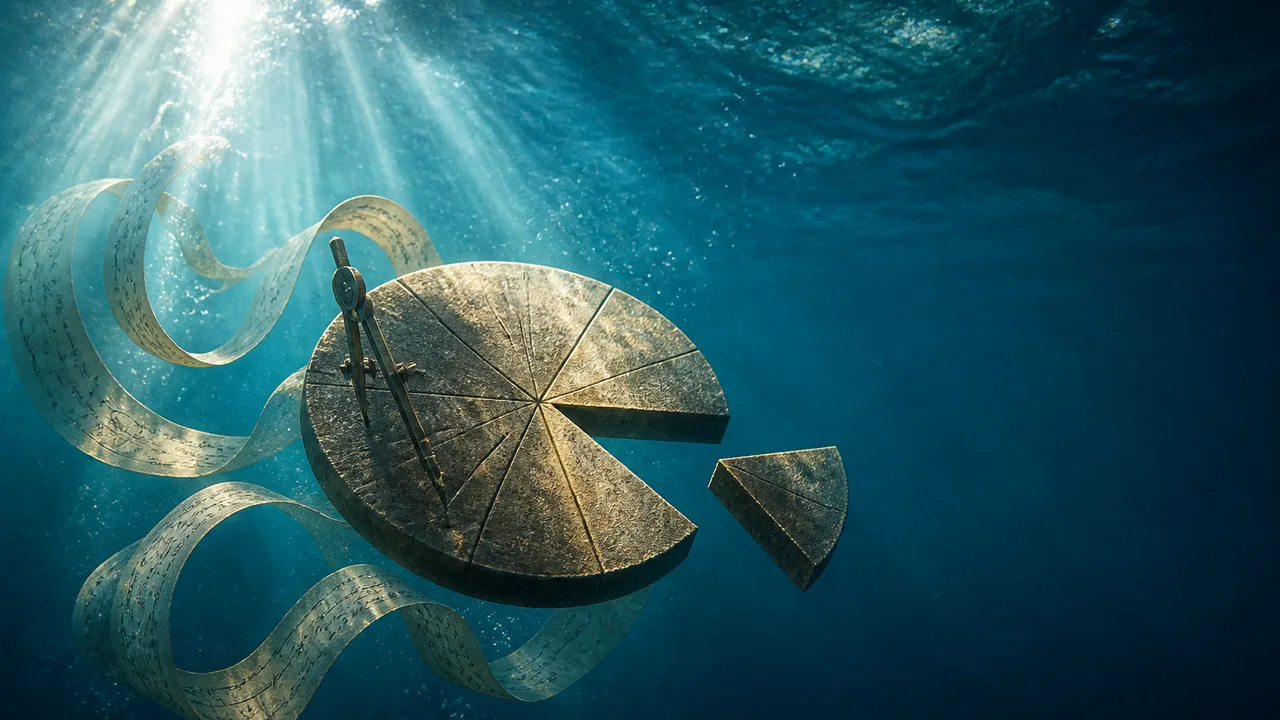
Photo: AI. Sela Marin
There's a number that civilization has been chasing for roughly 4,000 years. Not because anyone particularly needed it—by Archimedes' time, engineers already had more decimal places than a bridge would ever require—but because the chase itself kept revealing something uncomfortable: mathematics had a wall, and nobody could see past it.
A recent video from STEM in Motion by Gaurav traces the full arc of that chase, from Archimedes squeezing polygons around circles to Isaac Newton dissolving the circle entirely into algebra. It's a 20-minute piece that earns its runtime by taking the methodology seriously rather than just celebrating the result. The story it tells is genuinely strange—a 22-year-old in plague quarantine, bored out of his mind, accidentally producing one of the most efficient computational methods in mathematical history. And then feeling embarrassed about it.
That embarrassment, I think, is the most clarifying detail in the whole story.
The wall everyone kept running into
The polygon method is elegant in its logic and brutal in its execution. You inscribe a regular polygon inside a circle, compute its area, circumscribe another polygon outside, compute that area, and pi is trapped between the two. Double the number of sides and your bounds tighten. Double again. Keep going.
Archimedes ran this to 96 sides around 250 BCE and pinned pi between 3.1408 and 3.1429—a genuinely remarkable result given that every step required nested square-root extractions done by hand as fractions. In 263 CE, Liu Hui found a clever shortcut: he noticed that the area difference between successive polygons shrank by a factor of roughly one-quarter each time, which is a converging geometric series, and you can extrapolate from that without computing the larger polygon directly. The video describes this as "convergence acceleration," and it's a real technique—Liu Hui achieved the precision of a 1,536-sided polygon using only his 96-sided calculations.
Two centuries after Liu Hui, Zu Chongzhi took the brute-force approach to its absolute human limit. Using physical counting rods as a kind of decimal calculator, he worked out the perimeter of a polygon with 24,576 sides and pinned pi to seven decimal places: between 3.1415926 and 3.1415927. That record stood for nearly 900 years. Not because nobody cared. Because nobody could do the arithmetic.
That detail deserves to sit for a moment. A mathematical record held for nine centuries not because the method was exhausted, but because the method demanded more from human computation than human computation could give. By the 1600s, a Dutch mathematician named Ludolph van Ceulen spent 25 years of his life—25 years—grinding through polygons with more than four quintillion sides to produce 35 decimal places of pi. As the video puts it: "25 years of work, 35 digits, and every future digit would cost even more."
The polygon method hadn't failed. It had simply hit the ceiling of what humans could compute.
Wallis finds the door without finding the key
In 1656, John Wallis published Arithmetica Infinitorum and reframed the problem entirely. Instead of squeezing polygons, Wallis asked about areas under curves—specifically, the area under (1 − x²)^n for various values of n. For whole-number powers, this was straightforward. For n = 1/2, which is what you need to describe the top half of a unit circle, it wasn't. Wallis couldn't integrate a fractional exponent.
So he interpolated. He computed the areas for n = 0, 1, 2, 3—clean fractions that shrank in a predictable pattern—then reasoned about what value should sit at n = 1/2, in the gap. What he found was an infinite product now called the Wallis product: pi expressed as pure arithmetic, no geometry involved. It was a genuine result. But the video makes a careful distinction here worth preserving: Wallis had guessed the pattern between known values. He hadn't derived it from a general method. "Wallis had found the door to pi. He just didn't have the key."
That gap—between an observed pattern and a proved mechanism—is exactly the kind of thing that should make a careful reader pause. Wallis's product is correct, and it can be proved rigorously by other means. But Wallis's own path to it was interpolation, not derivation. The result was valid; the methodology was an educated guess. Nine years later, Newton would read the same book and find that distinction intolerable.
What Newton was actually building
Here is where the story pivots. Newton, quarantined at Woolsthorpe during the plague years of 1665–66, read Wallis cover to cover. But Newton wasn't interested in pi. He was building what he called the "method of quadratures"—a general procedure for computing the area under any curve. Pi would be a test case, not a goal.
His entry point was the binomial theorem, which tells you how to expand (1 + x)^n for positive integer values of n. Newton looked at the coefficient formula—n(n−1)/2!, n(n−1)(n−2)/3!, and so on—and noticed something that now seems obvious in retrospect but apparently wasn't obvious to anyone else at the time: nothing in those expressions actually requires n to be an integer. Every operation is just multiplication and division. So he plugged in n = 1/2.
What came out was an infinite series that never terminates—because when n is a fraction, the descending factors (1/2, −1/2, −3/2, −5/2…) never hit zero. When n is a positive integer, they eventually do, which is why the expansion stops. Newton had taken a finite formula and stretched it into an infinite one. He then verified it wasn't nonsense by checking n = −1, whose series (1 − x + x² − x³ + …) he could confirm by multiplying back through.
With that tool in hand, he could expand the equation for the top half of a unit circle—√(1 − x²)—into an infinite polynomial. Then he integrated it term by term. Then he made a strategic choice that the video presents as a mark of genuine craft: instead of working with the full unit circle, he shifted to a circle with half the radius, and chose to evaluate his integral only from 0 to 1/4. Why 1/4? Because at x = 1/4 on a circle with radius 1/2, the geometry produces a 30-60-90 triangle. That triangle has a known area. The arc it cuts off is exactly one-sixth of the full circle—a sector with area π/24. So the area under his curve from 0 to 1/4 equals π/24 minus √3/32, and he could solve for pi directly.
The real payoff: when you evaluate the integrated series at x = 1/4, every term contains a power of 1/4. Those collapse fast. Each term is roughly 16 times smaller than the previous one. The Leibniz series for pi—perhaps the most aesthetically satisfying formula ever written down—needs 5 billion terms to produce 10 correct decimal places. Newton's method needed 22 terms for 15.
The embarrassment is the point
Newton's response to all of this, shared in a letter to Henry Oldenburg at the Royal Society, is the line that makes the whole story land differently:
"I am ashamed to tell you to how many digits I carried these computations, having no other business at the time."
He wasn't being falsely modest. To Newton, the digits were beside the point—"trivial arithmetic output of a far more important machine," as the video describes it. He'd built a universal method for computing areas under curves. Pi was just what fell out when he aimed it at a circle. The fact that he'd apparently kept computing digits anyway, bored in quarantine, was the embarrassing part.
There's something worth sitting with in that framing. The polygon-method tradition had treated pi as the goal—a competition to push one number further than anyone before. Ludolph van Ceulen had his 35 digits engraved on his tombstone. The record was the point. Newton didn't care about the record because he hadn't approached it as a record-breaking exercise. He'd changed what the question was.
That shift—from "how precisely can I compute this specific number" to "what general method will let me compute anything"—is what produced calculus. Pi was, in Newton's framing, incidental. Which means the 2,000-year chase for digits wasn't really about pi. It was about the absence of a general method, and the slow, grinding, heroic work of building approximations in that absence.
Newton didn't end the chase. He made it irrelevant.
By Amelia Nwofor, Science Desk Editor
More Like This
Differential Equations: The Math Beneath Everything
From Newton's plague-year breakthrough to Poincaré's expensive mistake, differential equations underpin everything from planetary orbits to COVID forecasts.

The Formula You Memorized Was Hiding Calculus
Why does differentiating πr² give 2πr? The answer reveals the deepest structural idea in mathematics—and it was hiding in plain sight all along.

Chaitin's Omega: The Number That Knows Everything
Chaitin's Omega encodes answers to every mathematical question—yet its digits are provably uncomputable. Here's what that actually means, and why it matters.

How a Programmer Tried to Crack the Rubik's Cube
Sebastian Lague's coding adventure to solve the Rubik's Cube reveals why 43 quintillion permutations humbles even clever algorithms. A craft-focused breakdown.

Why Light Beams Seem to End: Physics Explained
Discover why searchlight beams appear to stop and how physics and atmospheric conditions contribute to this phenomenon.
The Deeper Geometry Behind the Pythagorean Theorem
Explore why the Pythagorean Theorem appears in unexpected places, from geometry to relativity.
Space Is Accelerating Brain Disease Research on Earth
UC San Diego researcher Aline Martins explains how brain organoid experiments aboard the ISS are generating new leads for Alzheimer's, Rett syndrome, and aging.
Webb Detects Methane on Interstellar Comet 3I/ATLAS
Webb's MIRI instrument detected methane on interstellar comet 3I/ATLAS after perihelion—a timing that hints at buried volatile layers from another planetary system.