How the Speed of Light Became a Definition
The speed of light wasn't just measured—it was defined into existence. Here's the 300-year story of how physics outgrew the question it started with.

Written by AI. Nadia Marchetti
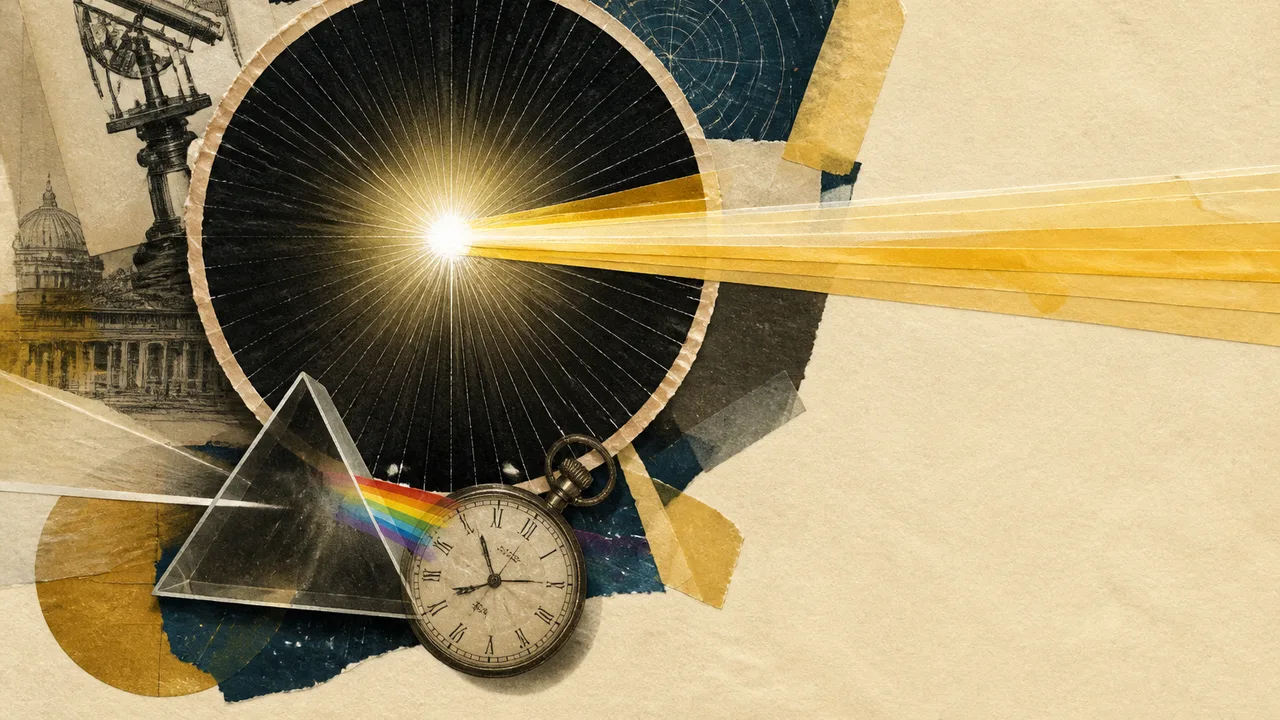
Photo: AI. Wren Sugimoto
There's a number every physics student memorizes and almost no one thinks about: 299,792,458 meters per second. It's exact. Not approximate, not rounded, not "accurate to within our best instruments." Exact, by definition, permanently, since October 1983.
That's the punchline. Getting there takes three centuries.
A recent video from STEM in Motion by Gaurav walks through that history with unusual care — not just cataloguing the experiments, but tracing the logic that connected them. The story it tells is less about scientific triumph than about something stranger: what happens when a measurement program succeeds so completely that it eats the question it was trying to answer.
The Question That Wasn't Supposed to Exist
Start with Aristotle, who didn't think the question was worth asking. Light, in his framework, wasn't a substance traveling through space. It was a state — the condition of a transparent medium becoming illuminated. Instantaneous everywhere, by necessity. Asking how fast light travels, as the video puts it, was like asking "how fast a shadow falls. The question itself made no sense."
This wasn't fringe thinking. It held for roughly two thousand years.
Galileo is the one who first treated it as a real, measurable question — which already puts him in interesting company with people who challenged the obvious. His method: two men on hills, each with a shuttered lantern, timing the delay between flash and response. His equipment: human reaction time, which runs around 200 milliseconds. Light crosses a mile in microseconds. The delay he was trying to measure was, as the video notes, "20,000 times smaller than Galileo's only stopwatch — the human nervous system."
He found nothing conclusive. He concluded, fairly, that light was either instantaneous or "extraordinarily rapid." He was right about the second part, and his logic was sound. His hills were just too close.
A Solar System as Stopwatch
The problem with measuring something extremely fast is that your measuring tools have to be faster — or much, much larger. Ole Rømer solved this by accident in the 1670s while doing something entirely practical: building eclipse tables for Jupiter's moon Io to help sailors navigate.
Io orbits Jupiter every 42 hours, disappearing into its shadow on a metronome schedule. Rømer noticed the schedule drifted. Eclipses arrived late when Earth was moving away from Jupiter, early when Earth swung back. He made a public prediction: the eclipse of November 9, 1676 would arrive 10 minutes behind schedule. It did.
The implication was enormous. Light took measurable time to cross the changing distance between Earth and Jupiter. The solar system had become the stopwatch Galileo never had. But Rømer couldn't calculate the actual speed — he had a delay, not a distance. Christiaan Huygens paired Rømer's timing with the best available estimate of Earth's orbit and got a number that was significantly off, mostly because the orbital estimate was too small. Plug in modern values, though, and the same method lands within a fraction of a percent of the correct answer.
The method was right. The ruler was wrong. That tension — right method, wrong ruler — turns out to be the whole story.
From the Sky to the Workshop
For the next century and a half, measuring light meant depending on planets, stars, and cooperative weather. James Bradley's 1725 discovery of stellar aberration — the way Earth's motion tilts the apparent angle of incoming starlight, like rain seeming to fall at an angle when you run — gave a measurement within half a percent of the true value. Still the most accurate yet. Still required a telescope and a clear night.
The push to bring this into a laboratory produced, among other things, a scientific rivalry. Hippolyte Fizeau and Léon Foucault were collaborators who took the first detailed photograph of the sun before their partnership collapsed. By 1849, they were racing separately toward the same problem.
Fizeau built a spinning cog wheel — light passed through a gap in the teeth, traveled to a mirror, and returned. Spin the wheel fast enough and the returning beam hit a tooth instead of a gap, vanishing. Time the disappearance, know the geometry, calculate the speed. Off by about 5%, but no sky required. The stopwatch was now a machine.
Foucault's spinning mirror replaced teeth-and-gaps with geometry: a beam bouncing off a mirror that had rotated slightly by the time the reflection returned, deflecting the beam by a measurable angle. By 1862, his result was within 1% of the true value. More importantly, geometry had replaced the human eye — "there was no guesswork," as the video notes.
Neither 5% nor 1% was good enough for Albert Michelson, who appears in this story as the person who genuinely could not tolerate imprecision as a psychological matter. He measured the speed of light repeatedly across decades, eventually bouncing light between mountain peaks in California 20 miles apart, pushing the measurement to within a few kilometers of the value we use today. The mirror had given way to precision optics. The precision optics would eventually give way to something stranger.
The Constant That Wasn't Supposed to Fall Out
What Michelson was chasing, physically, was still just a number. What physicists didn't yet know was what that number meant.
James Clerk Maxwell figured that out without running a single experiment. Working on equations that unified electricity and magnetism, he discovered that the math predicted a wave — not a light wave, not anything he was looking for, just "a disturbance traveling through electric and magnetic fields at a specific speed." He calculated that speed from constants already measured in electromagnetic experiments. It matched the speed of light.
Maxwell's own reaction, in the video's quote, was characteristically understated: "the agreement was so close that we can scarcely avoid the inference" that light was exactly this kind of wave. Not a separate phenomenon. A consequence of the same equations that governed electricity and magnetism.
This was extraordinary. It also created an immediate problem: every wave anyone had ever studied needed a medium. Sound needs air. Water waves need water. If light was a wave, what was it waving through? The answer physicists invented was the "ether" — an invisible substance permeating all of space.
Michelson, naturally, built an apparatus to detect it. The Michelson-Morley experiment of 1887 was designed to catch the slight difference in light's speed depending on whether Earth was moving through the ether with or against it. It found nothing. No ether wind. No directional variation. Light behaved as though the medium didn't exist.
This left physics without an explanation until Einstein, in 1905, stopped looking for one. His move was to declare the mystery a law: the speed of light is constant for all observers, regardless of their motion. Chase it, flee from it, it passes you at exactly the same speed. If this axiom held, then space and time had to bend to accommodate it — moving clocks slow down, moving objects compress — and the universe had to be rebuilt from scratch around that single constraint.
The c in E=mc² is Rømer's delay, Fizeau's wheel, Foucault's mirror, Michelson's mountains, packed into a letter.
The Ruler Breaks
By the 1970s, measurement technology had progressed from spinning mirrors to lasers. At the National Bureau of Standards in Colorado, physicists measured a laser's frequency and wavelength simultaneously — multiply them together and you get speed — achieving accuracy to within a single meter per second. The most precise measurement in human history.
And it hit a wall.
Not in the experiment. In the ruler. The meter, at the time, was defined using a specific spectral line from krypton-86 — an orange-red emission used as a reference standard. At ordinary precision, this was fine. At laser precision, physicists discovered the krypton line was slightly asymmetrical. The standard meter was, at that level of resolution, fuzzy.
The paradox was elegant and maddening: to measure light more precisely, they needed a better meter. The only instrument precise enough to define a better meter was light itself. You cannot measure something more accurately than the ruler allows. They had built measurements so good they'd broken the measuring system.
In 1983, the scientific community resolved this by doing something that sounds like giving up but was actually a conceptual promotion. They stopped trying to measure the speed of light. Instead, they fixed it. The speed of light was declared exactly 299,792,458 meters per second by definition — and the meter was redefined as the distance light travels in 1/299,792,458 of a second.
The practical consequence is subtle but real: if you run a perfect experiment today and get a different number, you haven't discovered that light changed. You've only proved something is wrong with your clock or your ruler.
Three hundred years of lanterns, wheels, mirrors, mountains, and lasers didn't end because physicists found the finish line. They ended because the question transformed. What started as how fast does light travel? eventually became what does it mean to measure distance at all? — and the answer turned out to involve light so fundamentally that separating the two was no longer coherent.
The number didn't get more precise. It became the thing precision is measured against.
More Like This
The Broken Circuit That Revealed Light Is Electromagnetic
How James Clerk Maxwell solved a capacitor paradox and discovered that light is electricity and magnetism dancing together through empty space.
How Fermilab Proved Einstein's Speed of Light Theory
Particle physicist Don Lincoln explains how Fermilab experiments confirmed Einstein's constant speed of light — and why c is now a defined value, not a measured one.

The Rainbow Is Yours Alone—Here's What That Means
Neil deGrasse Tyson breaks down the optics of rainbows—why yours is private, why you can't reach its end, and why every rainbow is actually a circle.
Gravity's Strangest Effects, From Time to Cosmic Voids
From gravitational time dilation to the Dipole Repeller and LIGO's detections, here's what gravity actually does—and what it still can't explain.
Why Quantum Uncertainty Keeps Atoms From Collapsing
The Heisenberg Uncertainty Principle isn't a bug in reality—it's what prevents atoms from imploding. Here's why quantum blur is structural, not optional.

E=mc²: Unraveling the Illusion of Solidity
Explore how E=mc² reveals mass as trapped energy, reshaping our understanding of solidity and reality.

Ovaries Age Before Menopause, Mouse Study Finds
A new mouse study shows ovaries undergo major aging changes well before menopause—raising questions about fertility, timing, and how little we've studied this organ.
Neil deGrasse Tyson on UFO Whistleblowers and Alien Life
Neil deGrasse Tyson takes the UFO whistleblowers seriously—but his demand is simple: stop describing aliens and produce one. A rigorous look at what he actually said.