Why Physics Still Cannot Explain What Time Actually Is
Philosopher Simon Saunders tells Curt Jaimungal why time remains physics' most poorly understood concept—and why our models may never capture its felt reality.

Written by AI. Amelia Nwofor
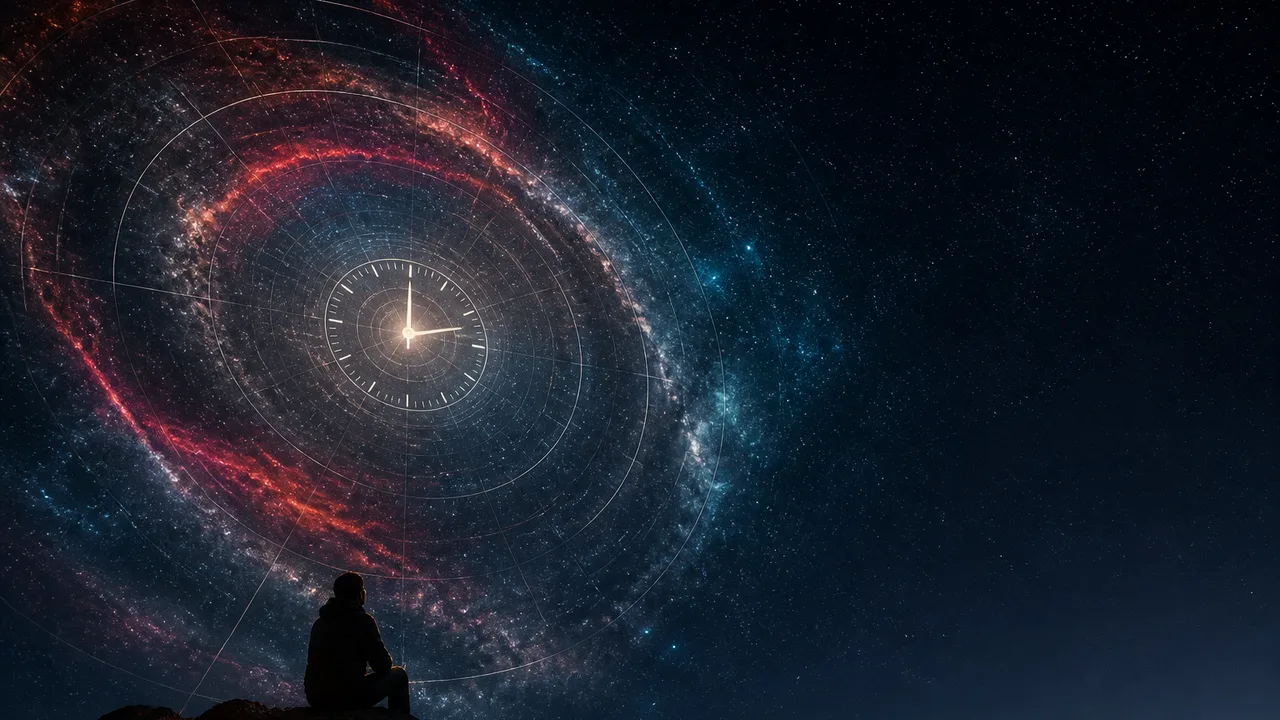
Photo: AI. Castor Belov
Richard Feynman once offered what he considered the most honest definition of time available: "Time is how long you have to wait." It's funny precisely because it's a deflection. Ask a physicist what mass is, and you'll get something substantive. Ask what time is, and even the most rigorous among them tend to reach for analogies, qualifications, and eventually a kind of philosophically exhausted shrug.
That's the premise philosopher Simon Saunders works from in a recent conversation on Curt Jaimungal's Theories of Everything podcast—and it's a more radical claim than it first sounds. Not "we're still working on it." More like: the concept we use every waking second of our lives is one that physics has very adequate tools to represent but no coherent account of what it actually is.
The problem with the block
Start with what physics does say. Special relativity, which has been experimentally confirmed to extraordinary precision, rules out the existence of a "global present"—a single, universal "now" that applies everywhere simultaneously. Different observers moving at different velocities will disagree about which events are simultaneous, and there's no frame of reference privileged enough to settle the dispute.
The upshot, as Saunders explains it, is that the only consistent picture relativistic physics offers is the block universe: all moments in time laid out alongside all points in space as a single, static four-dimensional structure. Past, present, and future aren't unfolding—they're already there, fixed, complete. Your life isn't a journey through time so much as a thread woven through that block, your "worldline," as physicists call it.
It's a coherent picture. It handles the math. But as Saunders puts it plainly: "That reality just doesn't look or feel like time at all. It looks and feels like space."
That's where the trouble lives. The block universe accounts for the causal structure of events, the light-cone geometry of Minkowski spacetime, the relative ordering of moments. What it doesn't account for is the felt difference between the past and the future, the sense that time is moving, or the stark phenomenological asymmetry between a moment already lived and one not yet arrived. You can label a dot on a spacetime diagram and call it "now," but as Saunders points out, that label is arbitrary—you could put dots anywhere, marking yourself at any moment, and nothing in the geometry distinguishes one as more present than any other.
Stephen Hawking once asked what "breathes fire into the equations." The block universe is, in a sense, the maximally fire-free picture: complete, frozen, indifferent. Something about our experience of time remains stubbornly outside it.
Three tensions that won't collapse
Jaimungal proposes a useful diagnostic framework in the conversation: the gap between physical models and lived experience might reduce to three specific tensions. First, we experience a privileged now—this moment feels categorically different from all others. Second, we experience time as flowing in a direction. Third, the past feels fixed while the future feels open.
All three are in friction with what the models say. Relativity undermines the privileged now. The block universe picture undermines flow. And the time-symmetric equations of fundamental physics—which work just as well run backwards—undermine the fixity-of-the-past intuition.
Saunders doesn't claim these three tensions are all distinct. It's genuinely possible they collapse into fewer, more fundamental puzzles. What he does insist is that constructing accurate physical models requires, structurally, removing the personal perspective—and that removal works fine for space but creates a real problem for time.
His analogy: you can draw a map of your garden without marking where you are in it. That's spatial self-removal, and it costs you nothing important. But now try to draw a timeline of a duration without situating yourself somewhere on it. Suddenly the map is just a frozen diagram, not a duration. The "nowness" of a moment, the 50-millisecond specious present in which awareness actually occurs, doesn't survive the abstraction. You can represent the geometry but you lose the thing you were trying to represent.
Awareness and the time-scale problem
There's a thread in the conversation that gets less attention in standard philosophy-of-time discussions, and it's the one I find most genuinely generative. Saunders notes that awareness is temporally local—it happens in a window, not at an instant, and not over arbitrarily long stretches. Our specious present is roughly 50 milliseconds. Dogs seem to process events at a faster rate. Birds faster still. Insects, presumably, faster yet.
This isn't just biological trivia. It points at something: the timescale of awareness is not fixed by physics, it's fixed by the organism. If you're a creature whose "now" spans a few milliseconds, your moment-to-moment experience of causality and change would be qualitatively different from ours. If you could experience time over enormously longer stretches—days, years compressed into a single felt present—the block universe might actually feel like a static structure to you. The geometry and the phenomenology might align.
For us, they don't. And that mismatch is, Saunders suggests, "little attended to" in the literature. Most philosophers of time focus on the structural question (is the block universe picture correct?) rather than the biological question (why does awareness have the temporal grain it does, and what does that grain tell us about the relationship between physical time and experienced time?).
It's also, notably, adjacent to one of the hardest problems in philosophy of mind. The question of why physical processes produce subjective experience at all—the hard problem of consciousness—looks structurally similar to the question of why a static geometric structure produces a felt sense of temporal passage. Saunders draws this connection explicitly. Whether it's a hint at a unified solution or just a family resemblance between two hard problems is an open question.
What general relativity (almost) rescues
One potential escape hatch: general relativity, combined with the actual structure of our universe. The cosmic microwave background—the thermal afterglow of the early universe—is nearly isotropic in all directions. You can define a "cosmic time" by identifying, at each point in spacetime, the velocity at which the CMB appears uniform, then stitching those velocities together into a preferred foliation—a global slicing of spacetime into a sequence of "nows."
That's closer to the Newtonian absolute time Newton's physics assumed, which was lost with the shift to relativity. But Saunders is careful here. It works approximately. You cannot use the CMB to recover a precise global present—only a conventional one that holds to a certain level of approximation. The universe is close enough to homogeneous that this foliation is useful for cosmology, but it doesn't give you back the sharp, universal "now" that our intuition demands.
There is, in other words, a ghost of Newtonian time visible in the real universe's structure—but it's a ghost. Approximate, conventional, not fundamental.
The deep irony in all of this is that time is the thing none of us can step outside of to examine it. Every moment we spend thinking about what time is, is itself a moment in time. The block universe, if it's real, already contains every thought anyone has ever had or will have about whether the block universe is real. Which is either reassuring or deeply unhelpful, depending on your disposition.
Physics can tell you the geometry. It can tell you the causal structure, the light cone, the worldline. What it cannot yet tell you is why any of that produces the thing you're experiencing right now—this particular instant, moving, irreversible, already becoming past even as you read it.
More Like This
Why Physics Has No Preferred Direction of Time
Physics equations work equally well forwards or backwards in time. So why does time feel so irreversibly one-directional? The answer is stranger than you'd expect.
The Quantum Twin Paradox and the Nature of Time
A new trapped-ion experiment may finally reveal whether time is a quantum property—bridging the long-standing gap between quantum mechanics and general relativity.
Exploring the Enigma of Negative Time in Quantum Physics
Dive into the perplexing world of negative time in quantum physics with insights from Prof. Aephraim Steinberg.
George Ellis: Why Penrose's Cyclic Universe Breaks Down
Physicist George Ellis argues Roger Penrose's conformal cyclic cosmology has a fatal flaw: infinity isn't a large number, it's unreachable—and that changes everything.
Rethinking Inflation and the FLRW Model
Explore the complexities and challenges of cosmological models, including inflation theory and the FLRW model.
Why Quantum Uncertainty Keeps Atoms From Collapsing
The Heisenberg Uncertainty Principle isn't a bug in reality—it's what prevents atoms from imploding. Here's why quantum blur is structural, not optional.
Neutrinos, Oscillation, and the Matter-Antimatter Mystery
Particle physicist Kirsty Duffy explains neutrino oscillation, what it broke in the Standard Model, and why DUNE may finally answer why matter exists at all.
Donald Hoffman: Evolution Hid Reality From Us
Cognitive scientist Donald Hoffman argues on StarTalk that evolution gave us a VR headset, not a window—and the math behind Darwin backs him up.