Why Physics Has No Preferred Direction of Time
Physics equations work equally well forwards or backwards in time. So why does time feel so irreversibly one-directional? The answer is stranger than you'd expect.

Written by AI. Amelia Nwofor
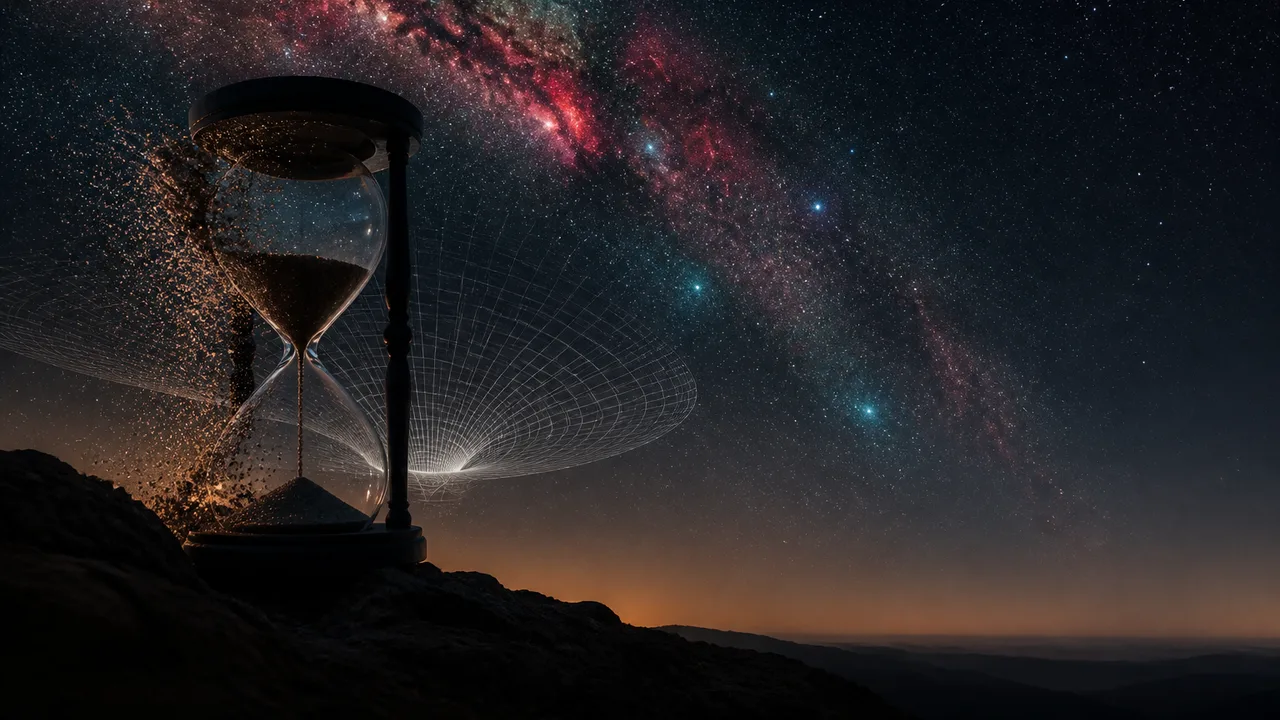
Photo: AI. Castor Belov
Here is the uncomfortable thing about time: physics doesn't care which way it runs.
Write out the fundamental equations governing particle interactions, electromagnetism, even gravity—run them in reverse, and they remain perfectly valid. No law is broken. No alarm sounds. The universe, at its mathematical core, is indifferent to whether time flows forward or backward. And yet you cannot unscramble an egg. You cannot un-remember a memory. You cannot watch a shattered mug reassemble itself from the floor. Something is imposing a direction on time that the equations themselves never asked for. That gap—between what physics permits and what reality delivers—is one of the genuinely unresolved problems in modern science, and a recent video from science communicator Arvin Ash works through it with admirable care.
The starting point is the block universe, and it's worth taking seriously before moving past it.
Everything that will happen already exists
Einstein's theory of relativity doesn't just say time is flexible. It says time is a dimension—as real and extended as the three dimensions of space. In this picture, called the block universe, the past and future aren't gone or not-yet-here. They exist, spatially fixed, at their own coordinates in four-dimensional spacetime. MIT physicist Max Tegmark puts it flatly in Ash's framing: "we can view the universe as a three-dimensional space where stuff happens or [a] four-dimensional block universe where nothing happens." In the latter case, he says, change is an illusion—everything is already there, the way a film already exists on a reel before you watch it.
This is not fringe speculation. The block universe is a legitimate interpretation of relativity, taken seriously by a substantial number of physicists. It's also genuinely disorienting, because it implies that your sense of time moving—of the present sliding forward—is something your consciousness is doing, not something the universe is doing. British physicist Julian Barbour goes further, arguing that time itself may not exist as a fundamental feature of reality; it's simply what change looks like from the inside.
That's the conceptual territory. Now for the harder question: if the block is static, why do we experience it sequentially? And why always in the same direction?
Entropy is doing the heavy lifting
The standard answer is entropy, and it's more interesting than the textbook version suggests.
Entropy measures disorder. The Second Law of Thermodynamics says it increases over time—reliably, relentlessly. Drop ink in water: it spreads. Break a glass: it shatters. The reverse processes are not forbidden by physics; they're just staggeringly improbable. A scrambled egg could theoretically spontaneously reassemble, but the number of ways molecules can be arranged in a scrambled state vastly outnumbers the arrangements corresponding to an intact egg. Disorder wins by sheer statistical weight.
This is where the arrow of time comes from. Past and future are asymmetric because there are far more ways for the universe to be disordered than ordered. We remember the past rather than the future because memory formation is entropy increase—recording information requires physical change, which increases disorder.
MIT cosmologist Alan Guth, who developed the theory of cosmic inflation, presses this connection further in Ash's account: memory formation and entropy increase are, in a deep sense, the same process. "A conscious system can only be conscious in one direction," Ash explains, "when entropy increases, which allows information to increase." Consciousness, by this logic, is not just shaped by the arrow of time—it requires it. A universe where entropy decreases would be one where information is systematically erased. No memories could form. No observer could accumulate a sense of before and after.
This suggests something strange: we're not experiencing time despite entropy. We're experiencing time because of it.
But it immediately generates a follow-up problem. If entropy has been increasing since the Big Bang, the universe must have started in an extraordinarily low-entropy state. Why? There's no thermodynamic law that demanded it begin that way. Guth's proposed answer leans on the possibility that the universe is infinite: if the total potential entropy is infinite, then any finite starting entropy is, by definition, low—there's always more disorder available to flow toward. Whether that argument fully satisfies is, charitably, an open question.
Time is real, measurable, and elastic
Whatever the philosophical status of time's flow, there is no ambiguity about one thing: time passes at different rates for different observers, depending on their velocity and gravitational environment. This is confirmed physics, not speculation.
Atomic clocks at sea level tick slightly slower than identical clocks at altitude, because they sit deeper in Earth's gravitational well. Clocks on high-speed aircraft run slower than clocks on the ground. GPS satellites require relativistic corrections—without them, positioning errors would accumulate at roughly 10 kilometers per day. The math is Einstein's; the evidence is the satellite your phone uses to tell you where to turn.
The practical implication is that traveling into the future is, in principle, straightforward: move fast or get close to a massive object, and your clock runs slower relative to everyone else's. One year at 99.5% of the speed of light corresponds to roughly ten years for people who stayed home. Ash is careful to note what the movies get wrong about this: within a single reference frame, you cannot perceive your own time as moving differently. "There would be no difference in your perception of the movement of time within your reference frame," he explains. It's only when you return and compare clocks that the gap becomes visible. The Flash scenario—one person experiencing slow-motion while another in the same room moves normally—isn't physics. It's set design.
The wormhole problem
Traveling backward is where things get genuinely hard, and genuinely speculative.
General relativity permits mathematical solutions—Einstein-Rosen bridges, better known as wormholes—that would connect distant regions of spacetime through a kind of tunnel. If one mouth of that tunnel experienced time differently from the other, you could theoretically step in at one end and emerge at a different point in time. Caltech physicist Kip Thorne, who served as scientific consultant on Interstellar, worked out a thought experiment illustrating exactly how this might function using time dilation to desynchronize two ends of a wormhole.
The proposal has a curious built-in constraint: even if it worked, you couldn't travel further back than the moment the wormhole was first created. This provides a tidy answer to the absence of time travelers—if no wormhole time machine has ever been built, there's no past moment to return to.
But the gap between the thought experiment and anything buildable is enormous. No wormhole has ever been observed. Keeping one open requires exotic matter—material with negative energy density. The Casimir effect, a well-documented quantum phenomenon involving virtual particles between uncharged plates, demonstrates that negative energy densities can exist. The amounts produced, however, are vanishingly small compared to what a traversable wormhole would need—orders of magnitude smaller. A 2020 paper from Princeton proposed charged wormholes stabilized by hypothetical "dark sector" matter, and other researchers have suggested connecting charged black holes with cosmic strings, themselves unconfirmed relics of the Big Bang's first moments. Both approaches require exotic objects that remain undetected.
It's worth being precise about what this means: the theoretical framework is consistent, the engineering is not merely difficult but may be physically impossible. Those are very different statements, and coverage that collapses them does readers a disservice.
What the equations don't tell us
Strip away the wormhole speculation and you're left with a genuine open problem: why did the universe begin in a low-entropy state at all?
The Second Law explains why entropy increases from wherever it starts. It does not explain why it started where it did. The block universe interpretation explains why time might be an illusion—but it doesn't explain why our slice of the block feels like it has a direction. Consciousness may require increasing entropy, but that doesn't tell us why the universe obliged by providing the right initial conditions for entropy to have somewhere to go.
Physics has made extraordinary progress on the nature of time. It has confirmed that time is relative, elastic, and—under the right conditions—very strange. What it has not done is answer why time's arrow points the way it does, or whether the "flow" we experience is a feature of the universe or a feature of minds embedded in it.
That distinction matters, and it doesn't have an answer yet.
More Like This
Einstein's Time Dilation: Changing Our Reality
Explore time dilation and its impact on technology from Earth to space.
Exploring the Enigma of Antimatter at CERN
CERN's antimatter factory reveals mysteries of the universe's matter-antimatter asymmetry and the quest for new physics.
Physics Says Time Has No Direction. So Why Does It Feel Like It Does?
Physicist Sean Carroll explains why the laws of physics are time-symmetric — and why that has more to say about regret and urgency than you'd expect.

Is Time Fundamental? New Physics Says Maybe Not
Physicists are questioning whether time is real or emergent. A climate journalist finds the stakes unexpectedly familiar—and the implications surprisingly close to home.

Why Light Beams Seem to End: Physics Explained
Discover why searchlight beams appear to stop and how physics and atmospheric conditions contribute to this phenomenon.
Why Quantum Uncertainty Keeps Atoms From Collapsing
The Heisenberg Uncertainty Principle isn't a bug in reality—it's what prevents atoms from imploding. Here's why quantum blur is structural, not optional.

The Double Slit Experiment's Real Mystery
Physicist Sabine Hossenfelder dismantles common misconceptions about the double slit experiment—and reveals the one question nobody is actually asking.

Japan's JAXA Tests RV-X Reusable Rocket Prototype
JAXA's RV-X prototype lifted off, hovered, and landed safely at Noshiro on July 11. Here's what the test actually showed—and what it didn't.