The Quantum Twin Paradox and the Nature of Time
A new trapped-ion experiment may finally reveal whether time is a quantum property—bridging the long-standing gap between quantum mechanics and general relativity.

Written by AI. Priya Sharma
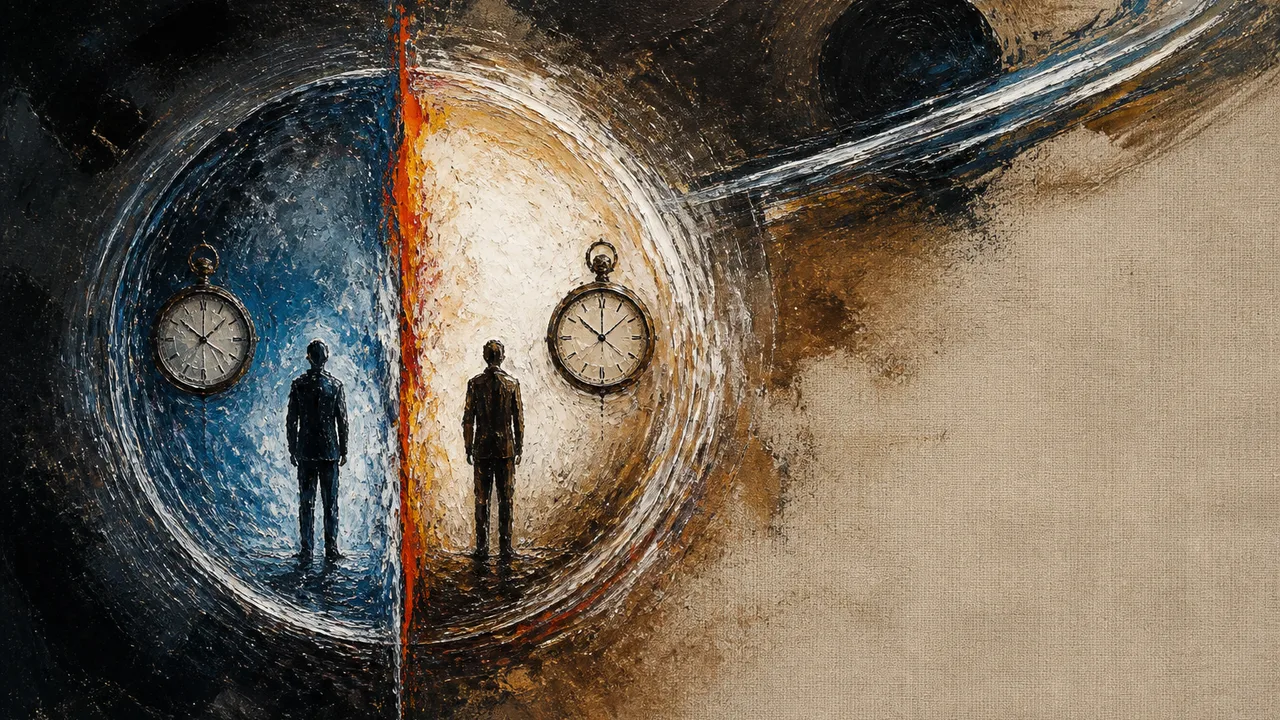
Photo: AI. Saskia Aaltonen
Physics has two extraordinarily successful theories of reality that cannot, at bottom, agree on what time is. That disagreement is not a footnote. It is the central wound of modern physics—and a new experimental proposal, built around a trapped ion vibrating inside an electromagnetic cage, may be the sharpest instrument yet for probing it.
The tension is easy enough to state, harder to fully absorb. In quantum mechanics, time is a background parameter—a universal metronome ticking at the same rate for every particle in the universe, regardless of what quantum weirdness those particles are otherwise getting up to. It is, as PBS Space Time host Matt O'Dowd puts it, "just as it is in good old Newtonian physics, where time is a global parameter that ticks the same for everyone and everyone agrees on a singular now." General relativity dismantles that picture entirely. Time in relativity is local, personal, and plastic—its rate of passage depends on how fast you're moving and how deep you sit in a gravitational field. Two clocks that start synchronized will read differently after one of them takes a trip. The universe has no master clock. Both theories are spectacularly accurate in their respective domains. They simply cannot both be completely right about time.
What the old experiments actually showed
The 1971 Hafele-Keating experiment is the classic entry point here. Physicists flew atomic clocks around the world on commercial jets and compared them to stationary clocks afterward. The traveling clocks showed exactly the time differences Einstein's relativity predicts—slowed by their speed relative to the ground, accelerated slightly by their higher altitude and reduced gravitational pull. It was a precise and elegant confirmation of relativistic time dilation.
The trouble is that Hafele-Keating, for all its elegance, is not a quantum experiment. The atomic clocks at its heart use quantum mechanical processes—electron transitions in atoms—but the clocks themselves travel one path at a time, like any classical object. There is nothing superposed. The experiment measures relativity with quantum tools; it does not probe what happens when both are operating simultaneously on the same system.
The 1970s COW experiment (Colella-Overhauser-Werner) came closer. It sent neutrons through a Mach-Zehnder interferometer with the two paths oriented at different altitudes, so one arm of the interferometer experienced slightly more gravitational time dilation than the other. The neutrons showed a phase shift consistent with the time difference. On the surface, O'Dowd notes, "this feels like it can only be explained with both quantum mechanics and general relativity, bringing us closer to a union between the two." But he's careful to add the complication: the same phase shift is perfectly reproduced by treating gravity as a simple Newtonian force rather than relativistic curved spacetime. The interpretation stays muddy. Phase shifts in an interferometer and actual differences in time flow are not, experimentally, the same thing.
The quantum clock proposal—and why it's still unbuilt
The cleaner test was proposed about fifteen years ago by physicist Magdalena Zych and colleagues. Their approach was to equip the particle with something more than a phase—an internal quantum oscillator, a kind of miniature clock that would tick differently depending on which arm of the interferometer the particle traveled. If gravitational time dilation genuinely affects the two arms differently, the internal clocks of the two superposed components would fall out of sync. When those components recombine, the desynchronization would act as path information—effectively telling you which arm was taken—and would degrade the interference pattern in a measurable, predictable way. The degree of degradation maps directly onto the magnitude of the time difference.
It's a sharper test than COW because a ticking clock accumulates a continuous record of elapsed time, not just a momentary phase offset. O'Dowd frames the logic cleanly: "if no change is seen in the interference pattern, then there's no path information, and it must be that the clocks remained in sync—that might indicate that both wave function components were ticking to the same global clock." That null result would be interesting in its own right.
The experiment has not been done. Fifteen years on, maintaining quantum coherence across two spatially separated paths—with enough altitude difference and path length for the time discrepancy to accumulate—remains beyond current experimental capability. The engineering demands are severe.
There is also a residual interpretational debate even in principle. Some physicists have argued that the internal oscillator in a Zych-type experiment can still be understood as a phase effect rather than a genuine temporal one. O'Dowd acknowledges this without resolving it: "maybe there's no way to disentangle the interpretations of phase decoherence versus time dilation as a which-path marker, in which case maybe the COW experiment got it right 50 years ago." That's a genuinely open question, not a rhetorical hedge.
The trapped-ion shortcut
A 2024 paper by Gabriel Sorkin, colleagues in Igor Pikovski's group, and experimental teams at NIST and Colorado State proposes a different route that sidesteps the spatial separation problem entirely.
The setup is this. Take an ion—an atom with a net electric charge—and trap it in an electromagnetic field. The ion can vibrate back and forth inside that trap, and crucially, its motional states are quantized: it can only vibrate at specific discrete frequencies. Higher frequency means faster motion. Faster motion means more special-relativistic time dilation. Now, if those motional states are genuinely quantum, the ion can be placed in a superposition of a slower vibrational state and a faster one simultaneously.
Without time dilation, that superposition is stable and produces a regular, predictable interference pattern detectable by the coupled laser. With motional time dilation, the faster state accrues time more slowly than the slower state. The two components of the superposition start accumulating different amounts of elapsed time. They become increasingly distinguishable from each other—increasingly which-path-marked by their own internal clocks—and the interference pattern degrades accordingly.
The spatial separation problem disappears because the two superposed states occupy essentially the same location. The experiment trades gravitational time dilation for special-relativistic time dilation and trades hard-to-maintain spatial coherence for the more tractable quantum control of internal ionic states.
The numbers are not comfortable reading. For an aluminum ion clock, the relevant time shift runs to "a few parts in 10 billion billion," as O'Dowd describes it. That is an almost surreal level of precision to demand from any instrument. The significant claim in the Sorkin paper is that the best current NIST ion clocks are already operating at sufficient precision to detect it. The experiment is not yet done, but it appears to be within reach of existing technology rather than dependent on future breakthroughs.
Two caveats matter here. First, this approach is purely special relativistic—it probes motional time dilation, not gravitational. The deeper unification that physicists are after requires connecting quantum mechanics to general relativity, and this experiment does not deliver that. Second, the interpretation of the math remains contested. The question of whether what's being measured is genuinely "a quantum superposition of time flow" or something more mundanely describable as a relativistic correction to the system's internal mass has not been definitively settled.
Neither caveat makes the experiment less worth doing. The history of physics is full of cases where an experiment designed to answer one question ended up clarifying a different and more important one. And there is something genuinely novel in the design: rather than sending particles along different routes through space and hoping their quantum coherence survives the journey, the Sorkin approach folds the problem inward, interrogating time's structure through a system's internal degrees of freedom.
The broader prize, if any of these lines of inquiry eventually pay off, is a picture of time that both quantum mechanics and general relativity can share. Right now they don't have one. Quantum mechanics insists on a single background clock; general relativity insists there is no such thing. An experiment that genuinely demonstrates a quantum superposition of different rates of time flow—whatever form that experiment ultimately takes—would require quantum mechanics to abandon one of its quietest assumptions: that time is the one thing that stays classical while everything else goes quantum.
As O'Dowd puts it, "quantum mechanics may have to give up its single clock ticking in the background, and instead treat time as a quantum property of each branch of the wave function, just as the double slit experiment does with space."
Whether that revision would constitute progress toward unification, or simply reveal a new layer of confusion, is a question the experiment itself would have to answer.
More Like This
Why Physics Has No Preferred Direction of Time
Physics equations work equally well forwards or backwards in time. So why does time feel so irreversibly one-directional? The answer is stranger than you'd expect.
Einstein's Time Dilation: Changing Our Reality
Explore time dilation and its impact on technology from Earth to space.
A New State of Matter in Earth's Core?
Exploring Earth's core: Could it exist in a superionic state, both solid and liquid? A new study delves into this possibility.
Gödel's Time Machine: A Universe That Defies Causality
Kurt Gödel's solution to Einstein's equations reveals time loops, challenging our understanding of spacetime and causality.
Is Time Fundamental? New Physics Says Maybe Not
Physicists are questioning whether time is real or emergent. A climate journalist finds the stakes unexpectedly familiar—and the implications surprisingly close to home.
Einstein vs Quantum Mechanics: The EPR Paradox Explained
Physicist Jim Al-Khalili unpacks the EPR paradox—Einstein's 1935 challenge to quantum mechanics that inadvertently gave us the concept of entanglement.
Nuclear Clocks Are Now Real — Here Is What That Means
Two independent teams built working nuclear clocks in 2026. Here's what the thorium-229 breakthrough actually achieved — and what it hasn't yet.
Homo Erectus Survived 1.9 Million Years. We've Managed 300,000.
Homo erectus outlasted us by six to one. A new look at the fossil record asks whether our big brains are an advantage—or a liability with a slow fuse.