The Wow! Signal at 47: What We Know and Don't
47 years after the Wow! signal stunned radio astronomers, it remains unexplained. Here's what the data actually shows—and what it still can't tell us.

Written by AI. Mei Zhang
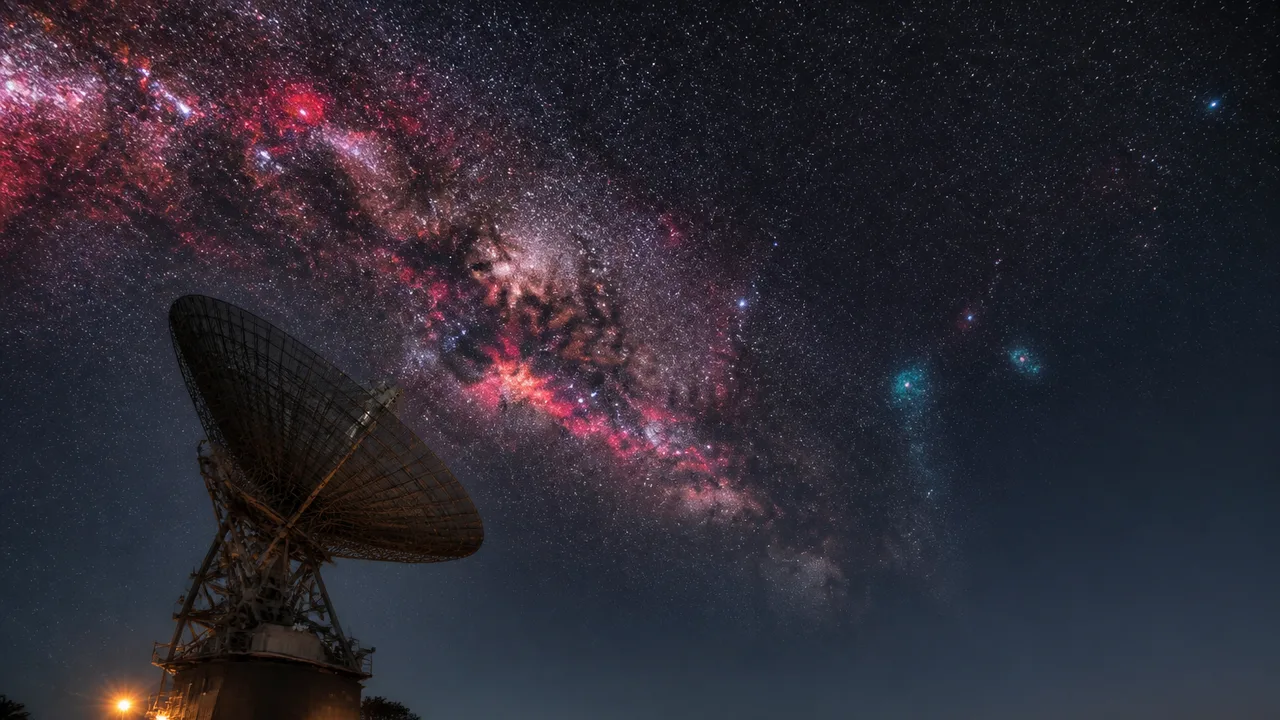
Picture this: it's a few days after August 15, 1977, and astronomer Jerry Ehman is sitting at his desk, doing the most unglamorous part of science—reviewing printouts. Pages of alphanumeric data from Ohio State University's Big Ear radio telescope, mostly noise, mostly nothing. And then he sees it. A sequence so striking, so anomalous, that he circles it in red ink and scrawls a single word in the margin.
Wow!
That annotation gave us the most famous unresolved mystery in the history of radio astronomy. Forty-seven years later, the signal hasn't been explained. It hasn't been replicated. And it has absolutely not stopped people from arguing about what it means.
What actually happened on that printout
The basics are clean and well-documented. According to Astronomy Magazine, the Big Ear telescope on August 15, 1977 detected a narrowband radio signal that was powerful, lasted 72 seconds, and was picked up on only 1 of 50 possible channels. History.com confirms it appeared on just one of those 50 channels—which matters enormously, because natural broadband interference tends to wash across multiple frequencies, not land with surgical precision on one.
Wikipedia's entry on the Wow! signal notes that it appeared to come from the direction of the constellation Sagittarius—and that it bore the expected hallmarks of what SETI researchers in the 1970s were actually looking for: a narrowband transmission near the 1420 MHz hydrogen line, a frequency considered cosmically "logical" because hydrogen is the most abundant element in the universe. The thinking was that any spacefaring civilization capable of broadcasting across interstellar distances might use that frequency precisely because another civilization would expect to find it there. A cosmic meeting spot, of sorts.
The signal rose and fell in intensity over the 72-second window in a pattern consistent with a fixed point source passing through the telescope's beam as Earth rotated—exactly what you'd expect from a genuine signal originating from a fixed position in space. That's not nothing. That's actually a very specific, very telling shape.
And then it was gone. It has never been detected again.
Why "probably not aliens" is not the same as "definitely not aliens"
Here's where the science gets genuinely complicated, and where I'd push back gently on headlines that sometimes flatten the nuance.
Space.com reported on a hypothesis that the signal may have originated from a hydrogen cloud associated with a Sun-like star in the direction of the signal's apparent origin. The idea being that hydrogen clouds can, under certain conditions, produce brief, intense narrowband emissions that could mimic what Big Ear recorded. It's a legitimate hypothesis and it deserves serious attention.
But "may have" is doing a lot of work in that sentence. The signal has never been confirmed as coming from that star or any other specific source. No natural mechanism has been definitively demonstrated to produce a signal with those exact characteristics. "We have a plausible mundane explanation" is not the same as "we know what it was"—and conflating the two does readers a disservice.
What we can say with confidence: the Wow! signal is consistent with what an artificial extraterrestrial transmission might look like. It is also consistent with some natural phenomena we don't fully understand. The honest answer, 47 years on, is that the record is genuinely thin. Space.com puts it plainly: the signal "remains unexplained to this day."
What the signal actually changed
The Wow! signal's cultural and scientific afterlife is arguably more significant than the original detection—which is a strange thing to say about a data point that lasted 72 seconds, but here we are.
In the 1970s, SETI was still a fringe pursuit. Carl Sagan was working to legitimize it; Congress was intermittently hostile to funding it; the scientific mainstream treated it with polite skepticism. The Wow! signal didn't prove anything, but it did something arguably more useful: it demonstrated that if a signal like this were out there, we could actually detect it. The methodology wasn't just theoretical anymore. Big Ear had run the experiment, and the experiment had produced something anomalous enough to annotate.
That proof of concept—not proof of aliens, but proof of detection capability—energized a generation of researchers and helped build the institutional scaffolding that SETI still operates on today. The signal, as Space.com notes, "boosts the search for E.T." not because it confirmed contact, but because it made the search feel viscerally real.
There's also something worth sitting with about how Ehman found it. He wasn't at the telescope in real time; he was reviewing paper printouts days later. The Big Ear system logged data continuously, but no one was watching the feed closely enough to catch the signal live. The 72 seconds came and went while Earth rotated and nobody noticed. That's not a failure of science—it's just the honest condition of doing astronomy in 1977 with the tools available. But it does underscore why the signal could never be confirmed in the moment: there was no mechanism to do so.
The detection gap and what it means now
Modern SETI infrastructure is categorically different from what existed in 1977. The Breakthrough Listen initiative, launched in 2015, uses some of the most sensitive radio telescopes on Earth and processes data at scales Big Ear couldn't have imagined. Machine learning now helps sift signal from noise at speeds no human reviewer could match. If the Wow! signal appeared tomorrow, we'd have a much better shot at characterizing it in real time, cross-checking it with other telescopes, and ruling out terrestrial interference.
Which makes the silence since 1977 its own kind of data point. Forty-seven years of increasingly sophisticated listening, and nothing has matched what Big Ear recorded that August. You can read that two ways: either the Wow! signal was a fluke—natural, artificial, or instrumental—that hasn't repeated; or signals like it are genuinely rare on timescales humans can observe. Neither interpretation is reassuring if you're hoping for contact. Both are scientifically interesting if you're trying to understand the actual distribution of radio-frequency events across the sky.
The useful tension at the heart of this story
What I find most interesting about the Wow! signal's anniversary is what the disagreement around it reveals about how science handles genuine ambiguity. The pressure to resolve unexplained phenomena—to give them a clean "natural" or "artificial" label—is real and understandable. Funding bodies want answers. Headlines want certainty. "We don't know" is an uncomfortable place to camp.
But "we don't know" is precisely where the Wow! signal lives, and it's been honest about that address for nearly five decades. The researchers who propose natural explanations aren't wrong to try—that's the scientific method doing exactly what it should. The researchers who keep scanning for a repeat aren't credulous dreamers either; they're following an empirical thread that hasn't been tied off.
The signal was 72 seconds long. Ehman's annotation was three letters. The questions it opened have outlasted both—and they'll outlast whatever explanation eventually arrives, because the real question was never "what was that signal?" It was always "are we alone?"—and a single data point from 1977, however remarkable, was never going to settle that one way or the other. 🧬
More Like This
How Maxwell Unified Electricity and Magnetism
A compass needle twitched in 1820 and set off a chain of discoveries that now powers every wireless signal in your life. Here's the physics behind it.

Total Solar Eclipse 2026 Dazzles Spain and Science
The August 12, 2026 total solar eclipse over Spain was a spectacle—and a rare scientific window into a solar mystery we still can't solve.

TON 618: The Black Hole That Defies Its Own Physics
TON 618 weighs 66 billion solar masses—more than current black hole growth models can explain. Here's what that gap in our knowledge actually means.
Black Hole Paradox: Are Reference Frames the Key?
Exploring how reference frames might resolve the black hole information paradox.
The Fermi Paradox: Why Silence From Space Makes Sense
Brian Keating and Shawn Ryan unpack the Fermi Paradox — from cosmic scale to civilization lifespans — and why silence might be the expected answer.
LIGO May Have Found a Primordial Black Hole
LIGO's latest catalog may contain a sub-solar-mass black hole that couldn't form from a star—and what that means for our understanding of the early universe.

The Two Poles Theorem Solves a Geometry Puzzle
A geometry puzzle about two walls and a man's height reveals a classical theorem — and a surprising connection to teamwork math. Here's what's actually going on.

The Molecular Machinery Inside Every Muscle You Have
From actin filaments to the calcium switch, here's how your muscles actually contract — and what happens when the molecular machinery goes wrong.