What Not to Wear at Airport Security Checkpoints
From metallic thread to strong cologne, your outfit choices can delay or deny your flight. Here's what airport security actually flags and why.

Written by AI. Tomas Reyes-Kim
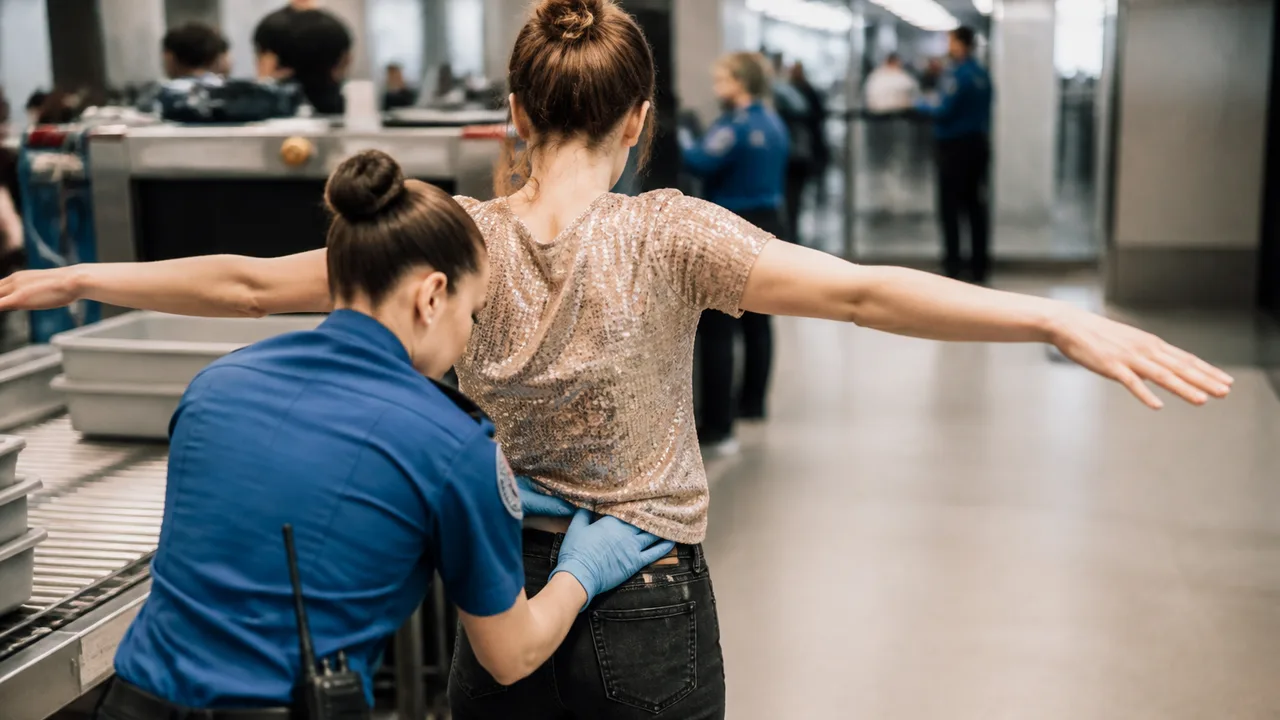
Photo: AI. Renzo Vargas
Because of sequins. That's the sentence I keep coming back to after watching Megan's recent breakdown of airport clothing mistakes on her Portable Professional channel. Your holiday party top — the one with the metallic thread and the cute little buttons — might be the reason you're standing barefoot in a TSA lane with a stranger's wand tracing your ribcage at 6 a.m.
This is the texture of modern air travel. It's not just liquids and laptops anymore. Your outfit is infrastructure.
Megan runs through nine specific clothing and accessory mistakes that routinely slow travelers down or — and this is where budget travelers specifically need to pay attention — get them denied boarding entirely. Some of the advice is straightforward. Some of it surfaces real friction between how aviation security actually works and what travelers reasonably expect. All of it is worth knowing before you pack.
The Layers Problem
The foundational mistake, according to Megan, is showing up to security in a jacket or sweater with nothing underneath. According to SmarterTravel, TSA officers routinely ask travelers to remove outer layers — jackets, hoodies, sweaters — before going through scanning equipment. If you can't take the jacket off, you're not just slowing down the line; you're almost guaranteeing a wand sweep and possibly a pat-down.
Megan describes learning this the hard way at Delhi Airport: "The specific agent that was screening me seemed to be unable to find a creative workaround for the fact that I was not able to take my jacket off since I was not wearing anything underneath. My bad."
The fix is boring but real: wear a base layer you'd actually be comfortable standing in. Not a see-through undershirt. Not a spaghetti strap tank. A high-neck t-shirt, something you wouldn't feel exposed in while lifting your arms over your head in a crowd of strangers. It's a small adjustment that costs nothing.
The Rules Nobody Published
Here's where it gets genuinely complicated, and where the stakes for budget travelers get concrete.
Airlines can deny you boarding based on dress code violations. Megan names United, Delta, and Spirit as carriers that have tightened these policies, citing incidents where passengers were removed for shorts deemed too short, crop tops, or outfits a gate agent considered see-through. The critical word is deemed. There's no universal published standard. A gate agent makes a call, and that call is final.
For a budget traveler, this isn't an abstract inconvenience. A denied boarding on a non-refundable ticket can mean $300–$500 to rebook, assuming you can get on a same-day flight at all. That's a week of accommodation in Southeast Asia. That's your entire flight budget for the next trip. The asymmetry between what the airline risks (nothing) and what you risk (everything) in that interaction is worth sitting with.
"While you might get through the TSA checkpoint with some of these questionable clothing choices, you might not be getting on the plane," Megan notes.
Fragrance policing sits in the same subjective territory, and I'll be direct: I find it the most absurd item on this list. TSA officers can pull you from a line for smell. Airlines can deny boarding if they believe your cologne will impact the comfort of other passengers. The enforcement is entirely at the discretion of whoever is standing in front of you that day. Heavy smoke smell, heavy perfume, general body odor — all technically actionable, all governed by no written threshold. At least dress codes have the visual component of "I can see what you're wearing." Scent policing is vibes-based gatekeeping with a $500 downside. Don't push your luck is right, even if the rule itself is difficult to respect.
The Fanny Pack Trap
Money belts and hidden fanny packs are widely promoted in budget travel circles — Megan herself says she's recommended them — as a way to keep valuables secure and, frankly, to sneak extra carry-on capacity past tight airline restrictions. The problem is structural: they trigger body scanners and need to come off before you go through.
Which means you have two bad options. Forget to remove it and get flagged for additional screening. Or remove it, place it in a bin, and broadcast to everyone in your immediate vicinity exactly where your cash, passport, and cards are stored.
Megan raises a third concern worth taking seriously: USA Today reported in 2023 on TSA agents at Miami International charged after surveillance video captured them apparently stealing from passenger bins during the distraction of the screening process. It's rare, but it's documented. Keeping your valuables visible and unattended in a gray bin — even briefly — is a real risk, not a paranoid one.
The Scanner Is Not Magic
The body scanners used at TSA checkpoints are millimeter-wave machines that detect anomalies against the body's surface. What they're actually looking for is anything that breaks the expected contour of a human body — which means they flag based on density and shape, not just metal content. That's why metallic thread (not a metal object, but a conductive material woven into fabric) can still trip an alarm. Sequins create irregular surface patterns. Large metal buttons concentrate the signal. The scanner isn't reacting to danger; it's reacting to difference. Which is why your sequined holiday blouse — completely harmless — can land you a pat-down just as reliably as a forgotten belt buckle.
The practical list Megan provides: sequins, metallic thread, large metal buttons, chunky necklaces, heavy belt buckles, metal hair clips. Pack them, don't wear them. Wedding rings, stud earrings, and medical alert bracelets are generally fine — small, consistent, low-signal. The line between "fine" and "flagged" is roughly the line between subtle and decorative.
The Shoes Situation
Megan addresses the shoe-removal question and the short version is: it's complicated, it varies by airport and by checkpoint, and boots are almost always a problem regardless. Even when scanners are set up to allow shoes to remain on, the density of boot soles and the hardware in most boots tends to trigger alarms anyway. Her advice is to take them off proactively rather than waiting to be asked — or better, not wear them at all.
On socks: wear them. Barefoot on airport floors is a genuine hygiene risk, and according to reporting from the Austin American-Statesman on airline policies, carriers including American and United have explicitly banned barefoot travel in their passenger conduct policies for health and safety reasons. Socks cost nothing. Foot fungus costs more.
The One-Piece Oversight
Jumpsuits and rompers get a mention that deserves more credit than it usually gets in travel content: they require you to be essentially undressed in an airplane bathroom to use the toilet. I'm not saying don't wear them. I'm saying plan accordingly and maybe don't wear the one-piece on the 11-hour flight to Tokyo.
Wide-leg pants and flowy skirts also make Megan's list — the concern is safety (snagging on conveyor belts and escalators) and hygiene (floor contact in airport and airplane bathrooms). Joggers with cuffed hems are genuinely the correct answer here, which is not what I expected the correct answer to be, but here we are.
The Unwritten Rules Are the Real Story
What Megan's video actually documents, underneath the practical checklist, is a security and boarding ecosystem with a significant amount of discretionary enforcement and very little published guidance. The dress code that can get you denied boarding is real. The fragrance threshold that can get you pulled from a line is real. Neither has a document you can point to and say "I complied."
For travelers with financial safety nets, this is an irritation. For budget travelers running on non-refundable tickets with no rebooking cushion, it's something closer to a trap — one that activates based on a gate agent's read of your outfit on a given Tuesday.
The armor against it is boring: wear a real base layer, skip the statement jewelry, leave the bodysuit for the destination, don't bathe in cologne before a 6 a.m. flight. Not because the rules are fair, but because the cost of being wrong is yours alone to absorb.
Airlines get to write subjective dress codes and enforce them however they want, with no posted standards and no appeals process. That's not a clothing problem. That's a power problem dressed up as a dress code.
More Like This
Airport Perks Travelers 50+ Are Legally Entitled To
From wheelchair escorts to seat accommodations, here are the federally protected airport perks seniors are entitled to — and airlines won't volunteer.
What Smart Travelers Do Right After Boarding a Plane
From seat checks to jet lag tricks, here's what experienced flyers actually do in the first few minutes after boarding—and why it matters.
American Airlines Ends 24-Hour Refunds on Last-Minute Tickets
American Airlines has quietly removed the 24-hour refund window for tickets booked within seven days of departure. Here's what that means for last-minute travelers.
Hotel Check-In Safety Checks Worth Doing
From bed bugs to hidden cameras, a former hotel worker's check-in routine covers safety, hygiene, and avoiding surprise charges—here's what actually holds up.
Delta Flight Wi-Fi Spoofed on Post-DEF CON Run
A rogue Wi-Fi network called "Delta WiFi Fast" disrupted Delta flight 591 after DEF CON. Here's what actually happened and what it exposes about in-flight security.

TSA Airport Security: Passenger Rights and Limits
From leaked master keys to surveillance programs, here's what TSA's checkpoint procedures actually look like — and what rights you have going through them.

Mass Media Doesn't Change Your Accent. Your Friends Do.
A linguist breaks down why Netflix won't flatten your vowels, what the Peppa Pig effect actually proves, and why teenage girls lead every major sound change.
U.S. Customs Cash Rules: What Travelers Must Know
A $53,800 seizure at Fort Lauderdale Airport puts the $10,000 cash declaration rule back in focus. Here's what travelers actually need to know.