TSA Airport Security: Passenger Rights and Limits
From leaked master keys to surveillance programs, here's what TSA's checkpoint procedures actually look like — and what rights you have going through them.

Written by AI. Tomas Reyes-Kim
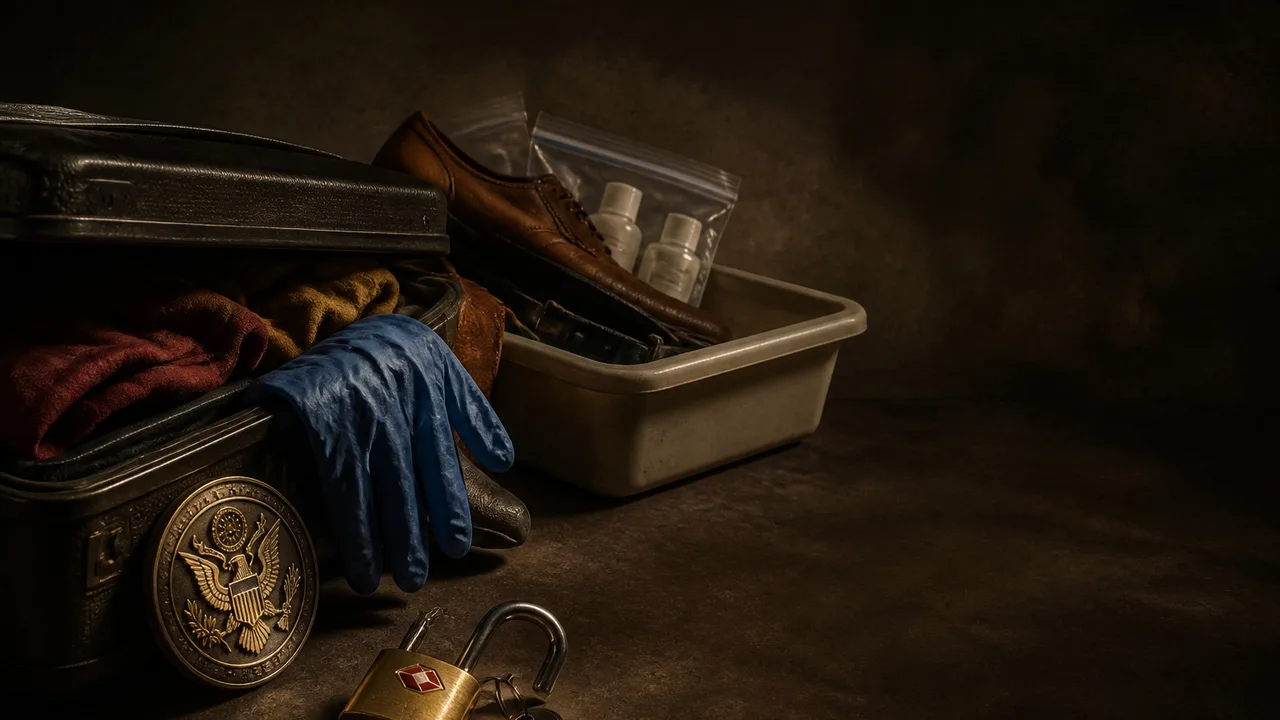
Photo: AI. Soraya Hadid
Most people approach the TSA checkpoint the same way they approach a speeding ticket: vaguely guilty, definitely compliant, not entirely sure what the rules are but unwilling to find out by pushing back. Travel creator Megan of Portable Professional recently put out a video that makes a pretty compelling case that this posture is both understandable and, in several ways, more deferential than the situation actually requires.
The video covers ten things TSA isn't exactly advertising to passengers. Some of it is rights-and-rules stuff that's genuinely useful to know. Some of it is institutional history that lands somewhere between uncomfortable and clarifying. All of it is worth thinking through before your next flight.
The Power Gap Nobody Talks About
The first and maybe most practically useful point: TSA officers cannot arrest you. They have no arrest authority. If an agent finds something in your bag that isn't a direct security threat — say, something that's illegal but poses no danger to the plane — the most they can do is call local police and hand it off. They're screeners, not law enforcement, and that distinction matters.
From there, Megan runs through a list of passenger rights that are technically public knowledge but rarely explained at the checkpoint. You can film TSA agents and the screening area, as long as you're not interfering with the process or capturing sensitive equipment readouts. Your passport doesn't have to go in the bin — you can carry it through the body scanner. And if an agent asks you to do something you're unsure about, she says the right move is simply to ask: "Am I legally required to do this?"
On devices specifically: TSA can ask you to power on a laptop or phone to confirm it works. They cannot make you unlock it, and they have no authority to demand access to your photos, files, or messages. That's a harder line than most people realize exists.
The body scanner opt-out is similarly underused. You can decline the scanner entirely and request a pat-down instead — and Megan points out you can specify conditions: a private screening area, a same-gender officer, a witness present, and fresh gloves. These aren't special accommodations. They're standard options that just don't get announced.
The Scanner Upgrade That Came After Documented Abuse
Current TSA body scanners produce a generic, cartoon-like outline — software flags areas where something might be concealed, but the image itself is not of you. This is worth knowing because the previous generation of machines, called backscatter X-ray scanners, worked very differently.
Backscatter machines produced near-photographic images of passengers' bodies beneath their clothing. Critics called them digital strip searches, and Megan notes that the criticism wasn't really an exaggeration. There were documented cases of agents saving and sharing the images internally. Congress eventually intervened, and by 2013 TSA had phased backscatter machines out entirely, replacing them with the current millimeter-wave scanners.
The upgrade happened. The technology is meaningfully different now. But it's useful context for understanding why some passengers still feel uneasy, and why the opt-out right exists.
Quiet Skies: The Program That Watched You Blink
The section of Megan's video that hits differently once you sit with it concerns a program called Quiet Skies.
Quiet Skies placed ordinary American travelers — not suspects, not people on watchlists — under surveillance by undercover air marshals on domestic and international flights. Marshals would sit near the flagged passenger and document their behavior in reports: bathroom habits, body language, how often they blinked. The targets had been identified by an algorithm, and the criteria for flagging were never fully disclosed.
Megan says the program cost over $200 million annually and never resulted in a single terrorism arrest — a figure she cites in the video. The program's termination is confirmed: DHS posted on X in 2025 that "Under the leadership of @Sec_Noem, DHS terminated the Quiet Skies Program," and the agency's own statement noted the program had not stopped a single attack. Megan's cost figure and DHS's efficacy record are separate claims — only the latter is confirmed by the official statement.
What makes the shutdown context particularly pointed is the dual revelation that apparently prompted it: the program had been used to monitor political figures including Tulsi Gabbard, while simultaneously a sitting senator's husband had been placed on an exclusion list — meaning he was exempt from standard TSA screening entirely. That's not a bureaucratic glitch. That's the system working exactly as designed for someone connected enough to be removed from it, while it surveilled everyone else. The screening apparatus was, in practice, optional for the right people.
SPOT: Still Running, Still Watching
A separate behavioral monitoring program called SPOT — Screening of Passengers by Observation Techniques — operates at the checkpoint level and is still active. TSA invested heavily in training officers for the program, according to Megan's video.
Trained SPOT officers watch for behavioral cues that could indicate a threat: avoiding eye contact, sweating, specific swallowing motions. The program tracks over 90 separate behaviors. When researchers obtained the full list, what they found was that nearly every indicator on it described something a nervous but entirely innocent traveler might do. Arriving late for your flight is on the list. Excessive blinking is on the list.
This is the context in which "random" SSSS selection makes more sense to scrutinize. SSSS — Secondary Security Screening Selection — is the code that appears on some boarding passes and triggers extended screening: pat-down, explosive swab, full bag search, questions about your travel. TSA characterizes it as random. Megan says it can also be triggered by specific factors: paying cash for a ticket, booking a last-minute one-way international flight, or having any discrepancy in your ID information. If you've hit SSSS more than once, it's worth reviewing whether any of those factors were in play.
TSA-Approved Locks: The Security Theater Addition Nobody Asked For
Here's one that should probably be on more people's radar. TSA-approved locks — the ones with the Travel Sentry logo — are designed so TSA agents can open your checked bag with a master key if they need to inspect it, then relock it without cutting the lock. The system makes sense in concept.
The problem is that the master keys were photographed, leaked, and reverse-engineered years ago. A complete set is currently available on Amazon for under $10.
Which means: a TSA-approved lock signals to anyone who wants to open your bag that it can be opened cleanly, with no visible sign of entry. Megan's recommendation is zip ties on the zipper pulls instead — not because they prevent access, but because a cut zip tie tells you access happened. That information is worth having.
The Rules Aren't Always the Rules
TSA agents have significant discretion at the checkpoint, and that discretion cuts both ways. Megan covers the case of Dr. Tiffany Moon, whose Alexander McQueen bag was flagged because its decorative tiara-shaped handle is technically shaped like brass knuckles, which are prohibited. The agent's logic — that it could be used to assault someone — is hard to argue with, even if stopping a fashion accessory feels absurd.
A traveler at Orlando International was stopped over a pickleball paddle, despite pickleball paddles being explicitly permitted on TSA's own website. Unpredictability is, to some extent, intentional: varying screening procedures makes it harder for bad actors to game the system. But it also means that what you can and can't bring through depends partly on which agent you get and what they know. TSA's own Instagram has documented what the agency does intercept — including a replica pipe bomb and live turtles concealed in a passenger's bra at Miami — which provides some useful perspective on why agents might err toward caution.
Your Stuff Has a Second Life
When TSA confiscates something — or a traveler abandons it at the checkpoint — it doesn't disappear. Confiscated items are turned over to the state where the airport is located, and from there most end up sold through government-authorized platforms like GovDeals, GSA Auctions, and Public Surplus.
There's also a physical store in Scottsboro, Alabama called Unclaimed Baggage, where you can walk in and buy things that were taken from or left behind by travelers at airports. Knives, electronics, jewelry, sporting equipment, tools — all of it sitting on shelves with price tags.
More Like This
Flock Safety Cameras: Crime Tool or Privacy Risk?
Flock Safety's license plate readers are spreading fast. Retired Microsoft engineer Dave Plummer breaks down what they actually capture—and what's at stake.
Uber Wants to Book Your Hotel Now, Too
Uber is teaming up with Expedia to add hotel booking inside its app. Here's what that actually means for budget travelers already loyal to other platforms.
Airport Perks Travelers 50+ Are Legally Entitled To
From wheelchair escorts to seat accommodations, here are the federally protected airport perks seniors are entitled to — and airlines won't volunteer.
What Smart Travelers Do Right After Boarding a Plane
From seat checks to jet lag tricks, here's what experienced flyers actually do in the first few minutes after boarding—and why it matters.
American Airlines Ends 24-Hour Refunds on Last-Minute Tickets
American Airlines has quietly removed the 24-hour refund window for tickets booked within seven days of departure. Here's what that means for last-minute travelers.
Hotel Check-In Safety Checks Worth Doing
From bed bugs to hidden cameras, a former hotel worker's check-in routine covers safety, hygiene, and avoiding surprise charges—here's what actually holds up.
Mass Media Doesn't Change Your Accent. Your Friends Do.
A linguist breaks down why Netflix won't flatten your vowels, what the Peppa Pig effect actually proves, and why teenage girls lead every major sound change.
U.S. Customs Cash Rules: What Travelers Must Know
A $53,800 seizure at Fort Lauderdale Airport puts the $10,000 cash declaration rule back in focus. Here's what travelers actually need to know.