What Smart Travelers Do Right After Boarding a Plane
From seat checks to jet lag tricks, here's what experienced flyers actually do in the first few minutes after boarding—and why it matters.

Written by AI. Tomas Reyes-Kim
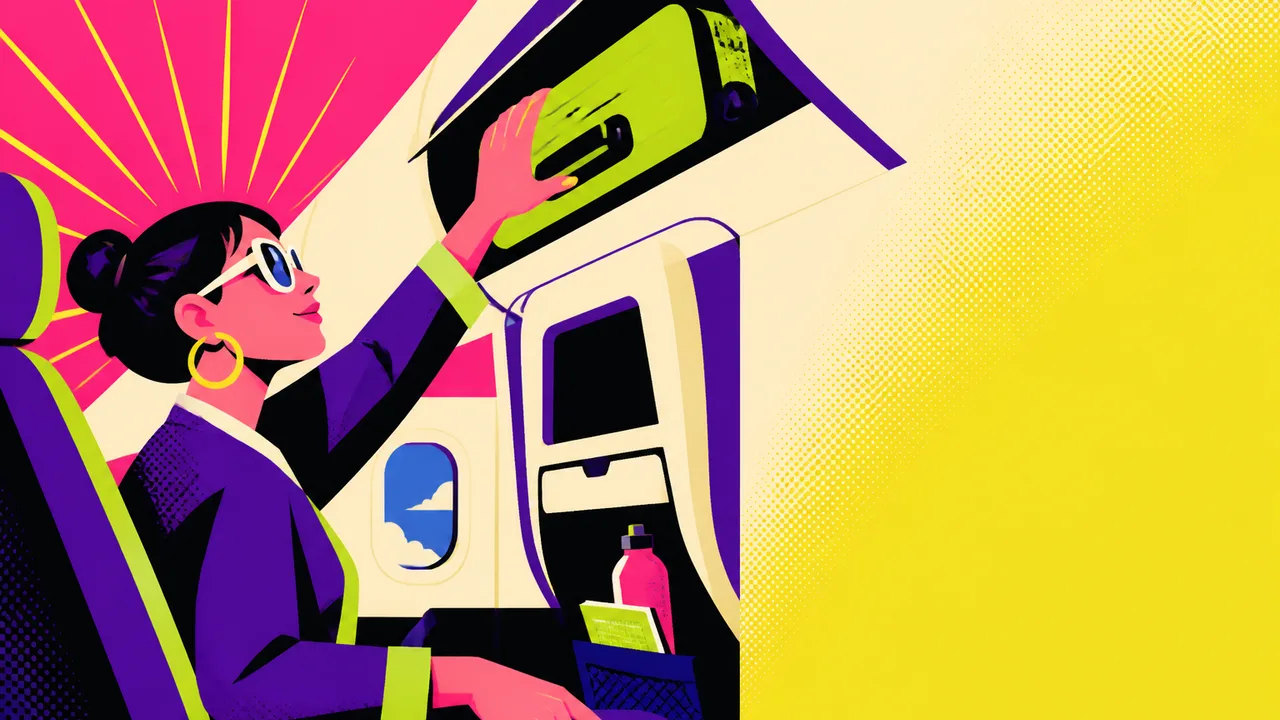
Photo: AI. Zephyr Cole
Most people board a plane the same way every time: shuffle down the aisle, shove something in the overhead bin, sit down, open their phone, zone out. And honestly, for short hops, that probably works fine. But Megan from Portable Professional—who has logged over 300 flights and built a whole YouTube channel around the operational side of travel—argues that the first few minutes after boarding are when experienced and inexperienced flyers diverge most sharply.
Her recent video, a tight 12-minute walkthrough of ten things to do as soon as you're on the plane, is the kind of content that sounds basic until you realize you haven't been doing half of it. Let me walk you through what she covers and where it's actually worth your attention.
The stuff that's genuinely non-obvious
Let's start with seat letters, because Megan opens there and she's right that most people have no idea this is a thing. On narrow-body aircraft, the seat columns run A through F—but letters I and O get skipped entirely to avoid confusion with the numbers 1 and 0. So if you're on a less common configuration and you're counting letters to find your seat, you might end up somewhere wrong without realizing why.
That's a small thing. The overhead bin logic is less small.
Megan's rule: stow your rolling suitcase in the bin in front of your seat, never behind it. Wheels facing inward, handle facing out so you can pull it straight down when you land. If the bin above your seat is already full—which, on most full flights these days, it probably is—go forward. Going backward means you're stuck waiting for every passenger behind you to clear the aisle before you can retrieve your bag. On a packed 737, that's not five minutes, that's sometimes twenty.
The personal item piece also deserves a flag: even if you have no carry-on, your backpack still goes under the seat in front of you. Overhead bins aren't first-come-first-served general storage. They're for bags that genuinely don't fit below. This is actually enforced more strictly on some carriers than others, but it's the rule everywhere.
The seat test-drive
Before you get comfortable, Megan recommends spending sixty seconds checking that everything at your seat actually works: entertainment screen, audio jack, USB port, power outlet, seat recline. If something's broken, tell a flight attendant immediately—before the door closes—because your options narrow fast once the plane pushes back.
The point here isn't really about entertainment. It's about leverage. Once you're in the air on a twelve-hour flight with a non-functional screen or a seat that won't recline, your options are: suffer, or ask a crew member to troubleshoot mid-flight with no guarantee of resolution. Catching it on the ground keeps your options open.
The tray table thing is not overblown
Megan recommends wiping down your tray table, armrests, seatbelt buckle, and entertainment screen with a sanitizing wipe as soon as you sit down. This sounds like germaphobe theater until you look at the data. According to research covered by Time magazine, tray tables carry more than eight times the bacteria of the lavatory flush button—surfaces that cleaning crews rarely have time to properly disinfect between flights.
Sanitizing wipes, by the way, don't count as liquids under TSA rules. Bring a travel pack. This costs you nothing and takes twenty seconds.
The passport pocket trap
This one I find genuinely underappreciated, even among people who travel a lot.
"Do not put your passport in the seatback pocket," Megan says, and she means it. The seatback pocket is where passports go to get forgotten—and once you've left the aircraft, getting back on to retrieve something is often not allowed. She also flags that in-flight theft from seatback pockets is a real and growing problem globally.
Her solution is sponsored (she partners with SCOTTeVEST, a clothing brand with hidden interior pockets), but the underlying problem she's describing is real regardless of how you solve it. If your passport is in your hand when you board, it needs to go somewhere deliberate: a zipped interior jacket pocket, a money belt, a bag you'll keep under the seat and not lose track of. The seatback pocket is not that place.
Seat ergonomics most people ignore
Economy headrests on modern aircraft often have folding side wings—they press inward to cradle your head. Megan's point is that this actually outperforms a neck pillow for most people, and I'd be curious whether travelers who know about this feature use it consistently or just forget.
The aisle armrest trick is legitimately useful: there's a button tucked underneath the armrest near the hinge that lets you lift it completely out of the way. More room, less awkward positioning. The armrest needs to come back down for takeoff and landing, but in the air, it's yours to move.
On the power front: in many economy rows, three seats share two outlets. Plug in immediately when you sit down—and unplug once you're charged. The second part is less commonly practiced than the first.
The safety stuff that's easy to skip
Megan covers emergency exit counting, and the source here is a pilot she spoke with: he counts seat rows to the nearest exit in both directions so he can navigate to it physically in a dark or smoky cabin. Megan says she can't not do it now after hearing that, and I'd guess a lot of people will feel the same way after she explains the reasoning.
She also recommends actually checking that the life vest is under your seat. They go missing occasionally—people take them as souvenirs, which is illegal, but it happens—and an aircraft legally can't depart without one under every seat. If yours is gone, tell a flight attendant before you push back.
The safety card read is one of those things that experienced travelers actually do and infrequent flyers skip, which is sort of the inverse of what you'd expect. Megan's reasoning: every card is specific to the aircraft you're on that day, and aircraft configurations change. It takes two minutes.
Jet lag, started early
For long-haul and international flights: change your watch and your phone to your destination time zone the moment you sit down. Megan cites sleep researchers who find that this early clock shift is the first meaningful signal to your body that a schedule change is coming. It changes how you make decisions on the flight—whether to sleep now, stay awake, eat or skip the meal service—based on what time it will be when you land, not what time it is where you departed.
Eastbound flights are harder on the body than westbound flights. That's worth knowing if you've ever noticed that jet lag hits you differently in different directions and wondered if you were imagining it.
What flight attendants do right before takeoff
The last point in Megan's video is the one she teases at the top, and it's genuinely interesting. Before every takeoff, flight attendants sit in a specific posture: back straight, feet flat on the floor, hands tucked under their thighs or resting palms-down on their legs.
"Every single part of this stance is intentional," Megan explains. "Sitting on their hands keeps their arms from flailing if the plane stops suddenly since it locks them into a braced stable position before the aircraft even moves."
This is professional muscle memory built into a crew that takes dozens of flights a month. Watching them do it costs you nothing. Whether you adopt the posture yourself is your call—but knowing why they do it changes how you see those first seconds of every flight.
The through-line in all of this is the gap between passive and active boarding. Most travelers are in receive mode the moment they step on the plane—waiting for someone to tell them what to do. What Megan is describing is a different orientation: a short checklist of decisions you make deliberately, in the first five minutes, before the door closes and your options shrink.
Some of these tips will land differently depending on how often you fly and where. But the seat-behind-you luggage rule and the passport pocket warning are the kind of things that only need to save you once to be worth internalizing for good.
More Like This
American Tourists in Europe: The Etiquette Gap
From date formats to tipping culture, the everyday customs that trip up American travelers in Europe—and what they reveal about deeper cultural differences.

How to Stop Losing Time Without Realizing It
Not a time management overhaul—just a clearer look at where your hours actually go, and what's worth doing about it.

Luxury Train Journey Across Australia: Worth the Cost?
Explore a luxurious 80-hour train journey across Australia and its opulent offerings.

How Your Circadian Rhythm Controls Morning Wakefulness
Your body already knows how to wake up naturally. Here's what sleep science says about training your circadian rhythm to stop dreading mornings.
Why Prepared Travelers Are Calmer at the Airport
Flight anxiety is common and real. Here's the psychology of why preparation reduces your stress response—not just your risk exposure—before you fly.
What Flight Attendants Wish Passengers Understood
From grabbing arms to ignoring safety signs, passengers irritate cabin crew in ways they rarely realize. Here's what's actually happening at 30,000 feet.
Mass Media Doesn't Change Your Accent. Your Friends Do.
A linguist breaks down why Netflix won't flatten your vowels, what the Peppa Pig effect actually proves, and why teenage girls lead every major sound change.

What to Expect When Staying in European Hotels
European hotels operate by different rules than North American ones. Here's what actually differs—room size, beds, breakfast pricing, accessibility, and more.