How Your Circadian Rhythm Controls Morning Wakefulness
Your body already knows how to wake up naturally. Here's what sleep science says about training your circadian rhythm to stop dreading mornings.

Written by AI. Kira Yoshida
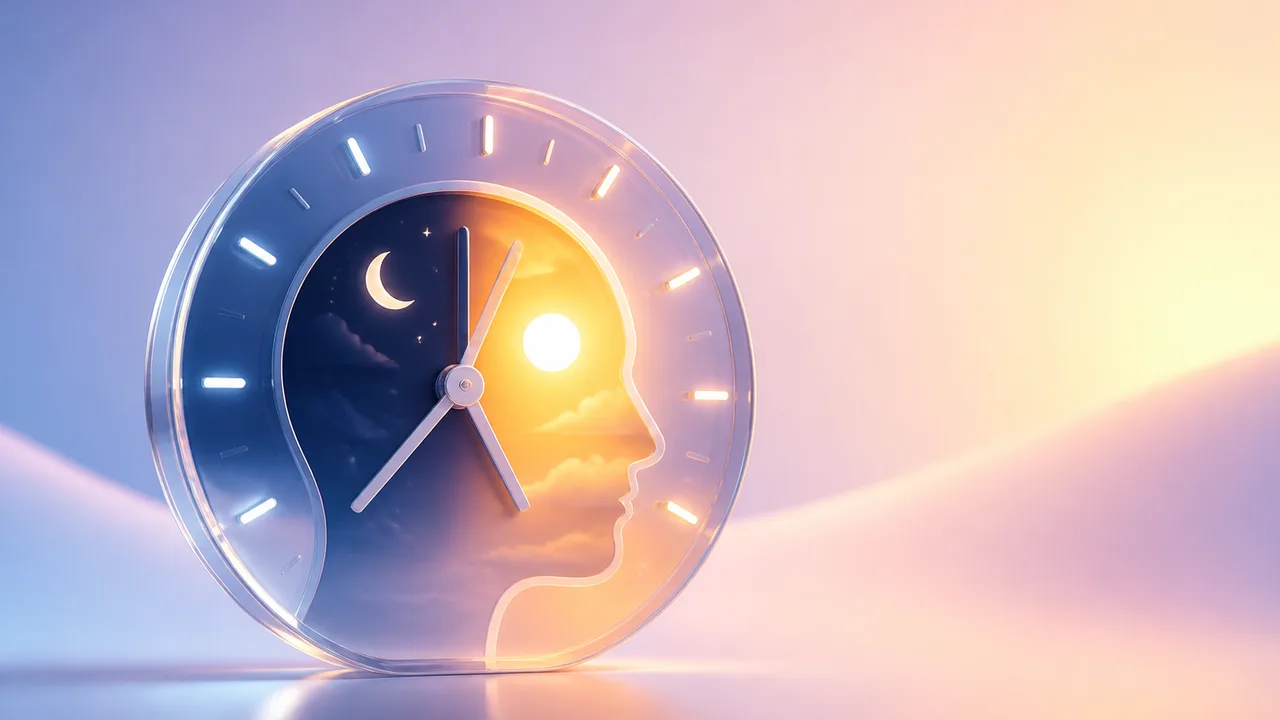
Photo: AI. Ren Takahashi
There's a specific kind of betrayal that happens on a Monday morning. The alarm fires. Your body—which was doing just fine a moment ago—suddenly becomes a sandbag. But think back to the last time you had a flight to catch, or a vacation starting, or something you were genuinely excited about. You probably woke up before the alarm. Maybe even before you meant to.
That gap—between the Monday morning sandbagging and the pre-vacation natural rise—is the thing that a recent video from the YouTube channel Simple, Actually zeroes in on. And the answer it offers isn't about motivation or discipline or buying a sunrise alarm clock that costs $180. It's about a fairly well-established piece of biology that most of us are inadvertently working against.
The clock that was already running
Your circadian rhythm is a genuine physiological system, not a metaphor. Housed primarily in the suprachiasmatic nucleus—a tiny cluster of neurons in the hypothalamus—it governs roughly 24-hour cycles of sleepiness, alertness, core body temperature, hormone release, and yes, when your brain expects to surface from sleep. It's regulated primarily by light, particularly the blue-wavelength light spectrum that peaks in natural morning sunlight.
This isn't fringe wellness content. The circadian clock was the subject of the 2017 Nobel Prize in Physiology or Medicine, awarded to Jeffrey Hall, Michael Rosbash, and Michael Young for their work on the molecular mechanisms controlling it. The science here is not contested.
What Simple, Actually is doing—and doing fairly well—is translating that mechanism into behavioral terms. The core argument is straightforward: most people's circadian clocks are confused because modern life sends conflicting time cues. Late-night screens, erratic sleep schedules, sleeping in on weekends, eating at odd hours. The clock receives contradictory signals and struggles to land on a stable rhythm. The result is that waking up feels like being dragged out of a time zone you weren't supposed to be in.
"When your internal clock becomes confused, waking up feels painful," the video observes. "The goal isn't to force yourself awake. The goal is to make your internal clock predictable again."
That reframe is worth sitting with. Most morning-routine content treats waking up as a willpower problem. The circadian lens treats it as an information problem: your body isn't being lazy, it's just miscalibrated.
What actually moves the needle
The behavioral interventions the video recommends fall into two categories: things that anchor the clock, and things that reinforce the signal once you're awake.
Anchoring the clock comes down to consistency, and specifically the consistency of your wake time more than your bedtime. Sleep researchers including Dr. Matthew Walker have noted that a stable wake time is the single most powerful lever for circadian regulation—your body backwards-calculates when to release melatonin and cortisol based on when it expects you to get up. The video's "10-minute window" recommendation for bedtime consistency is a stricter version of this principle, but it's directionally correct.
The social jet lag point is where the video is on particularly solid scientific ground. The term was coined by chronobiologist Till Roenneberg, and the research behind it is substantial: people who sleep significantly later on weekends than weekdays show health outcomes that resemble shift workers, including metabolic disruption, increased cardiovascular risk, and—relevantly here—worse subjective sleep quality. "Your circadian rhythm doesn't understand weekends," the video states plainly. "It only understands patterns."
Reinforcing the signal after waking is about giving the circadian system unambiguous information. Morning sunlight is the main tool here. The video recommends 5-10 minutes of outdoor light exposure as soon as possible after waking—not phone light, not overhead lighting. Actual photons from the actual sun.
This tracks. Sunlight hitting the retina triggers the suprachiasmatic nucleus to suppress melatonin production and begins a roughly 14-16 hour countdown to the next sleep window—a figure the video cites. What's interesting about framing it this way is that it turns morning light into a sleep intervention, not just a wakefulness hack. Better morning light anchoring means your sleep pressure will peak at a more predictable time that night, which means you'll fall asleep more easily, which means tomorrow's wake-up is slightly less awful. It's a flywheel, not a one-time fix.
The cool water face wash and cool morning air tips are lighter on direct evidence but consistent with what we know about body temperature cycles—your core temp naturally rises toward waking, and a cool stimulus can sharpen that transition. It's a minor nudge, not a primary intervention.
Where the video is honest—and why that matters
The section I found most notable is when the video explicitly separates "waking up early" from "waking up rested." These are not the same thing, and a lot of morning-optimization content either blurs them or ignores the distinction entirely.
"If your body genuinely needs 8 hours and you're only getting 5, no morning hack will fully fix that," the video says. "You can optimize, you can improve. You can reduce grogginess, but you cannot cheat biology forever."
That caveat does real work. It's easy to sell circadian optimization as a productivity tool—a way to extract more hours from your day by getting up earlier. But if you're just shifting the same insufficient sleep window earlier, you haven't solved anything. Sleep debt accumulates, and while there's evidence that it can be partially recovered, the idea that you can systematically run short and compensate with cold showers doesn't survive contact with the research.
The video's honest-ish framing also gestures toward something it doesn't fully develop: not everyone's circadian clock is set to the same time. Chronotype—whether you're a natural early riser or a natural night owl—has a genuine genetic component. Research published in Nature Communications in 2019 identified 351 genetic variants associated with chronotype. So while behavioral consistency can move your wake time, there are real limits, and some people are fighting a steeper hill than others when it comes to early mornings. That's not in the video, but it's worth knowing.
The part about "not negotiating with your bed"
The sit-up-immediately tip is the most behaviorally interesting recommendation in the video, and also the hardest to evaluate mechanically. The claim is that sitting up "breaks the sleep cycle" and reduces the strongest wave of morning grogginess—what sleep scientists call sleep inertia.
Sleep inertia is real: it's the grogginess you feel during the transition from sleep to full wakefulness, particularly if you're woken from deep slow-wave sleep. It can last anywhere from a few minutes to 30-plus minutes depending on sleep stage, individual variation, and how sleep-deprived you are. Whether sitting up specifically accelerates its clearance isn't something I've seen pinned down in the literature—but the behavioral logic is sound. Lying still in a warm bed is a strong environmental cue for continued sleep. Changing your physical position removes that cue. It's not magic; it's just not giving your brain the "stay" signal.
The broader point—that lingering in bed after waking trains your brain to treat wake time as optional—is well-taken. Behavioral conditioning applies to sleep-wake cycles just as it applies to other learned patterns.
The through-line in all of this is that the video is essentially describing zeitgebers—the German term sleep researchers use for time cues that entrain the circadian clock. Light, temperature, activity, social schedules: your clock is constantly reading these signals and updating its internal model of when "now" is. When those signals are chaotic, the model is unstable. When they're consistent, the clock locks in.
Framing morning wakefulness as a training problem rather than a willpower problem doesn't just make the advice more actionable. It also, quietly, removes a layer of moral weight from the whole thing. You're not a failure for hitting snooze; you've just been sending your clock mixed signals.
The question worth sitting with: if your mornings feel like combat, what signals has your body actually been receiving?
By Kira Yoshida
More Like This

5 Life Regrets That Are Actually Real (With Caveats)
The Art of Improvement's viral regret video gets a lot right — but the gap between what you *should* do and what you *can* do is where self-improvement content always falls apart.

Morning Habits That Transform Your Day
Explore science-backed morning habits that boost focus, discipline, and energy. Start your day right for lasting productivity.
Morning Routines: Intention, Gratitude, and a Dash of Skepticism
Explore morning routines focusing on intention and gratitude, with a critical look at wellness industry promises.
Designing a Productive Day When Life Won't Cooperate
A stay-at-home dad to 7-year-old twins stress-tests a popular productivity framework — and finds out where it holds up and where it quietly assumes you live alone.
Your Brain Learns Like a Muscle. Study That Way.
The science of memory retrieval, spaced repetition, and interleaving—and why study-optimization content keeps selling you the same recycled research.

The Science Behind Becoming an Early Riser
Discover the neurological and behavioral strategies to make early rising effortless, not forced.
Grounded Confidence Is a Body State, Not a Mindset
A viral Charisma on Command video gets the framework right but misses the physiology. Grounded confidence isn't a technique — it starts in your nervous system.

What an ER Doctor's Skill Failure Teaches About Learning
Jeremy Baird's TEDx talk on failing a lumbar puncture connects surprisingly well to sports psychology research on how bodies learn from physical errors.