Hotel Check-In Safety Checks Worth Doing
From bed bugs to hidden cameras, a former hotel worker's check-in routine covers safety, hygiene, and avoiding surprise charges—here's what actually holds up.

Written by AI. Tomas Reyes-Kim
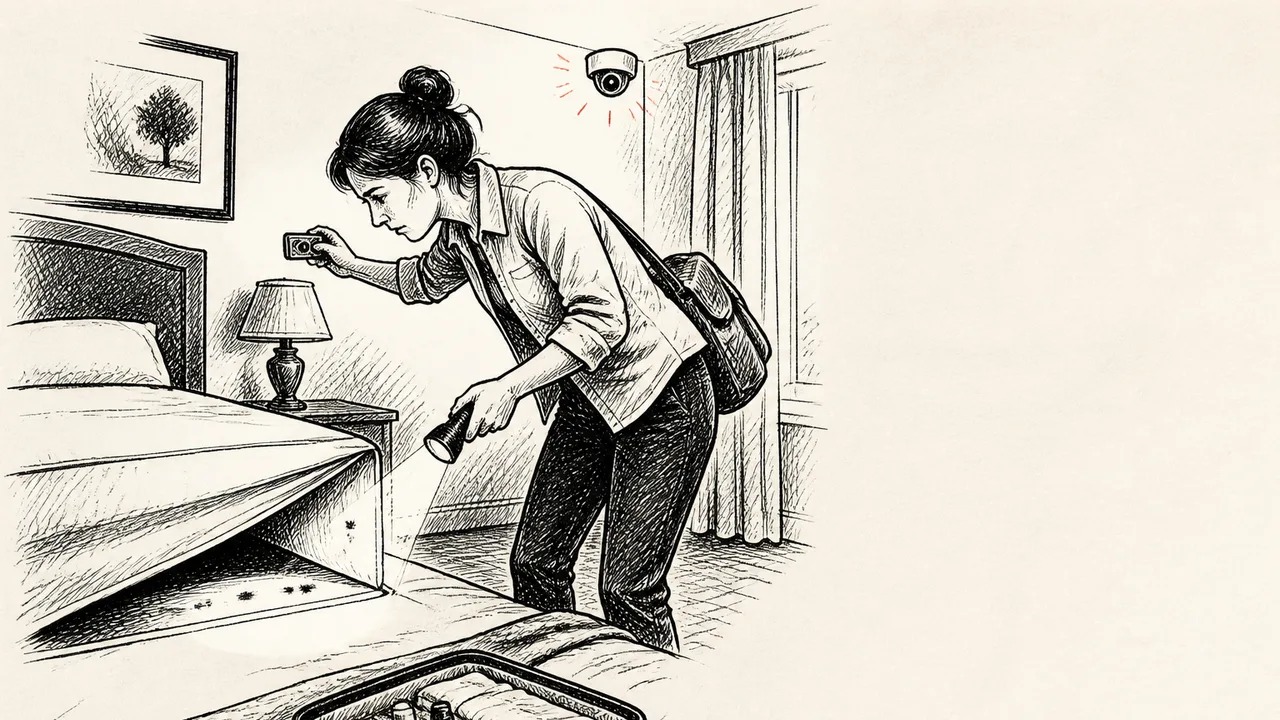
Photo: AI. Eira Pendragon
Nobody tells you the luggage rack is a trap.
Not in any hotel welcome pamphlet, not at check-in, not anywhere in the glossy travel content that makes every property look like a spa retreat. Megan from Portable Professional — who actually worked in a hotel before becoming a travel creator — is the one pointing at the luggage rack's woven straps and saying: that's where bed bugs hide. Put your suitcase in the bathtub instead. Smooth surfaces. Bugs can't climb them.
That's the kind of detail you only know if you've been on the other side of the door, and it's what makes her recent check-in checklist video worth breaking down. Not because every traveler is going to execute all ten checks every time — most won't — but because understanding why the list exists changes how you read a hotel room.
The Checks That Actually Matter for Safety
Megan's routine opens with something she calls the 30-second room sweep: prop the door open with your luggage, walk through the bathroom, check the closet, look behind the curtains and under the bed, step onto the balcony. The goal is simple. "You want to make sure that there are no people, obvious messes, or anything that's immediately apparent that would make you want to switch rooms."
That's not paranoia — that's just doing the thing that takes 30 seconds before you've already unpacked everything.
The bed bug check is more involved. Peel back the sheets and run your phone flashlight along mattress seams, corners, and piping. Look for reddish-brown bugs, small dark spots resembling black pepper, or shed skin. Check the gap between the headboard and the mattress too. According to Forbes, roughly one in seven US travelers reported encountering bed bugs in the past year — and as Megan points out, they show up in luxury properties just as readily as budget ones. If anything looks suspicious, the move is to request a room change and specifically ask for a different floor, not just a different room. Bed bugs travel through walls.
The lock check gets underrated airtime in most hotel safety content, but Megan is thorough here: deadbolt, chain, security swing bar, adjoining room door (firm pull to confirm it's secured from your side), window locks, balcony locks, peephole integrity — checked from both inside and outside, then covered with tape or a sticky note. "Peepholes can be reversed with inexpensive tools," she notes, "and it's only going to take you 10 seconds to cover yours up." This overlaps with safety checks that other travel creators like Mark Wolters have flagged as consistently skipped, even by frequent travelers.
The hidden camera sweep is where this starts to feel like a different genre of travel video — but the stakes justify it. Dim the lights, draw the curtains, sweep a flashlight slowly around the room watching for reflective glints near smoke detectors, alarm clocks, air vents, lamps. Any USB charger or random electronics that seem out of place deserve a hard look. If anything is off: photograph it, leave the room, and go straight to either the front desk or — if you have reason to think the front desk is involved — the police directly.
The fire exit check is one she makes a point of actually completing, not just glancing at the evacuation map. Physically walk the route. Find the stairwell. Go all the way down. The Hotel and Motel Fire Safety Act, which governs US properties, creates federal egress requirements — but Megan's been down enough emergency staircases to know that compliance and reality don't always match. "I cannot tell you how many times I have gone down the emergency exit staircase only to find a locked door at the bottom." Knowing that before a fire is considerably better than discovering it during one.
The Hygiene Stuff Is Grosser Than You Think
Here's where Megan's hotel experience starts to sting a little. "The TV remote is the single germiest object in a hotel room," she says. "Every guest uses it, and almost none are properly sanitized between stays."
Her fix — stretching a plastic shower cap over the remote for your whole stay — is genuinely clever. You can still see and press every button through the plastic. Zero contact, zero effort, and you're repurposing something the hotel already provided.
The remote is just the headline item. A peer-reviewed study published in the International Journal of Environmental Health Research — "How Clean Are Hotel Rooms? Part I: Visual Observations vs. Microbiological Contamination" — found that housekeeping routinely prioritizes visible cleanliness over microbial contamination. Light switches, door handles, faucets, the thermostat, the toilet flush button, the nightstand: all high-touch, all frequently missed. Megan's advice is to hit these with disinfecting wipes if you have them.
The bathroom test is worth doing before you do anything else: flush the toilet, run the shower, confirm hot water arrives and drains clear. Viewer-sourced advice from her previous videos adds a useful layer here — let the hot water run for a couple minutes before you shower. Stagnant water in pipes that haven't been used since the last guest is not something you want to be standing in.
The coffee maker and kettle get their own warning. Check inside the carafe or kettle for anything questionable before you run it. Even if it looks fine, run one cycle with plain water first. Ice bucket with no plastic liner: same principle as the uncovered drinking glasses — use with caution or skip it.
The Financial Protection Move
One check that gets overshadowed by the safety drama: photograph the room before you unpack anything.
Stains, cracks, damaged furniture, broken fixtures, the mini bar inventory — all of it. Timestamped photos of the room's condition at arrival are the difference between disputing a checkout charge successfully and just eating it. Megan frames it the same way you'd frame a car rental inspection, which is exactly the right analogy. "You will hopefully never have to reference these photos, but having them could save you from being charged at checkout for damage or missing items that you never had anything to do with."
This is one of those low-effort, high-upside moves that takes maybe two minutes and pays off the one time you actually need it.
How Much of This Do You Actually Run?
Honest answer from someone who has stayed in a lot of cheap hotels across a lot of countries: not all of it, every time.
The sweep, the bed bug check, and the lock check — those are non-negotiable for me now. I skipped the bed bug inspection exactly once, in a mid-range guesthouse in Southeast Asia that seemed clean enough, and spent three weeks back home figuring out why I kept waking up with welts. Lesson received. The photo documentation became a habit after a hostel in Lisbon tried to charge me for a broken mirror I'd photographed within ten minutes of checking in. Produced the timestamp, charge disappeared.
The hidden camera sweep and the fire exit walk feel like the checks that most people will do once — after reading something like this — and then inconsistently after that. That's probably fine. Doing them once in a new property type, or when something feels off, is meaningfully better than never.
Megan's full list with her bed bug guide is available free in her video description. The checklist format is genuinely useful if you're the kind of person who actually runs checklists. If you're not, the mental model is simpler: before you unpack anything, spend five minutes assuming the hotel doesn't have your best interests at heart. Because it doesn't. It has 200 other guests' best interests to manage simultaneously. Your room is your problem.
More Like This

35 Self-Hosted Apps That Actually Replace Your SaaS Stack
From recipe managers to AI memory systems, these GitHub projects let you own your data without sacrificing features. A security-focused look at what works.
Uber Wants to Book Your Hotel Now, Too
Uber is teaming up with Expedia to add hotel booking inside its app. Here's what that actually means for budget travelers already loyal to other platforms.
Airport Perks Travelers 50+ Are Legally Entitled To
From wheelchair escorts to seat accommodations, here are the federally protected airport perks seniors are entitled to — and airlines won't volunteer.
The 30-Second Hotel Safety Check You're Not Doing
A quick hotel room safety check—doors, locks, windows, exits—could prevent theft or worse. Here's what travel creator Mark Wolters says to do first.
Best Home Lab Gear Under $100: What's Actually Worth It
Raid Owl's budget home lab gear list skips the flexing and gets practical. Here's what the picks actually tell you about building a smart home lab setup.
What Smart Travelers Do Right After Boarding a Plane
From seat checks to jet lag tricks, here's what experienced flyers actually do in the first few minutes after boarding—and why it matters.
Mass Media Doesn't Change Your Accent. Your Friends Do.
A linguist breaks down why Netflix won't flatten your vowels, what the Peppa Pig effect actually proves, and why teenage girls lead every major sound change.
IHG Launches AI Conversational Hotel Search
IHG's new AI conversational search lets travelers book across 7,000+ hotels in plain language. Here's what it means—and what it still can't promise solo travelers.