Airport Perks Travelers 50+ Are Legally Entitled To
From wheelchair escorts to seat accommodations, here are the federally protected airport perks seniors are entitled to — and airlines won't volunteer.

Written by AI. Tomas Reyes-Kim
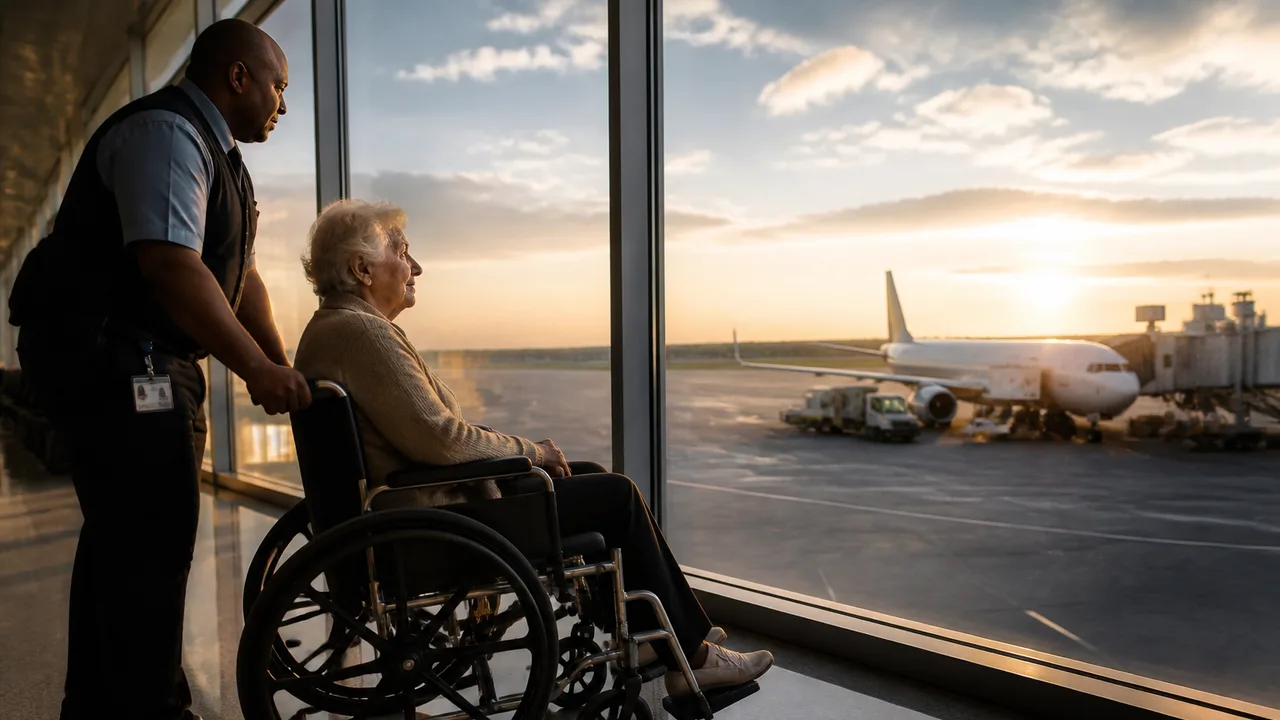
Photo: AI. Asha Kingsley
Picture this: your dad is flying solo for the first time in years. He's 68, one knee replacement deep, and slightly convinced that TSA is out to get him personally. You've done the booking. You've printed the boarding pass. And then you watch him shuffle toward the terminal and realize — you have no idea if he knows any of this stuff.
That's the actual audience for this piece. Not just older travelers themselves, but everyone who books flights for their parents, argues with gate agents on behalf of their grandmothers, or has ever stood at a check-in counter translating "accessibility request" into something an airline employee will actually act on. Megan Gougeon of Portable Professional just put out a video cataloguing nine airport perks that travelers over 50 (and really, anyone with mobility or medical needs) are either legally owed or can reasonably request — and the gap between what people are entitled to and what they actually claim is, frankly, embarrassing for the airlines.
Here's what's on the table.
They'll Charge You for Your Seat Even If Federal Law Says They Can't
Start here, because this is where the money is. Airlines have normalized charging fees to choose your seat — fees that can run well into the double digits. Megan puts the ceiling at $75 in her video, and whether or not that's every airline's max, the underlying dynamic is real: a lot of passengers have been paying for seat accommodations they were legally owed for free the entire time.
Under federal law, airlines are required to provide specific seating accommodations to passengers with physical needs at no extra charge — regardless of fare class. That means if you need an aisle seat with a movable armrest to transfer from a wheelchair, or a seat with extra legroom because your leg doesn't bend well, or a seat next to the person who's traveling with you to help during the flight, you are not supposed to pay for it. Basic economy included.
The catch: you cannot get this through the regular seat-selection flow online. Megan is explicit on this point — do not go to the seat map and pay. Instead, find the airline's accessibility desk number on their website and call. You can do it when you book or up to 48 hours before departure. And critically: "You do not need to give a specific diagnosis or over explain why you need a specific seat. Just tell them what you need the seat to do for you, and then let them handle it."
The number of people who paid a seat selection fee they were legally exempt from paying is not zero. It is probably a very large number. The system is designed to be opaque enough that people default to paying rather than asking.
The Free Escort Is Real, and You Should Actually Use It
Wheelchair assistance at airports is free. This seems obvious but apparently isn't — partly because people conflate "wheelchair" with "can't walk at all," and partly because nobody advertises it. An attendant will meet you curbside, take you through check-in, navigate security, and get you to the gate. If you have a connection, a new attendant picks you up on arrival and walks you to the next gate. On a tight connection at a sprawling hub airport, that is not a small thing.
You can request it when you book (look for "assistance requests" in your reservation options), add it through "manage my trip" later, or call the airline at least 48 hours before departure. When you arrive, go to the check-in counter and say: "I have wheelchair assistance requested on my reservation." Someone should already be there.
Megan used this service herself — not as a senior traveler, but when she had food poisoning the morning of a flight and genuinely wasn't sure she could make it to the gate alone. She called United about six hours before takeoff and they had someone waiting. Her take on the experience: "I wasn't made to feel uncomfortable or like I didn't deserve the service in any way. There was no violation of privacy and very few questions were even asked."
Megan notes that tipping your escort is appreciated but never required or expected.
You Can Bring a Civilian Past Security (Sometimes)
This one requires some nuance. Airlines can issue a gate pass to a non-ticketed companion — a family member or friend dropping someone off — so they can accompany the traveler through security and to the gate. You ask for it at the ticket counter when you arrive: "I'd like to request a gate pass for [name] so they can help me get through security and walk me to the gate." The companion needs a government-issued ID.
The honest version of this: gate passes are a courtesy, not a guaranteed right. Policy varies by airline and airport. Post-9/11 security infrastructure means some airports and airlines are more flexible than others, and gate agents have discretion. It's worth asking — and framing it as an assistance request, not a demand, probably helps — but don't book around the assumption that it'll happen.
Board Before Everyone Else, No Documentation Required
Under federal law, any passenger who needs extra time to board has the legal right to pre-board. The part that trips people up: you self-identify. You decide whether you need extra time. The airline does not get to make that call, and you don't need to explain yourself or produce any documentation.
Walk up to the gate agent before boarding starts: "I need a little extra time to board. I'd like to pre-board, please." If you're traveling with someone, mention them — they can pre-board with you. Then stay near the gate and be ready when the pre-boarding call is made.
Your CPAP Flies Free — If You Pack It Right
Under the Air Carrier Access Act, medical assistive devices — CPAP machines, portable oxygen concentrators, insulin coolers, and similar equipment — fly free and do not count toward your carry-on limit. The one condition: the device needs to be in its own dedicated case. Pack your CPAP inside your carry-on suitcase and it loses the exemption. Keep it separate.
If anyone at the airport questions you: "This is a medical assistive device. Under the Air Carrier Access Act, it does not count towards my carry-on allowance and I am allowed to bring it on the flight for free." At the security checkpoint, take it out of its case and put it in its own bin — same principle as a laptop.
TSA Has a Whole Program Nobody Tells You About
TSA Cares is a free program where a trained officer — called a passenger support specialist — is assigned specifically to you for the entire security screening process. They walk alongside you, explain every step, handle the bins, know how to manage medical devices, and make sure you're not rushed or confused. The program exists for exactly the moments when the checkpoint feels like a lot.
Call TSA Cares at least 72 hours before your flight, or submit a request on the TSA website. Give them your departure airport, flight date, and what kind of help would be useful. If you forgot to call ahead, ask any TSA officer at the checkpoint: "Can I speak with a passenger support specialist?" They'll try to arrange one based on availability.
No diagnosis required. No documentation. Megan has fielded enough comments from travelers who've used it to report that reviews are, broadly, excellent.
Two More That Depend on the Flight
Special meals on international flights are worth knowing about. If your flight includes meal service, you can usually request a diabetic-friendly, low-sodium, gluten-free, kosher, or low-calorie meal at no extra cost — and special meals get served before the regular service. Add it at booking or through "manage my booking" at least 48 hours out.
Gate checking a carry-on is the other one. This means handing your bag to the gate agent as you board — it goes below, and you pick it up on the jet bridge when you land. No overhead bin wrestling. This isn't guaranteed on every flight, but Megan points out that on full flights, gate agents actively want volunteers. Asking before the announcement ("Would it be possible to gate check my bag?") might be doing them a favor.
Both of these are courtesy-based rather than legally mandated, which is its own commentary on how airlines decided to structure what counts as a right versus what counts as a nicety.
The Two Words That Override Everything
If an airline employee denies you assistance you believe you're entitled to — wheelchair service that doesn't show up, pre-boarding that's being refused, a seating accommodation being ignored — ask for a Complaint Resolution Official. Every US airline is legally required to have one available either in person or by phone. They have authority to resolve disability and assistance disputes on the spot.
Say: "I'd like to speak with your complaint resolution official, please." Full stop. You don't need to escalate further than that. The title itself tends to recalibrate the conversation.
The whole architecture of these protections — federal law, the Air Carrier Access Act, TSA Cares, the CRO — exists because the default system, left to its own devices, produces outcomes where people pay for things they were owed and don't get help they were entitled to. Knowing the system better than the person behind the counter is, at this point, just practical.
Save this article. Text it to whoever in your life is flying alone next month.
More Like This

EU Entry/Exit System: Border Delays and What They Mean
The EU's new EES biometric border system is causing summer travel delays. Here's what it asks of travelers, workers, and the institutions behind both.
What Flight Attendants Wish Passengers Understood
From grabbing arms to ignoring safety signs, passengers irritate cabin crew in ways they rarely realize. Here's what's actually happening at 30,000 feet.

What Smart Travelers Do Right After Boarding a Plane
From seat checks to jet lag tricks, here's what experienced flyers actually do in the first few minutes after boarding—and why it matters.

Accor and H World Link 19,000 Hotels in Loyalty Deal
Accor and H World are linking loyalty programs across 19,000 hotels and 430 million members. Here's what it means for travelers—and why execution is everything.
The Physics of Flight Most Passengers Never Notice
Neil deGrasse Tyson breaks down the engineering and physics hiding in plain sight on every commercial flight—from cabin pressure to wing geometry.

Travel Spending Is Rebounding—But Read the Fine Print
Travel spending rebounded in June and agents are booking again—but the data tells a messier, more interesting story than the headlines suggest.

Uber Wants to Book Your Hotel Now, Too
Uber is teaming up with Expedia to add hotel booking inside its app. Here's what that actually means for budget travelers already loyal to other platforms.

Dual Internet Connections Are Still Needlessly Hard to Set Up
IPv6 multihoming could let you plug two ISPs into one network and get automatic failover. Here's how close we actually are—and what's still broken.