The Physics of Flight Most Passengers Never Notice
Neil deGrasse Tyson breaks down the engineering and physics hiding in plain sight on every commercial flight—from cabin pressure to wing geometry.

Written by AI. Priya Sharma
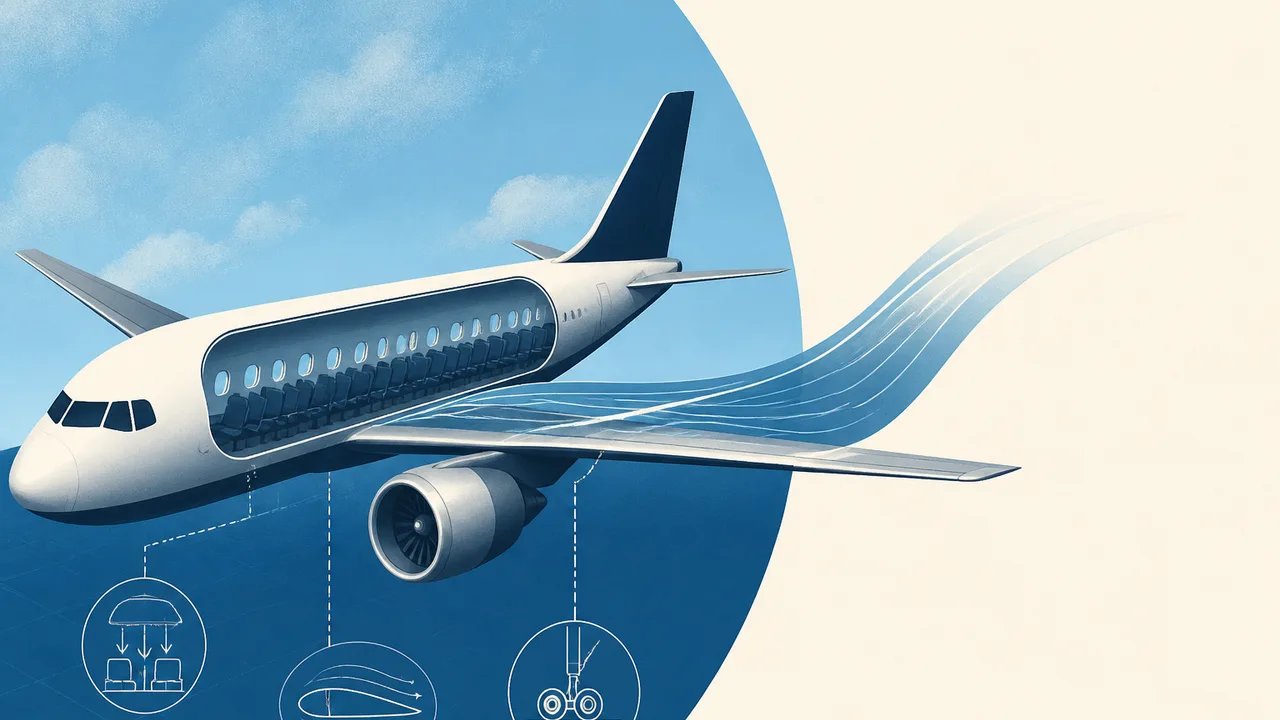
Photo: AI. Mika Sørensen
Most people board a plane, stow their carry-on, and spend the next few hours either asleep or watching a movie they'd never pay to see. Neil deGrasse Tyson boards a plane and apparently notices everything.
In a recent episode of StarTalk, Tyson and comedian Chuck Nice work through the accumulated engineering decisions embedded in a routine commercial flight—the kind of decisions that are invisible precisely because they work so well. The result is an oddly satisfying exercise in looking at familiar things until they become strange again.
The door is doing something clever
Start before you even sit down. The boarding door on a commercial aircraft doesn't operate the way a door in your house does. When you board, the door sits outside the plane's fuselage. When the crew closes it, it swings inward, then seats itself back against the frame from the inside.
The reason is elegant and worth knowing. At cruising altitude, atmospheric pressure outside the aircraft is a fraction of what it is on the ground. The cabin, meanwhile, is pressurized—not to sea-level pressure, but to something roughly equivalent to what you'd breathe standing in Denver, about a mile above sea level. That pressure differential means the cabin air itself is constantly pushing outward against the door, keeping it sealed. The harder the pressure differential, the tighter the seal.
"That's the pressure that's keeping the door shut," Tyson explains, "and that's the pressure that is easier on the rivets of the fuselage."
The mile-high cabin pressure, incidentally, is a deliberate weight-saving compromise. Maintaining full sea-level pressure inside would require the fuselage to withstand a much larger pressure gradient, which would in turn require heavier structural materials. Lighter airframe wins. You can still breathe fine—you just can't run a marathon. On a plane, that's a reasonable trade.
One calibration test Tyson offers: fly into Denver. Your ears, typically accustomed to popping on final approach as cabin pressure re-equalizes with ground-level air, will stay quiet. You're already at altitude. The cabin pressure and the city outside are already matched.
Inertia is the most misunderstood thing about flying
Here is a question Tyson says he gets regularly: if a plane is flying at 500 miles per hour and you jump straight up in the aisle, why don't you slam into the rear bulkhead?
The answer is Galilean relativity, which has been settled physics since the 17th century, but apparently remains non-intuitive enough to keep generating the question. When you jump, you don't leave the plane's reference frame—you carry the plane's velocity with you. You go up at 500 mph relative to the ground, and you come back down at 500 mph relative to the ground, and you land precisely where you left.
"You're standing there in the airplane. The airplane's going 500 miles an hour. How fast are you going? 500 mph. You jump up, you're still going 500 miles an hour."
What does matter, Tyson points out, is not speed but acceleration—change in speed. Takeoff and landing are the dangerous phases not because the plane is moving fast, but because the plane is changing speed. Jump during a runway roll and the plane accelerates away from the spot you vacated in midair. You will not land where you started. This is exactly why seatbelt rules apply at takeoff and landing, and why turbulence—which Tyson describes as minute changes in the aircraft's speed—prompts the same instruction.
Wings are not static objects
Window seat passengers who've watched the wing during takeoff have already seen this, but probably without processing what they were seeing: the wing is physically larger during takeoff than it is during cruise.
Variable-geometry wing surfaces—flaps, slats, and leading-edge devices—extend the effective chord and area of the wing at low speeds, generating more lift when the aircraft needs it most. As the plane accelerates and gains altitude, those surfaces retract. The wing shrinks back to a smaller, cleaner profile that generates less lift but also far less drag.
The trade is by design. At cruise speed, you don't need maximum lift—you need efficiency. A bigger wing surface fighting against the air at 500 knots is a fuel bill. So the wing adjusts.
The small upturned fins at the tips of modern wings—winglets—follow the same logic. Tyson traces their origin to NASA's aeronautics research division (the first A, as he puts it, in NASA), which found that curling the wingtip reduces the vortex that trails off the end of each wing and bleeds drag. The fuel savings per flight are modest, but multiplied across thousands of aircraft flying daily routes, the economics become real. Tyson frames it as government-funded research subsidizing private-sector efficiency, which is an accurate description of how much aviation technology actually developed.
What a depressurization event actually looks like
The disaster-movie version—hole opens, hurricane-force winds, passengers pinwheeling toward the breach—is physics-adjacent but not physics.
What actually happens when a fuselage breach occurs at altitude is that the pressurized air inside the cabin rushes toward the hole. It is not a sustained gale; it is a finite amount of air venting out. Once the cabin pressure has equalized with the outside atmosphere, the wind stops. Wind, as Tyson notes, travels around objects rather than through them. A person gripping a seat would experience the rush of air passing around them, not a force capable of lifting them off the floor.
The oxygen masks, which drop from the overhead panels when cabin pressure drops, are specifically for situations where the aircraft remains at altitude long enough after a breach that the thin outside air is insufficient to breathe. The protocol is for the crew to descend to a lower altitude as quickly as safely possible, at which point the masks become unnecessary. This is why they say to put your own mask on before helping others—unconsciousness from hypoxia at altitude happens faster than most people expect.
Landing is a coordinated act of controlled deceleration
Stopping is the underappreciated problem of aviation. Aircraft accumulate enormous kinetic energy in flight, and brakes alone—applied to rubber tires rolling on asphalt—are not sufficient to safely arrest that motion. So a landing aircraft deploys multiple simultaneous systems.
The wing, which retracted during cruise, extends again on approach—not to generate liftoff, but to modulate the descent rate and reduce approach speed. The moment the wheels touch down, spoiler panels flip up from the wing's upper surface, destroying lift and pushing the aircraft's weight onto the wheels, which increases braking effectiveness. Thrust reversers redirect engine exhaust forward rather than backward, contributing additional deceleration. The engines, which had been throttled back on approach, become briefly loud again as the reversers engage.
Tyson also notes that many aircraft, fully loaded with fuel at departure, cannot safely land immediately after takeoff—the structural landing weight limit is lower than the maximum takeoff weight. An aircraft that needs to return shortly after departure must either hold in a circuit to burn down fuel, or in some cases, dump fuel. This is the part of airline operations that tends to surprise people who assumed all that fuel was simply payload.
High-elevation airports—Denver, La Paz, Bogotá—require longer runways because thinner air generates less lift for a given speed, so the aircraft must reach a higher ground speed before it can climb. The same thin air that makes takeoff harder also reduces the aerodynamic braking available on landing. Physics applies to airports the same way it applies everywhere else; it simply becomes more visible when the margin gets tighter.
Aircraft always take off and land into the wind. Moving into a headwind increases the speed of air flowing over the wings without requiring additional ground speed—effectively giving the aircraft free lift. The wind sock on the airfield boundary is the low-tech display of a wind condition that meteorological instruments measure in far more detail, but it is a direct readout of aerodynamic priority.
The unannounced improvement
Tyson closes the StarTalk episode by noting that commercial aircraft have grown progressively quieter over decades—not through any single headline-making announcement, but through iterative engineering improvements that accumulated without fanfare. He describes filming on streets years ago and having to pause for a plane overhead; today, he says, that plane would go unnoticed.
That quieter ascent, combined with modern engines powerful enough to climb steeply immediately after rotation, means the aircraft spends less time at low altitude over populated areas. The noise footprint shrinks. Quality of life for people living near airports improves, without most of them knowing why.
Tyson's observation carries an edge, though. He notes that the neighborhoods immediately adjacent to many airports tend to house prisons and detention centers—populations whose quality of life, he suggests, society has historically been content to discount. The engineering improved. The distribution of its benefits is a different kind of question.
More Like This

The Rainbow Is Yours Alone—Here's What That Means
Neil deGrasse Tyson breaks down the optics of rainbows—why yours is private, why you can't reach its end, and why every rainbow is actually a circle.
What Flight Attendants Wish Passengers Understood
From grabbing arms to ignoring safety signs, passengers irritate cabin crew in ways they rarely realize. Here's what's actually happening at 30,000 feet.
A New Object in the Sky: The JetBlue Drone Strike
A JetBlue pilot reported hitting a drone on approach to JFK. What the incident reveals about airspace rules built before drones existed.

Exploring Black Holes and Asteroids with StarTalk
Neil deGrasse Tyson delves into black holes, asteroids, and more in StarTalk's latest Cosmic Queries episode with Chuck Nice.
Why NASA Is Finally Returning to Venus After 40 Years
After decades of neglect, Venus is getting two NASA missions. Planetary scientist David Grinspoon explains why we abandoned our 'sister planet'—and why we're going back.
Scramjets: The Engines That Keep Fire Lit at Mach 10
Scramjet engines maintain combustion at hypersonic speeds where conventional jets fail. Here's how they work—and why lighting a candle at Mach 10 is harder than it sounds.
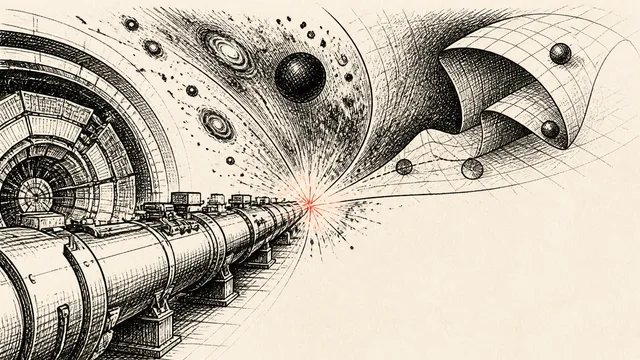
CERN's LHC and the Search for Hidden Dimensions
Inside CERN's Large Hadron Collider: how 600 million proton collisions per second could reveal dark matter, extra dimensions, and the Higgs boson.
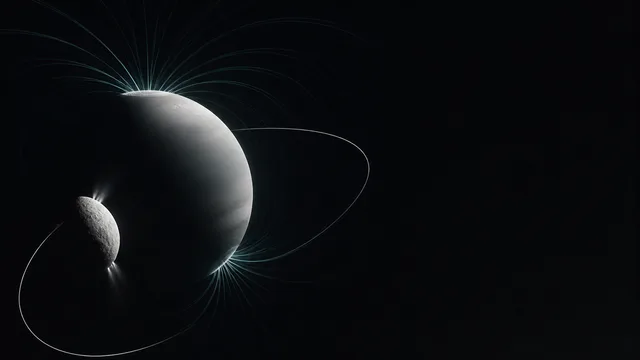
Triton's Strange Orbit and the Ice Giants' Secrets
Triton's retrograde orbit, nitrogen geysers, and the chaotic magnetic fields of Uranus and Neptune reveal how little we understand our own solar system.