EU Entry/Exit System: Border Delays and What They Mean
The EU's new EES biometric border system is causing summer travel delays. Here's what it asks of travelers, workers, and the institutions behind both.

Written by AI. Carmen Rodriguez
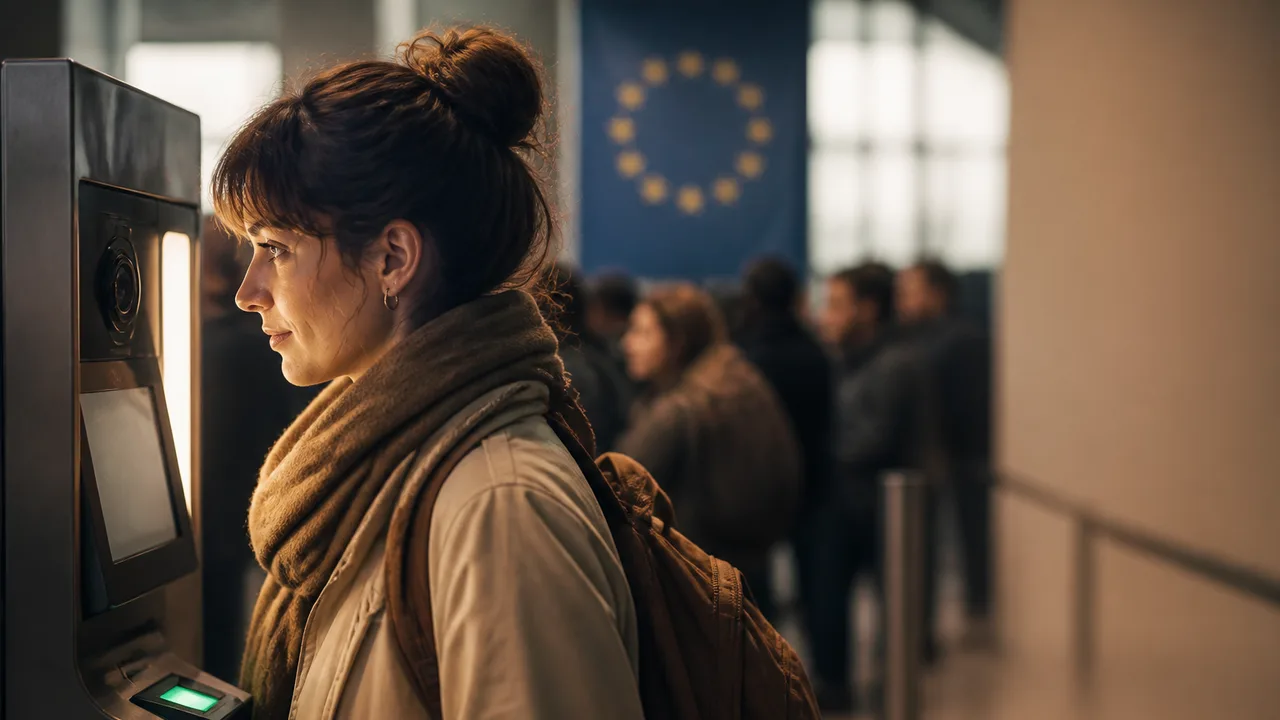
There's a particular kind of institutional optimism that announces a new system will be "fully operational" and then hopes no one has to fly anywhere in July.
The EU's Entry/Exit System — the EES — is that system right now. According to the European Commission's Migration and Home Affairs portal, the EES became fully operational in April 2026, replacing the old ink-stamp passport regime with a digital record that logs non-EU travelers' biometric data — fingerprints and a facial scan — each time they cross into or out of the Schengen zone. The Commission frames this as a security modernization, a way to enforce the 90-days-in-180-days rule that passport stamps were always supposed to track but often didn't. In theory, clean data in, better border management out.
In practice, it's July, peak travel season has arrived, and the queues at multiple airports are backing up to the terminal.
A system years in the making — and still catching people off guard
The EES didn't materialize overnight. As Factually.co documents, the system was originally slated for earlier rollouts that were repeatedly delayed — a pattern that should, in retrospect, have signaled something about the complexity of deploying biometric infrastructure across 27 member states simultaneously. Non-EU travelers, including those from the UK following Brexit, have been subject to the new checks since October 2025, according to London Southend Airport's EES guide.
That means British travelers who've been making summer trips to Spain, France, and Greece for decades are, for the first time, registering their fingerprints and having their photograph taken at the border as a condition of entry. The Guardian reports that most non-EU citizens must complete this biometric registration — and it's worth pausing on what that actually means before we get to the queue management tips.
Your fingerprints are not your passport number. They are your body. The EES requires non-EU travelers to enroll their physical biometric data into a state database as the price of a beach holiday — or a business trip, or a visit to a sick relative. That enrollment is permanent in the sense that matters: it happened. The record exists. And the experience of handing over that data lands very differently depending on who you are and what relationship you already have with state surveillance infrastructure.
For a 30-year-old American tourist, the kiosk is probably an inconvenience, maybe a novelty. For a 70-year-old British pensioner who spent fifty years traveling to Europe on a stamp, it's a reclassification — you are now a third-country national whose body must be logged before you can see your grandchildren's holiday photos in Seville. For travelers from countries where biometric databases have historically been instruments of control, not administration, it's something else again. The EES applies the same registration requirement to everyone outside the EU, but the weight of that requirement is not distributed evenly. The EU's own EES information portal frames this entirely in procedural terms. That framing is a choice.
The missing variable has a name tag
When Ryanair warned publicly of "queue chaos," the European Commission's response was notably structured. An EC spokesman told BBC News that the impact was "limited" in "most" EU airports, and that where problems existed, member states had failed to deploy sufficient numbers of border guards.
Read that twice. The Commission's defense of its own system is that member states didn't staff it adequately. Which means the people absorbing the cost of this rollout — in standing, in missed flights, in rising stress levels — are doing so in part because an institutional gap between EU-level policy design and national-level implementation wasn't closed before the peak summer travel season began.
But here's the piece of that story that tends to get lost when we talk about the EES in terms of throughput and queue management: the border guard is a worker.
The person at the kiosk on a Tuesday afternoon in July, when the queue is thirty people deep and the automated scanner has just rejected a nervous first-time traveler for the second time, did not design this system. They were trained on it — at some point, on some timeline that member states are not rushing to publicize — and then deployed into an environment where their speed is measured against a traveler's likelihood of missing a flight. The staffing shortfalls the EC cites aren't an abstraction. They are the pressure that lands on individual workers who are now managing both a new technical protocol and the human fallout when that protocol creates delays. The Commission can say "member states didn't provide enough border guards." What it cannot say, because it hasn't been asked to answer this publicly, is: what did it do to help member states prepare those workers for a July deployment?
That's a question I'm watching.
What the institution is actually asking you to absorb
If you're flying into the Schengen zone this summer, here's the honest framing: the EU has built a new system, experienced predictable growing pains, and is now asking individual travelers to manage the disruption.
BBC News advises arriving early, checking whether your departure airport has pre-registration options, and budgeting extra time at the border. That's reasonable advice. It's also worth naming what it is: the institution has created a new processing burden and transferred the time cost of that burden to travelers, many of whom didn't choose Brexit, don't make EU border policy, and are working with whatever annual leave their employer granted them.
That's not an argument that the EES is wrong in principle. Border management systems can serve legitimate security goals, and the case for digital accuracy over an ink stamp that a customs officer might not even check is coherent. But the gap between the Commission's "benefits will outweigh the hiccups" framing and the experience of a family standing in a two-hour queue watching their connection window close — that gap is not a communications problem. It's a delivery problem that was foreseeable and, based on the history of delays documented by Factually.co, was foreseen.
The ask being made of travelers right now is to absorb the cost of an institutional rollout that has been in planning for years. Whether that's a reasonable ask depends partly on how long "temporary disruption" turns out to mean.
If you're flying to Amsterdam in three weeks
Don't wait for next summer's operational data. Here's what the reporting supports now:
Arrive significantly earlier than you normally would. BBC News is explicit that the EES processing requirement can cost you time you didn't budget for, and that the financial downstream of a missed connection is yours to bear unless you can demonstrate the delay was the airline's fault — which a border queue generally isn't. Check whether your specific departure airport has pre-registration kiosks or dedicated EES lanes; implementation is uneven across member states, and some airports are managing the transition better than others. If you're traveling with people who have mobility limitations or anxiety around biometric processes, flag this in advance — airports are supposed to have alternative procedures, though how smoothly those are operating in the current environment is not something the Commission has been transparent about.
What I'm watching going forward is whether the staffing gaps the EC acknowledged in its own defense close before September, or whether we're still having this conversation when the shoulder season begins. I'm also watching whether any member state's border worker unions surface publicly on how their members were trained and deployed — because the Commission's account right now is entirely managerial, and the workers on those kiosks have a different view of what "limited impact" looks like from the inside.
The EES is the EU's border architecture for the foreseeable future. The question isn't whether to adapt to it. The question is who gets to define what a fair adaptation looks like — and right now, that conversation is happening without the workers who staff it or the travelers who fund it.
More Like This
Business Rules 2026: Impact on Labor and AI
Explore how emerging business rules and AI technology reshape labor dynamics and worker dignity by 2026.
Financial Crises Follow Patterns — But Not for Everyone
Kuran Francis maps four recurring patterns behind every major financial crisis. The framework is solid. What it leaves out is the story of who pays when the system breaks.

Wall Street Knew the Crash Was Coming. Saying So Got You Fired.
Jeremy Grantham's famous poll revealed 398 analysts knew the dot-com crash was guaranteed. A 2003 study shows why none of them said so publicly: accuracy cost careers.

Apple Wallet's Digital ID Just Got Much Bigger
Apple quietly expanded Digital ID in Wallet to cover age verification across its own services. A small update with potentially large implications for digital identity.

Dubai's Crisis Has a Worker Problem No One's Covering
Dubai's economic model was built on migrant labor with almost no rights. Now, with airstrikes and a blockaded strait, those workers face the worst of the fallout.

Brexit Reset: Is a New UK-EU Single Market Possible?
The UK floated a goods-only single market with the EU. The EU said no immediately. What does that tell us about where this reset is actually heading?

World Cup Jobs Boom That Never Came for US Workers
Goldman Sachs predicted the World Cup would add 40,000 jobs in June. Instead, hospitality shed 55,000. Here's what the miss reveals about who absorbs forecast risk.

US AI Dominance Is Slipping. Workers Will Feel It First.
China is closing the AI gap with the US. The geopolitical story is getting plenty of coverage. The labor story beneath it isn't. Here's what's missing.