European Train Travel Etiquette Every Tourist Should Know
From seat reservations to strike days, here's what experienced rail travelers know about navigating Europe's train systems without friction.

Written by AI. Mariel Fontaine
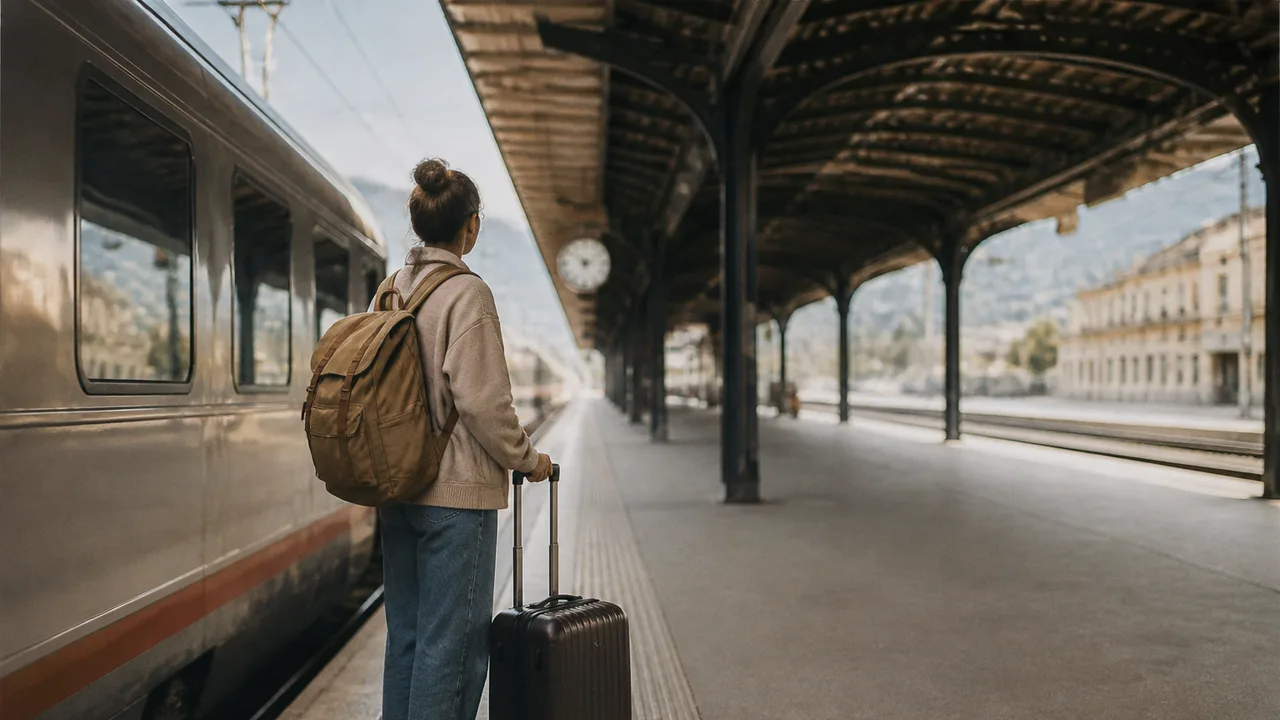
Photo: AI. Marcel Dubois
There is a German expression — Ich verstehe nur Bahnhof — that translates roughly as "I only understand train station." It's used to mean the opposite: when someone is utterly lost, when nothing makes sense, when the world has become noise. The irony is that European train stations, for a first-time visitor, can produce exactly that sensation. Departure boards scrolling in 24-hour time. Platforms that change without announcement. Conductors who are not, as Mark Wolters puts it in a recent Wolters World video filmed in Antwerp, "customer service."
Wolters has spent years riding European rails as an American traveler and travel educator, and his video on the unwritten rules of European train travel is a useful corrective to the romanticized version most people carry in their heads — the one with wine, countryside views, and effortless continental gliding. That version exists. It just requires knowing the rules of the game first.
The System Assumes You Already Know
The foundational premise of European train culture, Wolters argues, is that the infrastructure was not designed with tourists in mind. It was designed for people who use it every day. That sounds obvious, but its implications ripple through everything.
Departure time is not arrival-at-platform time. It is the moment the train moves. If your train leaves at 17:09, you should already be seated, ideally knowing which wagon your reserved seat is in. The information desks exist, but they're not oriented toward hand-holding — they're oriented toward resolving genuine exceptions. Showing up five minutes before departure with a basic question is not an exception; it's a planning failure, and the system will treat it as one.
This is not a complaint about European rail culture, though it can feel like one in the moment. It's simply a different operating assumption than what many North American or first-time international travelers carry. Airports have evolved around the confused traveler. Train stations, by and large, have not. The adjustment required is mostly attitudinal: arrive earlier than you think you need to, consult the yellow departure boards, and do your homework before you get there rather than hoping someone will do it for you at the platform.
Your Luggage, Your Problem
The luggage question is where the gap between airport travel and train travel becomes physically apparent. There are no porters. Steps onto trains can be steep. Overhead bins vary wildly by train type — a French TGV offers considerably more storage than a regional TER, and an Italian Regionale connecting Florence to Pisa or Lucca may offer essentially none. Elevators exist at some stations, are out of service at others, and are entirely absent at many smaller stops.
Wolters is direct about what he observes: "That's a big mistake I see people make when they travel in Europe. They bring these big huge suitcases and you have to realize there's not a lot of space in those trains sometimes."
Packing light is not a lifestyle philosophy here; it's infrastructure compliance. A 28-inch hardshell that rolls effortlessly through an airport becomes an obstacle course the moment you're navigating a narrow train aisle on a busy Friday afternoon, looking for overhead space that doesn't exist.
This matters at the booking stage too. Not all trains labeled as departing at similar times are equivalent in journey time — an earlier departure on a regional service that stops at every village between two cities can arrive hours after a faster intercity train that left later. Checking both departure and arrival times when booking is elementary, but easy to miss when you're focused on finding the cheapest fare.
The Ticket Question
Wolters makes a useful distinction between the long ticket counter queue — reserved for complex, multi-country bookings and the patient — and the self-service kiosks, which handle most single-country journeys in English at the push of a button. The queue is not for impulse purchases. Joining it twenty minutes before your train leaves is a way to miss your train while standing still.
The more contemporary answer is the operator's own app: Deutsche Bahn in Germany, Trenitalia in Italy, SNCF in France. These aren't just convenience tools; they're the most direct pipeline to your ticket as a QR code, your timetable, and real-time updates on the one piece of information that matters most when you're sprinting to a platform: whether anything has changed.
Early booking on European rail, particularly for high-speed services, follows airline-style yield management. Wolters describes booking first-class family tickets in Italy a month in advance for the same price as same-day second-class fares — a significant spread. The tradeoff is flexibility; early-booked discounted tickets on most European operators are either non-refundable or expensive to change. The calculus depends on how fixed your itinerary is.
Inside the Train
European public transit operates on a collective norm of quiet that feels strict to visitors from cultures where casual conversation on transit is unremarkable. Quiet cars exist, clearly marked, with near-total silence expected — in Finland, Wolters notes, trains have designated phone booths so passengers can take calls without disturbing the carriage. Even outside quiet zones, keeping voices down is the baseline expectation, not a special consideration.
Food on trains is permitted, but the unspoken rule is that strong-smelling food is not. Wolters frames it with good humor — "we all love our blue cheese from France. The Roquefort is fantastic. But, please, for the love of goodness, do not bring stinky food onto the train" — but the underlying point is real. Enclosed spaces and pungent food are a combination that will earn you very European expressions of displeasure.
Seat reservations introduce their own friction. On many European services, particularly intercity trains, seat reservation is separate from the ticket itself — you can have a valid ticket and still have no guaranteed seat. And even with a reservation, you may find someone sitting in your assigned spot. This is common enough that Wolters treats it as routine rather than exceptional. The process: show your reservation, ask them to move, and if they resist, find the conductor. What you should not do is occupy the seat in dispute without evidence of your reservation — the conductor's authority runs in the direction of paperwork.
Wolters also flags the conductor role specifically, and it's worth underlining: "They are not customer service. They're not there to like make you happy. They're there to check tickets and make sure people are following the rules." For travelers accustomed to airline staff who are trained to smooth over problems with apologies and upgrades, this can feel brusque. It isn't hostility; it's a different job description.
The Variables Nobody Prints on the Ticket
Two factors sit outside the traveler's control but reward awareness.
The first is the EuroCity (EC) train network — cross-border services connecting major cities across multiple countries. Wolters is blunt: they run late, and the more borders they cross, the later they tend to get. This is partly a coordination problem across different national rail systems, each with its own infrastructure, scheduling logic, and delay management. If your connection depends on an EC train arriving on time, build margin.
The second is labor action. Rail strikes are a legitimate and recurring feature of European transport across Germany, Italy, France, Spain, Portugal, and the UK. Unlike the surprise disruptions that characterize weather delays, European industrial action is typically announced weeks in advance, and booking platforms often flag planned strikes at the time of purchase. Wolters describes adjusting departure dates around known strike windows — leaving a city early to reach the next destination before service is suspended. The information is available; the discipline is in actually checking for it before finalizing plans.
Station security is also worth a note. Wolters points to train stations and the transition points between mainline rail and urban metro as environments with elevated pickpocket activity — specifically because people are distracted, burdened with luggage, and focused on not missing their connection. Awareness is not paranoia; it's appropriate attention calibration in a busy public space.
What the System Is, Not What You Wish It Were
None of this should put anyone off European rail. The network is genuinely remarkable — the ability to board in Antwerp and step off in Amsterdam, Paris, or Cologne with no security theater, no checked bags, and often faster city-center to city-center times than the equivalent flight, remains one of the more civilized ways to move between places.
But the traveler who arrives expecting the system to accommodate their unfamiliarity will have a harder time than the traveler who spends thirty minutes before departure understanding how it works. The unwritten rules Wolters catalogs are, in aggregate, one idea: European trains are public infrastructure, not hospitality products. They work well when you work with them.
Whether that distinction requires adaptation or represents something worth adopting more broadly is a question worth sitting with on your next journey — preferably in a quiet car, with no Roquefort in your bag.
More Like This
Casa del Desierto: Barstow's Forgotten Harvey House
Barstow's Casa del Desierto is a stunning 1911 Harvey House in the Mojave Desert—and one of America's least-visited Amtrak stations. Here's why it still matters.
The Transcontinental Railroad's Forgotten Price Tag
The golden spike ceremony hid a messier truth: fraud, erasure, and collapse. Here's the full accounting of what America's railroad actually cost.
The 30-Second Hotel Safety Check You're Not Doing
A quick hotel room safety check—doors, locks, windows, exits—could prevent theft or worse. Here's what travel creator Mark Wolters says to do first.
What Poles Actually Want Tourists to Know
From geography to drinking etiquette, here's what Polish locals wish visitors understood before arriving—and why it matters more than you think.

Learning Local Culture Without Setting Foot in a Museum
From grocery stores to barbershops, Mark Wolters argues everyday spaces teach travelers more about a culture than any museum ever could. He makes a strong case.
What to Expect When Staying in European Hotels
European hotels operate by different rules than North American ones. Here's what actually differs—room size, beds, breakfast pricing, accessibility, and more.

Japan Airlines Domestic Flying: Haneda to Sapporo
JAL's Haneda–Sapporo route carries 12 million seats a year. Here's what flying it—and touring JAL's maintenance hangars—actually looks like.
How to Protect Yourself From Pickpockets in Europe
Practical, unsentimental advice on avoiding pickpockets in Europe—how thieves actually work, where they target tourists, and what you can do about it.