Wall Street Knew the Crash Was Coming. Saying So Got You Fired.
Jeremy Grantham's famous poll revealed 398 analysts knew the dot-com crash was guaranteed. A 2003 study shows why none of them said so publicly: accuracy cost careers.

Written by AI. Carmen Rodriguez
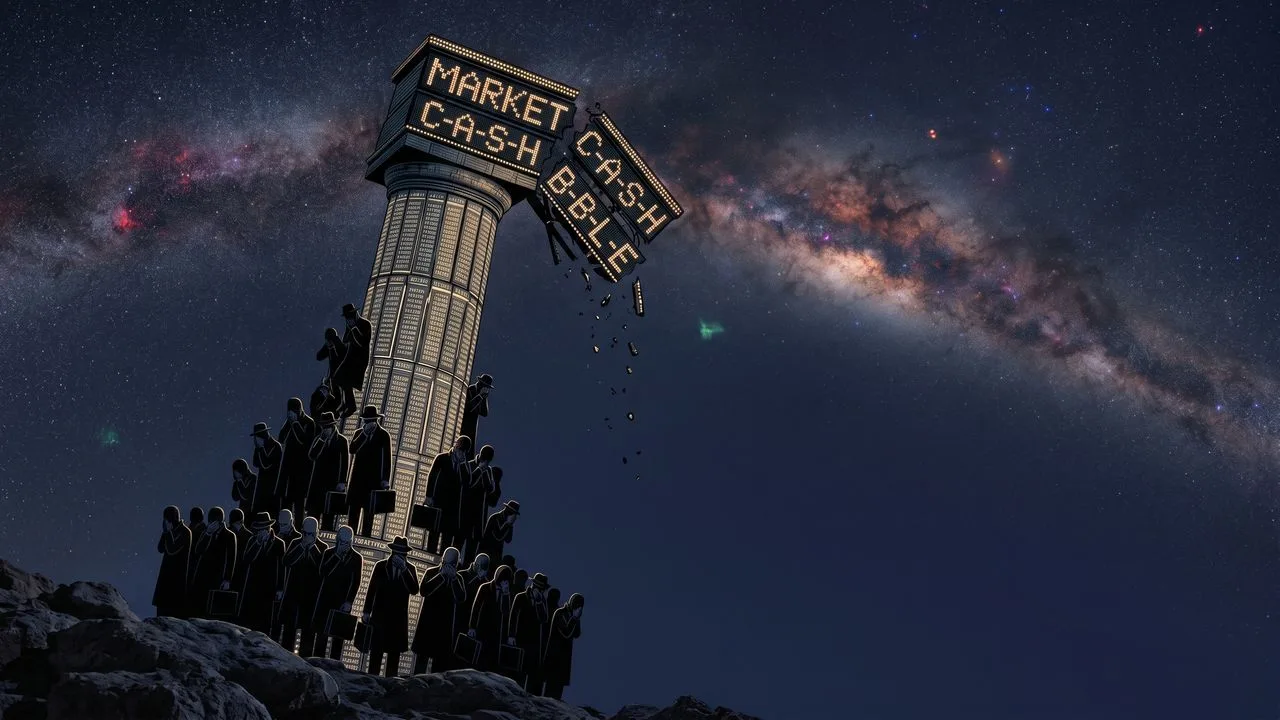
Photo: AI. Castor Belov
At the annual meeting of the Financial Analyst Society — CFA charterholders, portfolio managers, quants, the most credentialed room in American finance — Jeremy Grantham asked 400 institutional investors two questions. First: if the market's price-to-earnings ratio drops from 31 to 17 at any point in the next decade, does that guarantee a major bear market? Every hand went up. Second: how many of you think it will drop? Grantham was so shocked by what he saw that he rephrased the question three times. Both times, the answer was the same. Only two people in that room — two out of 400 — believed the PE ratio would hold.
The other 398 went back to their desks at Goldman Sachs and JP Morgan and Morgan Stanley and said nothing. Their bosses went on television and told you everything was fine.
That's not a remarkable story about the dot-com bubble. It's a precise description of how the labor market in finance functions. And Harrison Hong and Jeffrey Kubik documented it with the kind of rigor that should have made it front-page news in 2003 when it was published in the Journal of Finance — Hong then at Princeton, Kubik at Syracuse.
What they found: analysts who made accurate but unpopular calls — who told the truth when the truth was that the market was overvalued — got punished. Reassigned to smaller, less visible stocks. Quietly let go. Meanwhile, analysts who stayed optimistic, who kept their buy ratings even as their private models were screaming overvaluation, got promoted. Even when they were wrong. Especially when they were wrong with everyone else.
Think about what that means as a workplace dynamic. You are a research analyst. You have done your homework. The data in front of you says the market is heading for a wall. You know it. Your colleagues know it — 398 of them raised their hand in that room. You write up your findings. You show your work. And then you face a choice that has nothing to do with the quality of your analysis: say what you know and watch your career dissolve, or keep your mouth shut, update the buy rating, and collect your bonus.
Grantham describes the logic with characteristic precision: "If you have a large organization, you will typically be led by someone with substantial political skills. And if you have political skills, you understand Keynes in chapter 12 — never be wrong on your own. Just make sure that all your mistakes have plenty of company, and you'll do fine."
The analysts who got fired for accurate calls weren't rogue employees or troublemakers. They were doing their jobs. The system fired them for it.
At the peak of the dot-com bubble in mid-2000, 74% of all Wall Street analyst ratings were buys. Two percent were sells. For every analyst willing to say get out, there were 37 saying buy more. That ratio didn't emerge from stupidity or genuine optimism. It emerged from a structure that made honesty professionally fatal. Post-Eliot Spitzer reforms in the early 2000s shifted some of those numbers, but the underlying incentive architecture — analyst compensation tied to investment banking relationships, career advancement rewarded by consensus rather than accuracy — didn't disappear. It adapted.
The people who trusted those 37-to-1 buy ratings were not hedge funds managing other people's risk. They were pension funds. They were retail investors. They were the Gen X workers who'd finally gotten serious about their 401(k)s in the late 1990s and were watching their balances climb and thinking maybe this time the wealth would stick. When the S&P fell 49% between 2000 and 2003, when the Nasdaq fell 78%, those losses landed on real people's retirements, real families' savings, real plans that got deferred or abandoned. The analysts who kept the buy ratings couldn't act on what they knew. Their clients had no idea there was anything to act on.
Chuck Prince, CEO of one of the largest banks in the world in July 2007, sat down with the Financial Times and said out loud: "As long as the music is playing, you've got to get up and dance. We're still dancing." He used Grantham's exact metaphor — not because he'd read Grantham, but because it's the only honest way to describe the dynamic from the inside. Prince had access to every piece of data Citigroup produced. He knew the subprime exposure. He said so, in metaphor, on the record, to a major newspaper, and kept going anyway.
Four months later, Prince was forced out. Citi stock went from $55 to under a dollar by March 2009. Prince left with an exit package that, by various accounts, aggregated into the range of tens of millions of dollars when deferred compensation and pension values were included — the precise figures were contested at the time. The shareholders who lost 98 cents on every dollar of their Citi holdings were not mostly wealthy speculators. They were pension funds — teachers, municipal workers, transit workers — and retail investors who had listened to the buy ratings and stayed in.
No one went to prison. The next Citigroup CEO kept dancing because the music hadn't stopped yet and the structural logic hadn't changed.
Grantham's case against the current market rests on the Shiller CAPE ratio — the cyclically adjusted price-to-earnings measure that smooths out a decade of earnings to filter short-term noise. As of February 2026 (a snapshot, not necessarily current), it sat at approximately 40, the second-highest reading in 140 years of data. The only higher reading was December 1999 at 44.
The strongest counterargument is genuine, not dismissive. Jeremy Siegel — the Wharton professor who debated Grantham at that same financial analyst society meeting — has argued for years that today's S&P 500 is structurally different from 2000's. Apple generates over $100 billion in annual profit. Microsoft's cloud margins run north of 40%. These are not pets.com. Strip the Magnificent Seven out of the index and the CAPE drops to around 33 — still elevated, but well below the levels Grantham cites. Howard Marks has made a similar case: the best businesses in the world deserve to trade at a premium to historical averages.
That tension is real and unresolved. What Grantham adds to it is the question of who is making that case and why. The analysts in the engine room — the ones who raised their hands — have access to the earnings models, the AI CapEx burn rates, the credit spreads, the breadth data. The hyperscalers spent nearly $300 billion on AI capital expenditure in 2025, roughly 1.3% of total U.S. GDP, with revenue projections from private companies like OpenAI that are based on leaked internal documents and analyst estimates rather than audited figures. The gap between that spending and demonstrated returns is a legitimate variable in any honest valuation. Whether it's showing up in the private models while the public ratings stay bullish is the question Grantham's framework asks you to hold.
The market concentration tells part of the story. As of early 2026, ten stocks account for 40% of the entire S&P 500. The Magnificent Seven make up nearly a third. When that much index weight sits in that few names, earnings disappointment in two or three of them moves the whole index regardless of what the other 493 are doing. Grantham was early before — GMO lost a third of its assets under management in the late 1990s because clients couldn't wait for a crash that kept not arriving. Being right about the destination while being wrong about the departure time is how the system punishes the honest analysts and the cautious managers simultaneously.
The mechanism Grantham describes isn't a conspiracy. It doesn't require anyone to lie in the sense of consciously deceiving. It requires only that the people who know the truth face a job market where saying so gets you reassigned or fired, and the people who reach your television set face institutional incentives that reward the story over the analysis.
"At turning points, the authorities are nearly always wrong," Grantham says. "And I don't think it's a bug. I think it's part of the system."
The 398 are almost certainly in a room somewhere right now. Whether they're raising their hands is the question nobody in their organizations wants them to answer out loud.
More Like This
Business Rules 2026: Impact on Labor and AI
Explore how emerging business rules and AI technology reshape labor dynamics and worker dignity by 2026.
Bill Ackman's Art of Finding Invisible Money
Explore Bill Ackman's strategy of finding hidden value in companies, beyond standard metrics.
Opus 4.7 Drops Amid Molotov Cocktails and AI Fear
Anthropic's Opus 4.7 launches as a 20-year-old throws a Molotov cocktail at Sam Altman's house. The AI world is splitting in two—and it's getting violent.
GoFundMe's CPTO on Marketplace Failure & AI Growth
GoFundMe's CPTO Arnie Katz breaks down 3 marketplace failure modes and how AI agents are driving real revenue—not just dev productivity.

Lloyd Blankfein's Risk Rules Work on Main Street Too
Lloyd Blankfein's frameworks on crisis management, contingency planning, and AI risk translate directly to small business — if you know where to look.

Why Too Many Choices Make You Worse at Everything
Behavioral economics has known for decades that unlimited choice backfires. David Epstein's new book explains why—and who benefits from pretending otherwise.

Arq's $1.4M Quantum Bet and the Workers Inside It
Arq raised $1.4M to build quantum internet hardware. The funding story is easy. The labor story—who takes that job—is the one worth reading.

Apollo's EasyJet Buyout: What It Means for Workers
Apollo's £5.7bn EasyJet takeover is a win for shareholders. For cabin crew and ground staff across Europe, the calculus is far more complicated.