Apple Wallet's Digital ID Just Got Much Bigger
Apple quietly expanded Digital ID in Wallet to cover age verification across its own services. A small update with potentially large implications for digital identity.

Written by AI. Dev Kapoor
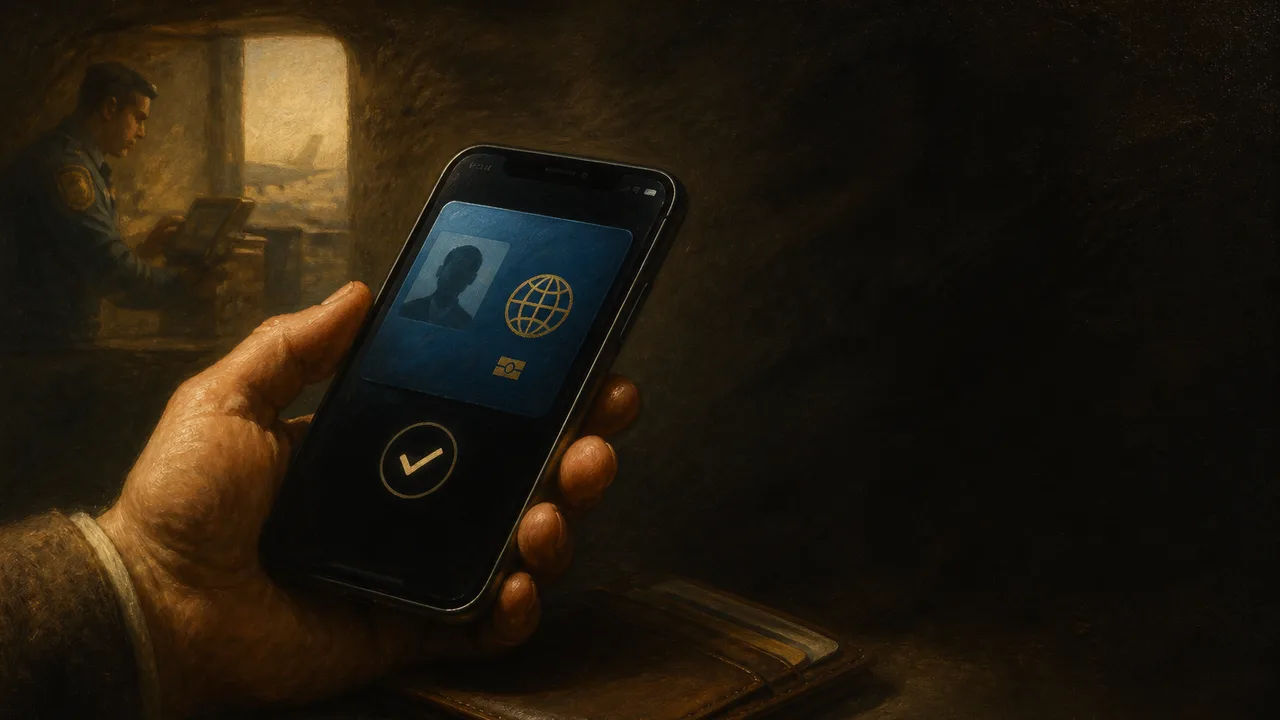
Photo: AI. Henrik Solberg
Digital identity has always had a coordination problem. Getting governments, companies, and users to agree on a single way to prove you are you is one of those problems that looks deceptively simple until you watch three or four years of state-by-state driver's license rollouts produce fewer than twenty participating states. Legislation moves at the speed of committee meetings. Tech moves faster than that. The gap between them is where Apple quietly planted a flag.
Apple's Digital ID, introduced with iOS 26 as what 9to5Mac's Fernando describes as "a stop gap" for the states still not supporting digital driver's licenses in Wallet, just got a notable expansion. A few weeks ago, Apple updated its support documentation to confirm that Digital ID can now be used for age verification across Apple's own services—creating new Apple accounts, downloading age-restricted apps, adjusting certain safety settings, and in some cases updating software. It's a narrow expansion, but the architecture it suggests is not narrow at all.
What It Actually Is, and How It Works
Digital ID is passport-based, not DMV-dependent. You open Apple Wallet, tap the plus sign, navigate to driver's license and ID cards, select Digital ID, and then go through a multi-step verification process that is—genuinely—more rigorous than most people will expect.
First, you scan the passport's photo page. Then the app asks you to find the NFC chip embedded in the back cover and physically place your iPhone against it—so the phone is reading the chip directly, not just processing an image. Then comes a live photo requirement. The system captures video, not just a still, and runs movement prompts to confirm you're a living person and not someone holding up a photo. Face ID gets pulled in somewhere in that process too. The whole thing ends with a "verification in progress" status and a notification promised when the check completes.
Fernando walked through the setup live on camera, admitting he hadn't done it before filming. His passport photo—taken when he had different hair and no facial hair—made the live verification step more dramatic than usual. He got through it, eventually, with "additional verification required" prompts along the way. It's not frictionless. But it's not supposed to be; the friction is the security model.
Apple says over 250 US airports support Digital ID for TSA domestic travel. The feature has been around long enough that real-world TSA use should be generating user reports—though firsthand accounts from people who've actually used it at a checkpoint still seem scarce enough that Fernando explicitly asked his audience to report back.
The Privacy Pitch Is the Interesting Part
Here's where the framing gets more substantive. The standard age verification experience online involves uploading a photo of your ID or passport directly to a third-party service—a bank, an age-gated platform, a car rental company. You hand over the image. You trust them to store and handle it responsibly. You mostly have no idea whether they do.
Digital ID breaks that chain. As Fernando explains it: "Apple now acts as a middleman with that digital ID. So you aren't uploading your verification information... the third party is not getting that actual image of your passport, which is huge from a privacy standpoint."
The model is closer to how OAuth works for login—you authenticate with a trusted intermediary (Apple, in this case) and the downstream service gets confirmation, not credentials. That's a meaningfully different data flow than the current status quo. Whether Apple's privacy posture is genuinely trustworthy, or whether concentrating identity verification in a single platform creates its own risks, are both legitimate questions—but the technical model itself addresses a real problem.
The open question is what "trusted middleman" costs at scale. Apple gets more embedded in the identity layer of everyday digital life. That's useful for users navigating age restrictions and account creation. It's also a significant expansion of Apple's role as infrastructure—not just for its own ecosystem, but eventually for third parties.
The Regulatory Tailwind Is Real
This isn't happening in a vacuum. The UK's Online Safety Act has put real legal teeth behind age verification requirements for online platforms. Discord has faced sustained criticism over minors misrepresenting their ages to access adult communities. Several US states have passed or are considering legislation requiring age gates on social media platforms and adult content sites.
All of that creates demand for a verification mechanism that doesn't require every individual platform to build its own identity infrastructure from scratch. Apple has the device footprint (over a billion active iPhones globally), the biometric capability, the NFC hardware, and—at least by reputation—a privacy-forward brand. Fernando's read is that Apple is "positioning themselves to take all that security and trust that they have from their user base" and become the identity layer that everything else plugs into.
That's a plausible trajectory. It's also a description of significant market power over digital identity, which has historically been the kind of thing that eventually draws regulatory interest. The EU's Digital Markets Act has already forced Apple to open certain ecosystems; it's worth watching whether a dominant identity intermediary role invites similar scrutiny.
The Slow-Motion Predecessor Problem
Digital driver's licenses in Apple Wallet were announced around 2021. As of now, fewer than twenty US states have implemented them. Each state requires its own integration agreement with Apple, its own technical implementation, its own legislation in some cases. Fernando calls it "painfully slow," and that's accurate.
Digital ID was designed to route around that slowness—using the federal passport infrastructure instead of the state DMV patchwork. That's clever, but it also means Digital ID is a US passport feature, not a universal one. Users without passports, which skews toward lower-income populations and infrequent travelers, can't participate. The 250-airport TSA support sounds impressive until you consider that not everyone who flies domestically holds a valid passport.
The expansion to Apple services doesn't require a passport check at TSA—it's pulling from the already-verified Digital ID stored in Wallet—but the passport requirement at enrollment is still the gatekeeping mechanism. That's a meaningful demographic constraint on a feature being positioned as a broad solution to age verification.
What the Quiet Documentation Update Actually Signals
Apple didn't hold a press event for this. They updated a support document. That's a specific kind of signal—this is infrastructure being built out incrementally, not a product being launched. The practical current use cases (Apple account creation, age-restricted app downloads, safety settings) are modest. The implied future use cases—car rentals, hotel bookings, healthcare, banking—are where the real stakes live.
For that future to materialize, third-party adoption has to happen. App developers need APIs, banks need legal review, hotels need point-of-sale integration. None of that is trivial. The history of Apple Wallet features is littered with capabilities that launched big and integrated slowly: transit cards, keys, loyalty programs. Digital ID may follow the same arc.
What's different this time is the external regulatory pressure. Platforms in the UK, EU, and increasingly the US don't have the luxury of waiting for organic adoption curves. Age verification mandates create procurement demand that didn't exist before. Apple's system may land in a market that's actively looking for it.
The setup is technically interesting. The privacy architecture is genuinely novel compared to the upload-your-passport status quo. The governance questions—about concentration, about access, about what happens when Apple's identity infrastructure goes down or gets it wrong—aren't questions anyone is prominently asking yet.
They probably should be.
More Like This

Baseus Nomos 140W: The Charger That Gets Standards Right
The Baseus Nomos isn't just a good charger—it's a case study in what happens when open standards win. Dev Kapoor on the $70 hub that earns its desk space.
Anthropic's Computer Control: What the Tech Actually Does
Anthropic's Claude can now control your entire computer through Dispatch. A look at how the permissions work, what it can do, and what it can't.
iPhone 18 Pro: Six Upgrades That Actually Matter
Leaked specs paint the iPhone 18 Pro as a year of internal gains over flashy redesign. Here's what the rumors actually mean for you.
Apple's 2026 Innovations: A New Era for Dev Communities?
Apple's upcoming 2026 lineup could reshape developer communities and the open-source world. Explore what's next.
Apple Card's Chase Transition: What Actually Changes
Goldman Sachs is out, Chase is in for $19B. But the Apple Card's real problem isn't who issues it—it's whether it can evolve beyond its 2019 vision.
Unveiling Agent Skills in VS Code: A New Era in Workflow
Explore how Agent Skills in VS Code enhance productivity by enabling tailored workflows and automation.

Thinking Machines Launches Inkling, Its First Open-Weight AI Model
Mira Murati's Thinking Machines has released Inkling, an open-weight multimodal AI model built on DeepSeek's architecture—and the implications go well beyond benchmarks.

35 GitHub Projects Mapping the AI Agent Trust Gap
This week's GitHub trending list is less a catalog of tools and more a collective argument: developers don't fully trust AI agents yet—and they're building accordingly.