iPhone 18 Pro: Six Upgrades That Actually Matter
Leaked specs paint the iPhone 18 Pro as a year of internal gains over flashy redesign. Here's what the rumors actually mean for you.

Written by AI. Rachel "Rach" Kovacs
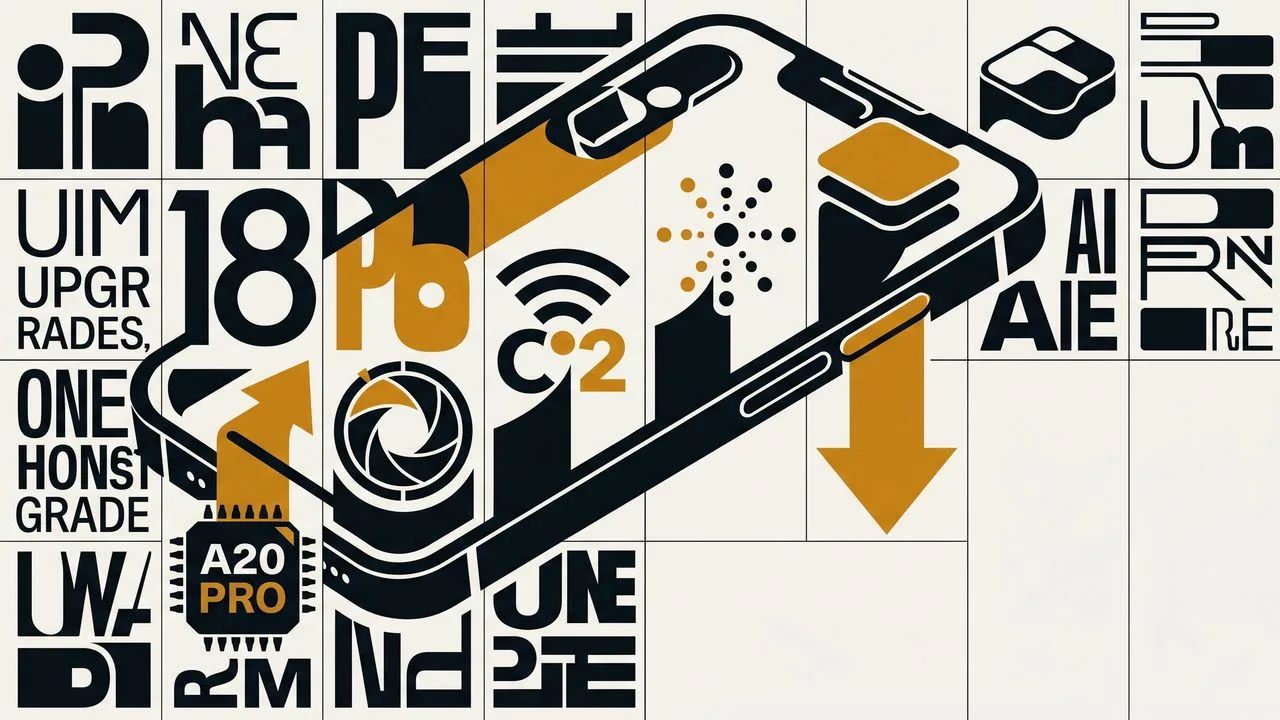
Photo: AI. Ondine Ferretti
Every iPhone fall cycle has a center of gravity, and this year it's clearly the rumored foldable. iPhone Fold coverage is eating the room. Which means the iPhone 18 Pro—the device that will almost certainly outsell it by a wide margin—is getting the B-plot treatment. That's backwards. Let me fix it.
Fernando from 9to5Mac laid out six meaningful spec changes coming to the 18 Pro and Pro Max in a recent video, and even without the pyrotechnics of a foldable debut, the list is more interesting than the current hype allocation suggests. Keep in mind: none of this is confirmed. We're deep in pre-announcement leak territory, which means treat these as informed speculation, not a spec sheet.
The screen gets a little more screen
The Dynamic Island is reportedly shrinking again. Not disappearing—it'll still be a pill shape—but smaller, because Apple is expected to move roughly half the Face ID sensor array under the display. More screen real estate follows naturally.
The under-display sensor transition is where I want to slow down, because the history here matters. Under-display fingerprint readers had a rough early run—optical sensors in particular were genuinely unreliable for years. Qualcomm's ultrasonic technology in Samsung flagships improved considerably faster, reaching daily-use reliability by 2020 or so. Apple is threading a different needle with Face ID rather than a fingerprint reader, but partial under-display placement still means betting on sensors performing through glass. Apple will have watched that entire maturation curve before shipping this. Whether they've solved it cleanly won't be clear until units are in actual hands, in actual lighting conditions.
The chip story is really an AI privacy story
Leaks point to an A20 Pro built on a 2nm process—which, if accurate, would be Apple's first chip at that node. Performance and efficiency gains at each process shrink are real and meaningful, so this would matter. But I want to flag that specific process node as unverified pre-announcement speculation. Apple hasn't confirmed it. Take it as a directional signal, not a data point.
What I find more structurally interesting than the benchmark headline is why this generation of chip gains matters specifically right now. Fernando frames it this way: "more and more people are trying to get on-device AI for privacy standpoint, for stability standpoint, for a quickness standpoint as well."
He's right, and from where I sit covering privacy, that framing deserves more weight than it usually gets in hardware coverage. The cloud AI model has a business logic problem that's starting to show: infrastructure costs are rising, pricing pressure is coming, and your queries are leaving your device by definition. A chip powerful enough to run capable AI models locally changes the threat surface entirely. Your assistant's outputs don't cross a network. They don't sit in a training pipeline. They don't get subpoenaed.
That's not a small thing. It's also not guaranteed by a chip upgrade alone—on-device AI requires Apple to build and ship models sized for local inference, which is a software and product commitment, not just a silicon one. But the hardware has to come first. If the 2nm A20 Pro leak holds, the 18 Pro would at least clear that prerequisite.
Variable aperture: genuinely new, genuinely uncertain
The camera upgrade getting the most attention is variable aperture—a mechanism that physically adjusts how much light the lens admits, rather than relying entirely on computational photography to compensate. This exists in some Android flagships already, but not at Apple's production volume, and not with Apple's image pipeline behind it.
Fernando is candid about the engineering tension: "It's all about physics, and these camera sensors are already very small. Adding a variable aperture in there, something that's constantly moving—more moving parts inside of it. Let's see what that ends up looking like."
Here's the thing about mechanical aperture systems in a phone-sized package: they're not just a physics puzzle, they're a long-term reliability question. A mechanical iris that works beautifully on day one has to keep working after a year of pocket heat cycles, the occasional drop, and the user who somehow always has sand near their phone. Smartphone camera modules have gotten impressively durable, but variable aperture adds a category of failure mode that fixed-aperture lenses don't have. Apple's supply chain and quality control are exceptional—but exceptional isn't invincible. The variable aperture question isn't just "can Apple build this?" It's "how does it hold up in year three?"
The iPhone Air rumor changes the Pro's identity
Current rumors also describe a forthcoming iPhone Air—a thinness-first model that, if it materializes, would take the design ambition Apple previously directed at the Pro line and redirect it entirely. That product hasn't been officially announced, so treat this as rumor-grade context. But if the Air rumor is accurate, it clarifies something about the Pro's direction: thicker chassis, larger battery, maximum capability over minimum profile.
Fernando reads this as Apple giving the Pro permission to be unapologetically beefy: a bigger battery becomes viable when you're not competing on millimeters. Silicon-carbon battery chemistry—which could further increase capacity in the same volume—is apparently still on hold while Apple watches the safety data mature. Reasonable. The history of novel battery chemistry in consumer electronics has enough cautionary chapters that caution here isn't conservatism, it's good engineering.
Camera Control: the quiet admission
The most honest signal in all of this might be what Apple is reportedly doing to Camera Control. Introduced with the iPhone 16 as a dedicated hardware shutter button, it landed with a thud for many users. Fernando doesn't sugarcoat it: "In my opinion, camera control has been a little bit of a failure. A great proof of concept... but in terms of actual usability, practicality, people don't even know what the camera control button really is."
The 18 Pro version is rumored to be scaled back—less functionality, possibly repositioned, possibly resized. That's a company acknowledging a misstep without deleting the evidence of it, which is about as close to a public admission as Apple ever gets. The button is staying because ripping it out a generation later would be its own story. Quietly making it less ambitious is the move.
I'd bet the Camera Control disappears by iPhone 20. This version is the graceful deprecation cycle.
The C2 modem and the Qualcomm divorce
Apple's in-house modem project is reportedly reaching its second generation with the C2, expected to ship in the 18 Pro. That framing—"expected"—is doing real work: this, too, is an anticipated spec based on leaks, not a confirmed announcement. The C1 shipped in the iPhone 16e; the C1X reportedly followed; the C2 would represent the next step in Apple owning the full silicon stack.
Why does this matter beyond the Qualcomm licensing fees? Modem efficiency has a direct battery life impact that most people never attribute correctly. When you're on 5G, the radio is a meaningful drain. Apple controlling that component means they can tune the power envelope in ways a third-party chip doesn't allow. The gains won't be dramatic enough to make headlines, but they accumulate into the "huh, my battery is holding up better" feeling that drives word-of-mouth.
Who this phone is actually for
If you're on an iPhone 17, the upgrade math is thin. Faster chip, smaller notch, potentially better camera in good light, a new color that's reportedly closer to burgundy than red—none of that is compelling unless one of those specifics solves a problem you're actually having.
If you're on a 15 or older, the accumulated delta across chip generations, camera systems, and modem efficiency makes the case more comfortably.
The broader pattern Fernando identifies is real: iPhones are good enough that most people are stretching upgrade cycles to four, five, six years, and Apple's continued software support makes that rational behavior. The security angle matters here specifically—staying on a supported OS with current patches is a defensible position. The 18 Pro isn't going to change that calculus for most people on recent hardware.
What it might change is the on-device AI story—and that's the thread I'll be watching most closely when actual units ship. The foldable will absorb the September attention. But if the 18 Pro quietly becomes the device where your AI assistant stops needing a data connection to function, that's a privacy shift worth more than any hinge.
More Like This
Apple's iPhone Fold: What Seven Years of Watching Taught Me
After covering foldables since Samsung's first attempt, Bob Reynolds examines what Apple's rumored iPhone Fold means for a market that's finally mature.
Apple's 2026 Lineup: From Foldables to AI Enhancements
Explore Apple's 2026 roadmap, featuring foldable iPhones, budget Macs, and AI-infused devices.
Apple's M5 Pro & Max Just Changed Everything About Chips
Apple's M5 Pro and Max use chiplets for the first time, ditching efficiency cores entirely. Here's what that means for performance and why it matters.
The Security Risks Hiding in Your $50,000 Desk Setup
A tech reviewer's decade-old workspace reveals what happens when premium gear outlives its security updates. The Mac Pro problem nobody wants to discuss.
Why Amazon Sells Apple Products Cheaper Than Apple Does
Apple never discounts its products, but Amazon routinely does. Here's what you gain—and what you actually lose—buying your MacBook or iPad from Amazon.
Apple's Touchscreen MacBook Reverses Steve Jobs' Vow
Rumors suggest Apple's M6 MacBook Pro will add touchscreen capability—contradicting Jobs' famous stance. What this means for the Mac-iPad divide.
Flock Safety Cameras: Crime Tool or Privacy Risk?
Flock Safety's license plate readers are spreading fast. Retired Microsoft engineer Dave Plummer breaks down what they actually capture—and what's at stake.

Why AI AppSec Needs Organizational Context to Work
AI finds more vulnerabilities than ever—but without organizational context, it still can't tell you which ones actually matter. Here's what that gap costs.