U.S. Customs Cash Rules: What Travelers Must Know
A $53,800 seizure at Fort Lauderdale Airport puts the $10,000 cash declaration rule back in focus. Here's what travelers actually need to know.

Written by AI. Kael Maddox
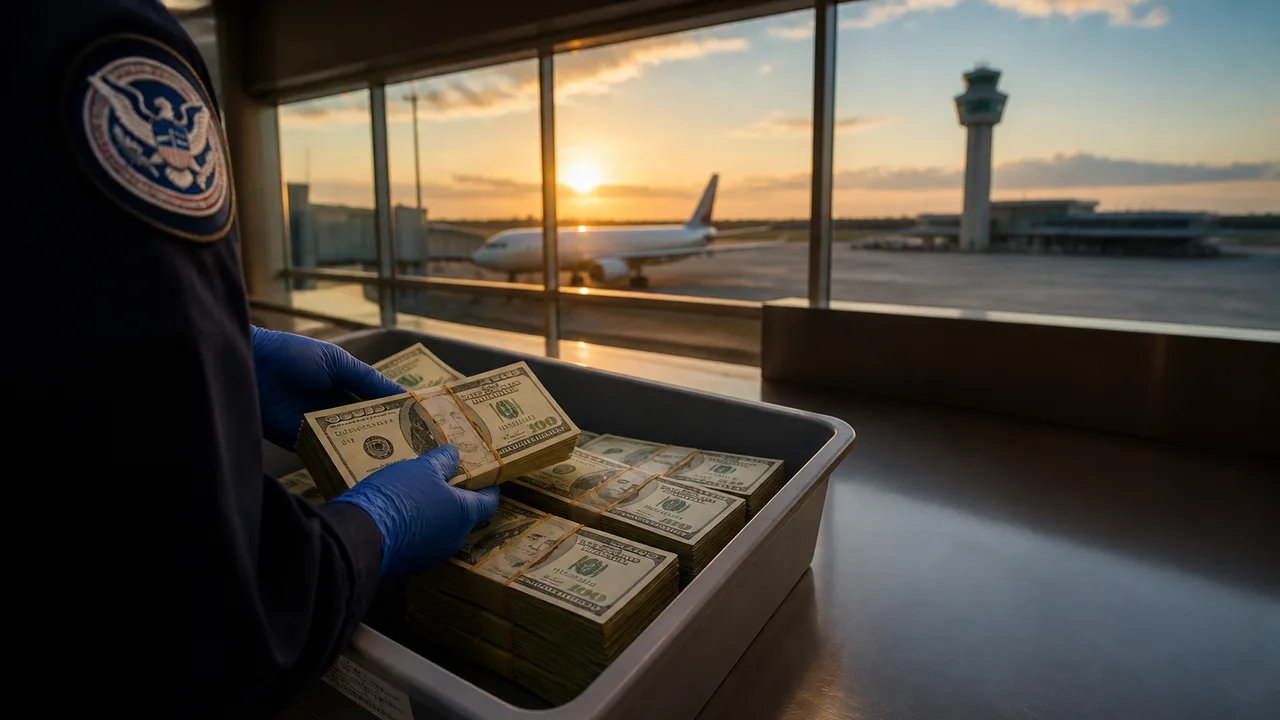
There are places in this world where cash isn't a preference — it's the only option. Markets in northern Nepal where the nearest ATM is a two-day walk and a failed card reader. Remote Patagonian villages where the word "Visa" produces a polite, confused shrug. If you travel seriously — not resort-seriously, but actually seriously — you learn to move money in physical form. You learn to think in thresholds.
The $10,000 threshold, specifically.
That number landed back in the headlines when U.S. Customs and Border Protection seized $53,800 in undeclared U.S. currency from a traveler at Fort Lauderdale–Hollywood International Airport. According to CBP's own press release, the traveler — bound for Kingston, Jamaica — initially declared he was not carrying currency. Officers found otherwise. Homeland Security Investigations responded to the scene. Federal prosecutors accepted money laundering charges.
It's a dramatic case. It's also, on its face, a fairly clear-cut one. But CBP used it as a public teaching moment, which suggests the agency thinks the lesson isn't landing broadly enough. They're probably right.
The Rule Is Simple. The Consequences Aren't.
Carrying cash across a U.S. border — either direction — isn't illegal. The law doesn't care how much money you have. It cares whether you tell the truth about it.
As the Sarasota Herald-Tribune explains, anyone carrying more than $10,000 in currency — or monetary instruments like money orders or traveler's checks — must report it to a CBP officer when entering or exiting the United States and complete Currency Reporting Form FinCEN 105. The $10,000 figure isn't a ceiling on what you can carry. It's a reporting trigger.
The gap between those two things is where travelers get destroyed.
View from the Wing noted that the Fort Lauderdale case is a reminder that the declaration requirement applies on departure as much as arrival — a detail that catches more people off guard than you'd expect. The instinct is to think of customs as something you face when you return, not when you leave. But the law doesn't observe that distinction.
What happens when you don't declare? The cash gets seized. Not temporarily held pending a fine. Seized — under civil asset forfeiture law, which means the government can keep your money without ever convicting you of a crime, as long as they can argue the funds are connected to illegal activity. In the Fort Lauderdale case, the traveler was also arrested and faces criminal money laundering charges, which makes this a harder case to sympathize with. But the civil forfeiture mechanism operates even in cases where the only apparent violation was the paperwork.
The Institute for Justice, a civil liberties law firm, has documented how significant this adds up to: CBP and other DHS agencies seized $500 million from air travelers over missing paperwork. Half a billion dollars. Mostly for failing to file a form.
What Declaration Actually Looks Like
I want to put you in the moment, because no government website does.
You're at the check-in counter or the customs checkpoint. An officer asks the standard questions. One of them is whether you're carrying more than $10,000 in currency. If you are, you say yes. You fill out the FinCEN 105 form — name, address, amount, source of the funds. The officer takes it. That's largely it, in the baseline scenario.
What the form doesn't protect you from is CBP's broader authority. The agency retains discretionary power to conduct secondary inspections regardless of whether you've declared. Filing the form correctly puts you on the right side of the law; it doesn't put you beyond scrutiny. That's worth understanding clearly: declaration is not a transaction that buys you a frictionless exit. It's the legal minimum.
The traveler in Fort Lauderdale didn't even get to that question honestly. According to CBP, he affirmatively declared he was not carrying currency — which takes this from a bureaucratic failure into something the agency could reasonably treat as an intentional lie. That distinction matters for how this case is being prosecuted. It may also explain why CBP chose to publicize it: a traveler who says "no" and is found with $53,800 is a cleaner public warning than the more complicated cases involving honest mistakes.
The Domestic Wrinkle
The Detroit Free Press makes an important clarification worth repeating: there is no federal limit on how much cash you can carry domestically, and no reporting requirement for travel within the United States. But — and this is a real but — carrying a large amount of cash can still attract law enforcement attention, and in some jurisdictions, local civil asset forfeiture laws apply even without a federal hook. The absence of a federal reporting requirement is not the same as immunity from scrutiny.
The $10,000 rule is specifically about international crossings. If you're flying from Chicago to Denver with $15,000 in cash to close a real estate deal, that's your legal right. If you're flying from Miami to Kingston with the same amount and you lie about it at the departure counter, you're in the Fort Lauderdale situation.
Who This Actually Catches
Here's the honest tension in how CBP frames this: the agency presents the cash declaration rule as anti-money-laundering infrastructure, and in cases like the Fort Lauderdale arrest — where federal prosecutors accepted money laundering charges — that framing holds up.
But the $500 million figure from the Institute for Justice doesn't describe only criminal enterprises. It describes the aggregate of a rule that also catches people who didn't know it applied to departures, people who misunderstood what "monetary instruments" included, people carrying inheritance money, business proceeds, or savings from communities where cash is culturally normative and bank distrust is historically earned.
The law doesn't ask why you have the money. It asks whether you told the truth about it. And civil forfeiture doesn't require proof of a crime to keep what it takes.
TheTravel reported that CBP is using the Fort Lauderdale case as a public warning, urging travelers to understand their obligations before they reach the checkpoint. That's reasonable advice. It also quietly acknowledges that the gap between what the rule is and what the traveling public understands it to be is wide enough for $500 million to fall through.
For anyone moving serious money across a U.S. border — legally, for legitimate reasons — the FinCEN 105 form is not your enemy. Lying to the officer asking about it is.
The paperwork takes five minutes. Recovering seized cash, if you can recover it at all, takes considerably longer.
More Like This

World Cup 2026 Economic Ripple Reaches Non-Host Cities
The 2026 World Cup is lifting hotels and spending in cities nowhere near a stadium. Here's what the data shows—and what it obscures about who actually keeps the money.
Ken Leechman and the 1966 Winnipeg Gold Heist
How Ken Leechman, the Flying Bandit, masterminded Canada's biggest gold heist at Winnipeg Airport in 1966—and how it all unravelled.
Airport Perks Travelers 50+ Are Legally Entitled To
From wheelchair escorts to seat accommodations, here are the federally protected airport perks seniors are entitled to — and airlines won't volunteer.

The World's Longest Domestic Flights, Explained
From Boston to Honolulu to Paris to Réunion, the world's longest domestic flights reveal how borders, customs zones, and sovereignty really work.
A New Object in the Sky: The JetBlue Drone Strike
A JetBlue pilot reported hitting a drone on approach to JFK. What the incident reveals about airspace rules built before drones existed.

Madrid Metro Line 11 Extended to Valdebebas for €880M
Madrid's Comunidad has approved an €880M extension of Metro Line 11 to Valdebebas Norte—7.2 km, four new stations, and a bet on the city's northern edge.

U.S. Travel Advisories for Europe: What They Mean
The State Department updated advisories for Belgium, Ireland, and Albania. Here's what the tier system actually signals—and what it doesn't—for travelers planning a trip.

Light Rail Automation Borrows Tech from Cars and Satellites
Cities are automating light rail using car sensors and satellite positioning. Here's what that shift means for urban transit, safety, labor, and city design.