What TSA Confiscates at Airport Security in 2025
From dead electronics to cordless hair tools, TSA confiscates over a million items a year. Here's what triggers confiscation and how to keep your gear.

Written by AI. Mariel Fontaine
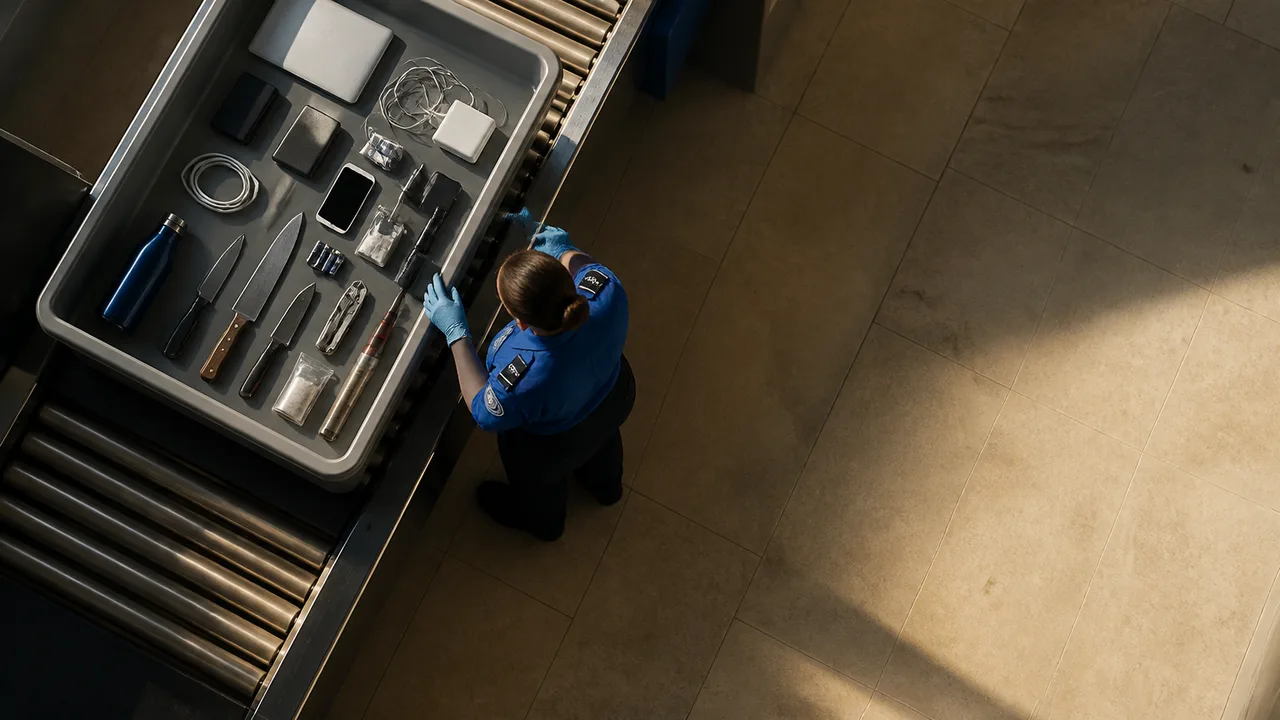
Photo: AI. Rio Sanchez
The TSA confiscates more than a million items at American airport checkpoints every year. Most of them are not weapons. Most of them are toiletries, forgotten pocket knives, and water bottles that someone filled before remembering the rule they have been ignoring for twenty years. The sheer volume of it — over a million items annually, according to figures cited by travel content creator Megan of the Portable Professional channel — says something worth sitting with: airport security policy has become genuinely difficult for ordinary travelers to track, and the costs of getting it wrong fall entirely on the traveler.
Megan's recent video walks through the major categories of confiscated items methodically, and while the format is familiar YouTube fare, the underlying information is substantive enough to warrant a closer read. A few of the rules covered are stable and well-known. Others have shifted recently in ways most travelers have not absorbed. The distinction matters.
The Rules That Haven't Changed — But Keep Catching People
The 3-1-1 liquid rule has been in place since 2006. That is nearly two decades. And yet, according to TSA data Megan references, over 130 million water bottles and coffee cups were confiscated in 2024 alone. The number is almost absurd until you account for the sheer number of people passing through American airports — roughly 900 million passengers annually, per TSA figures — and the fact that travel is, for most people, episodic rather than routine.
The rule itself is straightforward: liquids, gels, creams, and sprays in carry-on luggage must be in containers of 3.4 oz (100ml) or smaller, all fitting inside a single quart-sized clear bag. What catches people is the enforcement logic. As Megan explains it: "TSA does not care how much is actually inside the bottle. If the label says 6 oz, it is gone even if the bottle is almost empty." The container size is what triggers confiscation, not the actual quantity of liquid.
The rule extends further than most people realize. Hummus, yogurt, peanut butter, jam, cream cheese, and guacamole all fall under the liquid designation because they can be poured, spread, or spilled. Snow globes, for the same reason, cannot travel in carry-ons. There is, however, a genuinely strange exception that illustrates how literally TSA interprets the physical state of food: a jar of peanut butter fails the test, but a peanut butter sandwich does not. Spread it first, and the physics change enough to satisfy the rule.
Blades and sharp objects are another category with long-standing rules that still generate confusion at scale. Any blade in a carry-on is prohibited — pocket knives, multi-tools, souvenir knives, decorative letter openers, and Swiss Army knives regardless of blade length. Scissors pass if the blades are four inches or shorter. Hand tools like screwdrivers, wrenches, and pliers are allowed if they are under seven inches. Power tools are always banned. The waiter's-friend corkscrew — the style with a small foil-cutting blade — is prohibited from carry-ons, which will come as news to anyone who has been carrying one out of habit.
The Rules That Have Actually Changed
Two recent updates stand out for the gap between their significance and how little attention they have received outside specialist travel circles.
The first is the dead device rule. TSA agents have the authority to ask travelers to power on any electronic device at the checkpoint. If a laptop, tablet, or phone cannot turn on, it may be refused passage. The security rationale is that a non-functional device could be concealing something other than what it appears to be. The practical implication is that traveling with a depleted device is a genuine risk, not a theoretical one. Megan's recommendation is to charge devices before leaving for the airport or carry a power bank — which brings its own set of rules.
Power banks exceeding 100 watt-hours are banned from both carry-on and checked luggage entirely. The threshold is not about size or brand; it is about the watt-hour rating printed on the label. Lithium battery fires on aircraft are the driving concern, and the frequency with which power banks have been implicated in cabin incidents has tightened regulatory attention significantly.
The second update is newer still. As of August 2025, TSA and the FAA banned cordless curling irons, flat irons, and hot brushes from checked luggage. The reasoning is straightforward: lithium batteries in cargo holds can overheat with no crew access to manage a fire. Cordless hair tools can still travel in carry-on bags, but only one per passenger and only with a safety cover over the heating element. Megan's pragmatic workaround is also the simplest: travel with a corded tool, which carries no restrictions at all.
The Marijuana Question Is More Complicated Than It Looks
Cannabis law creates a particular category of confusion at American airports because the federal-state legal divide produces a situation where travelers can be compliant with their state's laws and technically in violation of federal rules simultaneously.
TSA operates under federal authority. Marijuana remains a Schedule I controlled substance under federal law. As Megan notes: "State legalization does not apply once you enter a federal security checkpoint." If TSA encounters marijuana during screening, they are obligated to refer the matter to law enforcement. Consequences vary by jurisdiction and quantity.
There is, however, a quiet update buried in TSA's current guidance: medical marijuana is now listed as permissible in both carry-on and checked bags, subject to normal screening, with the caveat that the officer at the checkpoint retains final authority, and that the laws of both departure and destination states apply. Megan's advice on this is measured — bring documentation, keep everything in original packaging, and verify your airline's policy independently, since airline rules can be more restrictive than TSA's.
The firearms data Megan cites deserves a moment of reflection regardless of one's views on the subject: TSA intercepted 6,678 firearms at checkpoints in 2024, approximately 18 per day, with 94% of them loaded. The legal path for flying with a firearm is clearly defined — checked bag, unloaded, locked hard-sided container, declared at check-in — but the volume of interceptions suggests either persistent ignorance of the rules or persistent disregard for them. Fines can reach $15,000, and criminal charges are possible depending on jurisdiction.
What Happens to Everything That Gets Taken
Here is where the policy becomes interesting from a structural standpoint. Liquids and gels are discarded immediately. Anything illegal goes to law enforcement. But the remainder — pocket knives, corkscrews, snow globes, and the roughly 100,000 personal items travelers leave behind in gray bins each month — enters a state surplus pipeline.
Unclaimed and confiscated property is transferred to state surplus agencies, which sell it through storefronts and online platforms like GovDeals. Megan puts the Texas figure plainly: "The Texas State Surplus Store in Austin receives 600 to 800 pounds of surrendered items every month just from DFW Airport alone." Pennsylvania's surplus program has been running this system for over seventeen years. iPads, jewelry, and pocket knives are sold in lots. The proceeds return to the government, not to the travelers who lost the items.
This is not a scandal, exactly. State surplus programs are a legitimate mechanism for handling abandoned and forfeited property. But the combination of opaque rules, inconsistent enforcement, and a resale system that benefits the state rather than the traveler does create a situation where the incentive structure is worth noticing.
A Practical Note on Checking Before You Pack
TSA maintains a "What Can I Bring" tool at tsa.gov that allows travelers to search specific items before packing. The agency also operates an Ask TSA service — accessible via Instagram, Facebook, or X — where agents respond to specific queries, typically within 24 hours. Both resources are more granular than the published rule summaries and are worth using for anything in a gray area.
The caveat Megan adds is worth keeping: these resources depend on an operational TSA. During government shutdowns affecting the Department of Homeland Security, update cycles slow and staffing thins. The tools exist and are generally useful, but they are not infallible infrastructure.
A million confiscated items per year is, at some level, a compliance problem. It is also a communication problem, a design problem, and a resource problem. The rules are real, and the consequences of ignoring them land on travelers. Knowing them is not optional — it is the price of moving through the system without losing something you wanted to keep.
More Like This
Air New Zealand's Business Class Dilemma
Air New Zealand's new business class faces criticism for its lack of privacy and direct aisle access, raising questions about its competitive edge.

Luxury Train Journey Across Australia: Worth the Cost?
Explore a luxurious 80-hour train journey across Australia and its opulent offerings.

US Airlines Are Profitable and Getting Worse
US airlines make billions but deliver miserable service. Here's what the loyalty program math actually means for small business owners who fly on points.
The World's Longest Domestic Flights, Explained
From Boston to Honolulu to Paris to Réunion, the world's longest domestic flights reveal how borders, customs zones, and sovereignty really work.
Why Prepared Travelers Are Calmer at the Airport
Flight anxiety is common and real. Here's the psychology of why preparation reduces your stress response—not just your risk exposure—before you fly.
Drone Detectors From the Front Lines, Tested
A Ukrainian battlefield drone detector meets consumer-grade SIGINT tools. What happens when war tech goes civilian? More than you'd expect.

What Hotel Staff Actually Tell You (And Who's Listening)
Hotel insiders speak candidly on a Travel + Leisure video — but what does "unfiltered" mean when the interviewer has advertisers? A close read of what they said and how.

Learning Local Culture Without Setting Foot in a Museum
From grocery stores to barbershops, Mark Wolters argues everyday spaces teach travelers more about a culture than any museum ever could. He makes a strong case.