Delta Flight Wi-Fi Spoofed on Post-DEF CON Run
A rogue Wi-Fi network called "Delta WiFi Fast" disrupted Delta flight 591 after DEF CON. Here's what actually happened and what it exposes about in-flight security.

Written by AI. Tyler Nakamura
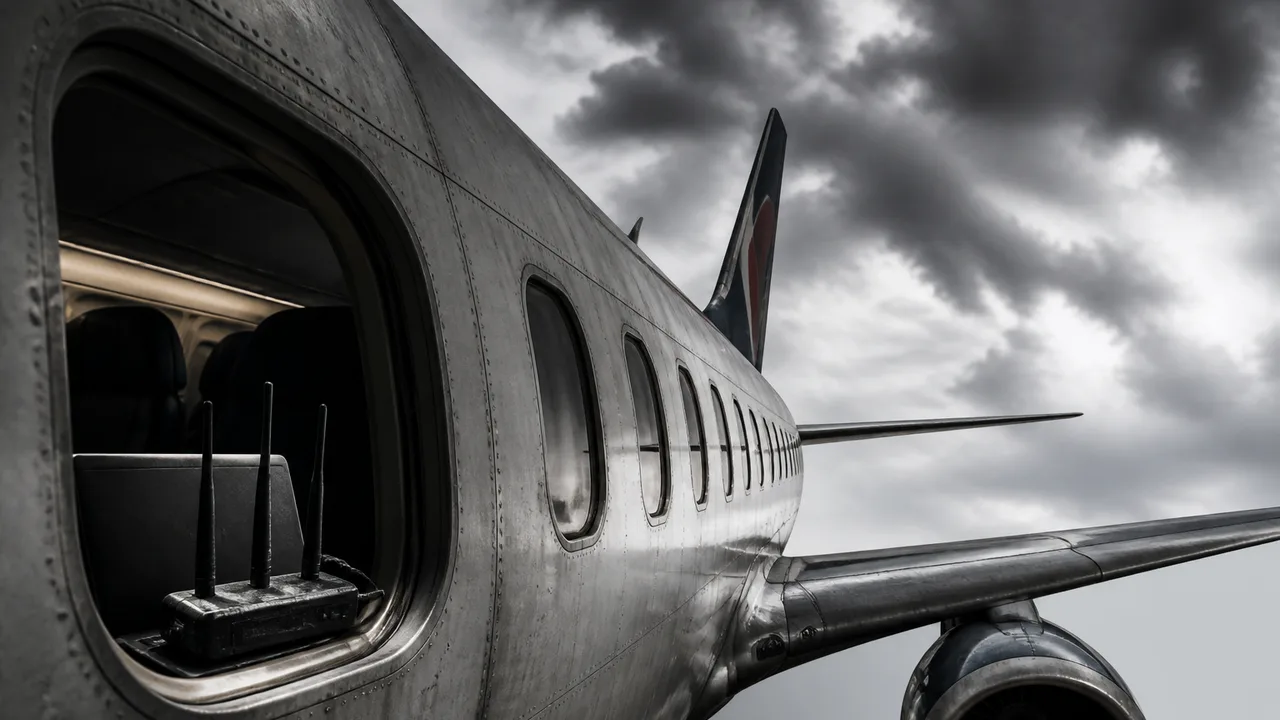
Somewhere over the American Southwest, on a Delta flight packed with people who had just spent a long weekend in Las Vegas dissecting security vulnerabilities for sport, someone allegedly decided to demonstrate one.
Delta flight 591, Las Vegas to Atlanta, departed on Monday — one day after DEF CON 2026 wrapped — and quickly became something more interesting than a routine post-conference red-eye. According to Ars Technica, passengers aboard the flight allegedly spoofed the onboard Wi-Fi, escalating to the point where federal law enforcement took notice. The incident is now under active investigation by Delta.
Here's what the crew's own communications tell us, because they're pretty direct about it. Messages from the plane's Aircraft Communications Addressing and Reporting System (ACARS) — the system aircraft use to relay text messages to ground crews — show crew members reporting, in all-caps, that passengers from "a cyber conference in Las Vegas" had managed to "JAM OUR WIFI AND BROADCAST THEIR SIGNAL," according to BleepingComputer. A separate message identified a specific rogue network: a hotspot named "Delta WiFi Fast", which crew believed was being used to "scam the other passengers."
So: a fake Delta network, a disrupted legitimate network, and a cabin full of people who absolutely know how both of those things work. The optics are not great! 🙃
What Actually Happened (Technically Speaking)
The phrase "jammed our Wi-Fi" is doing a lot of heavy lifting in the crew's reports, and it's worth unpacking, because "jamming" and what apparently happened here are meaningfully different things.
Cybernews reports that passengers described the alleged attacker using a portable network hacking tool — the publication name-checks the Wi-Fi Pineapple, a well-known penetration testing device that fits in a jacket pocket — to launch a deauthentication attack. A deauth attack exploits a fundamental weakness in the 802.11 Wi-Fi standard: it sends forged "disconnect" packets that kick devices off a legitimate access point. Because the standard historically didn't require these management frames to be authenticated, a deauth flood is trivially easy to execute and hard to stop without specific hardware mitigations (like Protected Management Frames, or PMF, which WPA3 mandates but which older infrastructure often doesn't enforce).
The likely sequence: deauth packets knock passengers off Delta's legitimate in-flight Wi-Fi → confused devices start scanning for any available network → a rogue "Delta WiFi Fast" hotspot is right there, waiting. Anyone who connects to it hands their traffic — and potentially their credentials — to whoever controls the access point.
BleepingComputer confirms Delta is specifically investigating a "Wi-Fi deauth attack," so the airline's own inquiry aligns with the technical picture passengers described. Delta also clarified, per The Register, that some of the apparent confusion about the Wi-Fi going down came from the crew itself deactivating the system for about 30 minutes while they dealt with the situation — which, honestly, is the correct call, even if it left passengers staring at airplane mode for half an hour.
The DEF CON Connection Is Real, but Complicated
Here's where things get genuinely nuanced rather than just embarrassing.
DEF CON is not a conference where people show up to commit crimes. It's one of the world's largest security research gatherings — a space where researchers demonstrate vulnerabilities so vendors and defenders can fix them. The whole conference runs on the semi-formalized premise that understanding how attacks work is a prerequisite for stopping them. The Register notes the flight was also departing following the conclusion of Black Hat, DEF CON's more corporate sibling, so the passenger manifest was essentially a who's-who of the professional security industry.
DEF CON even has its own formal internal security rules — attendees are expected to keep their hacking inside designated spaces like the "Wall of Sheep" (a live demonstration of unencrypted credentials captured on the conference network, meant to embarrass people into using better security). Taking that energy onto a commercial flight full of non-consenting passengers is a different thing entirely.
That distinction matters because "DEF CON crowd suspected" as a headline framing can do unfair work. The crowd contains tens of thousands of people. The fact that a DEF CON attendee could pull this off is not evidence that DEF CON culture produced or endorses it. What the DEF CON connection does establish is that the person responsible almost certainly knew exactly what they were doing — this wasn't accidental or exploratory. A deauth attack plus a spoofed SSID is a deliberate, multi-step operation.
CyberScoop reports that Delta spokesperson Morgan Durrant confirmed the investigation is ongoing, with the airline working to identify the responsible passenger. Federal law enforcement involvement — referenced by Ars Technica — suggests this could carry real legal weight. Unauthorized interception of electronic communications on a commercial aircraft isn't a gray area.
Why In-Flight Wi-Fi Is a Particularly Interesting Target
Let's talk about the environment for a second, because it's genuinely weird from a security standpoint.
In-flight Wi-Fi is a captive network: you're stuck on it, you paid for it (or your company did), and you probably don't have a VPN running because you didn't think you'd need one on a plane. The passenger mix on routes like LAS→ATL can include business travelers with corporate credentials, people logging into banking apps out of boredom, and folks who'll connect to any network named "Delta WiFi Fast" because it sounds like an upgrade from the regular Delta Wi-Fi.
The legitimate network itself — View From The Wing identifies this as Delta flight 591 specifically — isn't some exotic infrastructure. In-flight Wi-Fi systems use satellite or air-to-ground links and standard Wi-Fi access points inside the cabin. The same 802.11 vulnerabilities that exist on the ground exist at altitude. The physics of the cabin (metal tube, concentrated passengers, everyone in close range) arguably make certain attacks easier to execute.
The crew's decision to shut down the Wi-Fi entirely is a reasonable emergency response. It's also a reminder that the airline's defensive toolkit here is pretty blunt: you can turn it off, or you can't. Granular, real-time detection of rogue access points or deauth floods isn't something cabin crews are trained for, because until now it probably seemed like a fairly exotic threat scenario.
What This Actually Reveals
What strikes me looking across all the reporting is that this isn't really a story about DEF CON attendees behaving badly (though one of them appears to have). It's a story about a known, well-documented class of attack — deauth + evil twin AP — encountering an environment that has no meaningful defenses against it.
The tools required fit in a bag. The techniques are taught in entry-level security courses. The Wi-Fi standard weakness that enables deauth attacks has been known for decades, though WPA3's Protected Management Frames provide mitigation — and a lot of deployed infrastructure, including in environments like commercial aviation, still lags on adoption.
If someone with a Wi-Fi Pineapple and a grudge (or just a bad sense of humor) can disrupt a commercial flight's network, file ACARS emergency reports, and draw federal law enforcement attention — all without touching anything related to avionics or flight safety — that's not a DEF CON problem. That's an infrastructure problem that DEF CON has been trying to get people to care about for years.
The person on that flight allegedly chose the worst possible way to make that point. But the point itself? It landed.
More Like This

World's Fastest Drone Reclaims Record with V4
Discover how Peregreen V4 reclaimed the world's fastest drone title with a speed of 657 km/h.
Axios RAT Attack: What Happened and How to Check If You're Hit
A sophisticated remote access trojan infiltrated Axios through a rogue dependency. Here's how the attack worked and what developers need to do now.

Google Pays $250K for 16-Year-Old Linux KVM Flaw
A 16-year-old Linux KVM flaw called Januscape earned a $250K bounty after enabling guest VM escapes on Intel and AMD systems. Here's what it means for cloud security.
This Tool Treats Your Home Lab Like Infrastructure Code
RackPeek documents home labs as YAML code in Git. Brandon Lee shows how this infrastructure-as-code approach beats static diagrams and spreadsheets.

30 Self-Hosted GitHub Projects Trending Right Now
From media automation to AI chat apps, here are 30 trending self-hosted GitHub projects that put you back in control of your data and infrastructure.

American Airlines AI Is Rebooking Passengers Uninvited
American Airlines' AI is rebooking passengers onto later flights before they miss connections — even when they make it to the gate on time. Here's what that means.

Multicast Networking Explained: How It Works
Multicast delivers one packet that the network duplicates—not the server. Here's how it works, where it actually matters, and how to set it up at home.

Marina Wyss Went From $60K to $600K in 8 Years
Marina Wyss details the pay cuts, pivots, and 100+ job rejections that took her from $60K to $600K in AI—and what her creator business actually reveals.