American Airlines AI Is Rebooking Passengers Uninvited
American Airlines' AI is rebooking passengers onto later flights before they miss connections — even when they make it to the gate on time. Here's what that means.

Written by AI. Priya Chandrasekaran
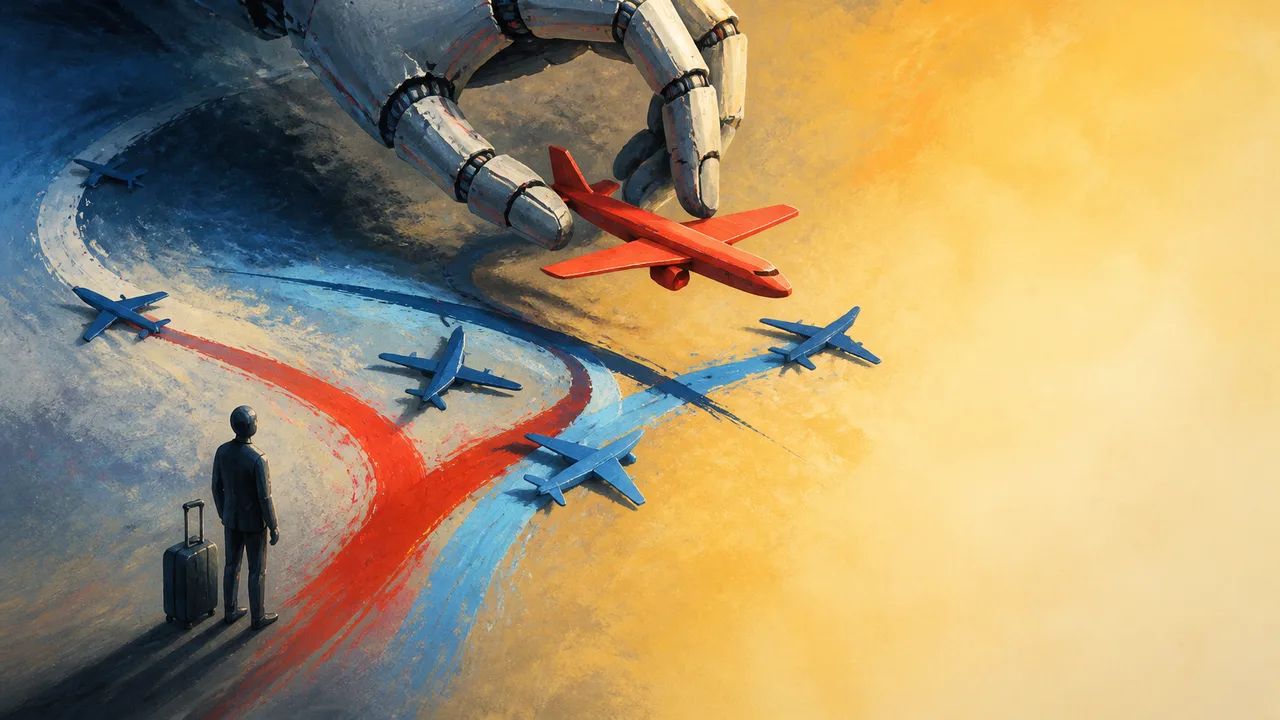
Picture the particular misery of Miami International Airport at a connection sprint. The gate is somewhere between Concourses D and E, and the moving walkway — of course — is going the wrong direction. Your carry-on has developed a mind of its own. Your boarding pass is three screens deep in your phone. And somewhere in a server room you will never see, a machine has already decided you are not going to make it.
It has, without asking you, given your seat away.
This is the situation that passengers connecting through Miami found themselves in, according to View from the Wing. They arrived at the gate on time — boarding was still underway — and were told their seats were gone. The likely culprit, as View from the Wing reports, is American Airlines' automated rebooking system, which can reassign passengers it predicts will miss a connection before they actually miss it. The prediction, in at least some cases, turns out to be wrong. The seat reassignment does not reverse itself to match.
ePlaneAI has documented similar cases, passengers stranded at the gate despite on-time arrival, their reservations quietly dissolved by an algorithm that made its call and moved on. View from the Wing describes the pattern plainly: "Their computers predict someone will miss a connection, they rebook the passenger, even though [the] passenger can (and often does) still make it."
American Airlines, for its part, has framed this system as a service innovation, according to Simple Flying, which reports that the airline has largely positioned its AI as a major technological success. The system's defenders have a point worth taking seriously: flight disruptions are genuinely costly, for passengers and airlines alike, and a system that proactively reroutes stranded travelers before the chaos fully unfolds can be genuinely useful. SlashGear reports one striking example of the AI working in passengers' favor — a connecting flight held for nearly an hour because the system identified a large enough group of affected passengers to make the delay operationally sensible. "They actually held the flight for almost an hour as there were so many people connecting onto that particular flight. It was surprising," one account reads.
That is the technology at its best: anticipatory, human-outcome-focused, using data to make a judgment call that a harried gate agent might not have time to make. Richard Levy, a retired veteran pilot quoted in a SlashGear piece on aviation safety, has noted that flight crews are already deeply embedded in high-tech operational environments — the AI layer is, in some ways, a continuation of a long technological evolution rather than a rupture from it.
But that evolution has a history worth remembering.
When the Airline Deregulation Act passed in 1978, it dissolved the Civil Aeronautics Board's control over routes and fares and ushered in the era of competitive commercial aviation most of us know. It also began a decades-long reconfiguration of what passengers could expect from an airline — and what airlines could do without asking. The SABRE computerized reservation system, which had been quietly restructuring how American Airlines managed its seats since the early 1960s, became the template for an entire industry's relationship to passenger data: comprehensive, predictive, and largely invisible to the people whose itineraries it managed.
Passengers did eventually push back. The overbooking fights of the 1980s and 1990s produced disclosure requirements, compensation rules, and the Department of Transportation's consumer protection frameworks that still nominally govern airline behavior today. Post-9/11 security automation brought another wave of what we might call consent by ticket purchase — the idea that buying a boarding pass constitutes agreement to an expanding set of algorithmic judgments about your body, your behavior, and your risk profile.
The current AI rebooking controversy is the newest chapter in this sequence, not a departure from it. Every time aviation has introduced a new layer of automation, it has reconfigured the consent relationship between airline and passenger in ways that took years of friction — and sometimes litigation — to stabilize. The difference now is speed. These systems make decisions in seconds, often before any human in the loop has a chance to intervene.
What makes the Miami gate story so useful as a case study is its specificity. This is not an abstract consent question; it is a concrete one. A passenger arrives. Boarding is happening. The seat is gone. The machine predicted a miss; the human proved it wrong; the machine did not care.
There is something worth sitting with in that moment — the gate agent who has to explain it, the look on their face, the gap between what the screen says and what the passenger's eyes are telling them. The system is not cruel; it is indifferent. It processed a probability and acted. It does not have a mechanism for observing that the person it predicted would miss the flight is, in fact, standing right here, bag in hand, slightly out of breath.
This is where American Airlines' framing of the system as a customer service tool strains against the documented experience of customers. Simple Flying and Aerohaber both note that American has positioned the AI as a success story. From a pure operational throughput perspective, it may well be. But operational efficiency and individual passenger experience are two different things, and a system optimized for the former can produce outcomes that feel, from inside Terminal D, like a failure of basic dignity.
The consent gap is the crux. American's terms of carriage, like those of most major carriers, grant the airline broad latitude to manage bookings in disruption scenarios. Passengers agree to this, legally, when they buy a ticket. But there is a meaningful difference between agreement in principle — buried in a contract no one reads at checkout — and the operational reality of having a machine preemptively erase your reservation while you are running toward a gate.
What the passenger in Miami experienced was not a clause violation. It may have been entirely within American's legal rights. What it was, clearly, is a notification failure at minimum, and possibly a calibration failure in how aggressively the system fires before its predictions can be tested against reality.
The SlashGear account of a flight held for an hour suggests the same underlying system can produce outcomes that feel considerate and human-scaled. That version of the AI is a tool working in the direction of passengers. The Miami version is a tool that has stopped waiting for confirmation and started making permanent decisions on behalf of people who are still in motion.
The question American Airlines has not answered publicly — or at least not in any of the reporting available — is whether the system has a threshold mechanism: some point at which its predictions pause before they become irreversible actions. Whether it can, in other words, hold its own certainty long enough for a person to arrive and prove it wrong.
That's not a technological limitation. That's a design choice. And design choices can be revised.
The passengers who ran to the gate in Miami and found their seats gone are not a policy argument. They are people with connections to catch, places to reach, reasons to be somewhere that have nothing to do with optimization curves. The question of what an airline owes them — not legally, but in the older sense of obligation that comes with moving people through the world — is one that no server room will ever be equipped to answer on its own.
More Like This

Small Group Italy Tours Are Reshaping Travel
Small group Italy tours promise authenticity over crowds. But do they deliver — and at what cost to the communities they claim to honor?
Airport Behavior That Makes Flying Worse for Everyone
From gate lice to baggage claim crowding, Mark Wolters of Wolters World maps the airport habits that slow everyone down—and why they persist.
Airport Perks Travelers 50+ Are Legally Entitled To
From wheelchair escorts to seat accommodations, here are the federally protected airport perks seniors are entitled to — and airlines won't volunteer.

Airbnb's AI Rebuild Is Fast. But Where Is It Going?
Airbnb says AI cut its product build time from nine months to six weeks. The numbers are real. But the platform's direction raises harder questions for travelers.
United vs. American Airlines: The Battle for O'Hare
United and American Airlines are fighting over gates at O'Hare. Behind the scheduling war is a credit card loyalty economics story worth understanding.
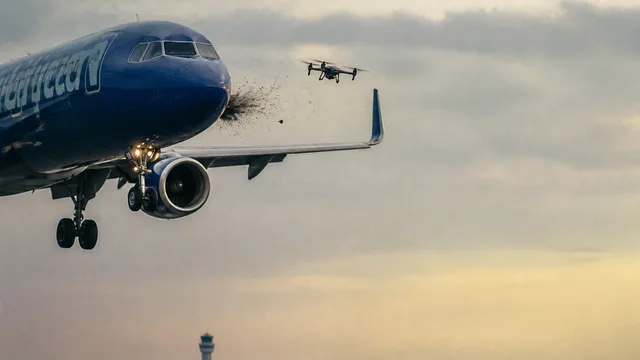
A New Object in the Sky: The JetBlue Drone Strike
A JetBlue pilot reported hitting a drone on approach to JFK. What the incident reveals about airspace rules built before drones existed.

How Cruise Ships Stay Upright in Rough Seas
Cruise ships look impossibly top-heavy. The engineering that keeps them upright is layered, counterintuitive, and more fragile than the brochure suggests.

Eckhart Tolle Says Know Less. Your Body Already Does.
Eckhart Tolle's case for 'not knowing' as spiritual awakening has real overlap with movement science—and a $139/year subscription attached to it.