Small Group Italy Tours Are Reshaping Travel
Small group Italy tours promise authenticity over crowds. But do they deliver — and at what cost to the communities they claim to honor?

Written by AI. Priya Chandrasekaran
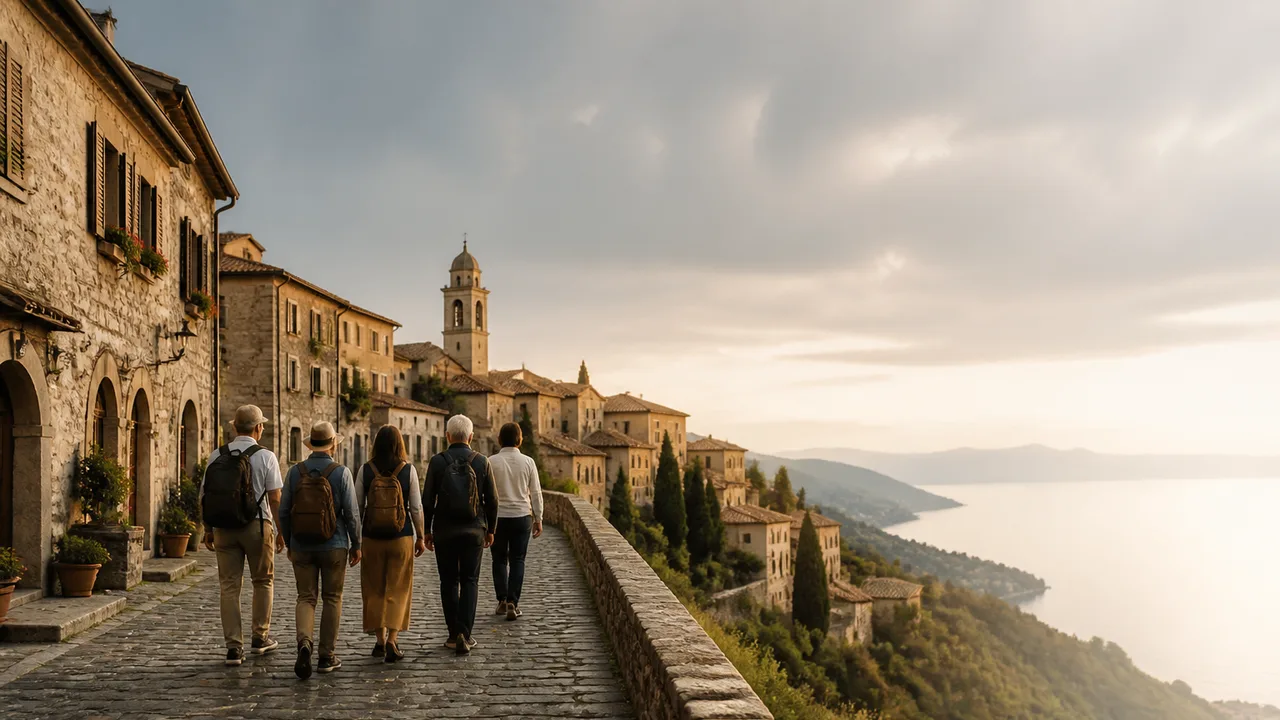
There is a laminated menu in every tourist-facing trattoria from Venice to Palermo, and it has photos. When the photos outnumber the items, you are not eating — you are being processed. Any experienced Italy traveler knows this feeling: the beautiful piazza, the gorgeous light, the gnawing sense that the entire operation is optimized for your presence and indifferent to your appetite.
This is the anxiety that small group travel has built its entire pitch around. And it is not an unreasonable anxiety.
The Grand Tour, Miniaturized
The logic of the small group Italy tour is actually quite old. Wealthy Europeans on the 18th-century Grand Tour traveled with fixers — local guides, letter-of-introduction networks, and hired experts whose job was precisely to move a small, discerning party through a landscape in ways that mass movement couldn't permit. What the contemporary small group travel market has done is democratize that infrastructure. The fixers are now licensed guides and specialist operators. The letters of introduction are skip-the-line privileges and pre-arranged access. The party is still small — Nadas Italy caps their groups at 6 to 12 travelers; Firebird Tours runs up to 14. The underlying logic — that smallness purchases depth — is the same logic that has governed quality travel since before the railway.
What's shifted isn't the concept but the scale of adoption. Post-pandemic, smaller groups became a preference not just for philosophical reasons but practical ones. The brief period when mass tourism was structurally impossible reset a lot of traveler habits. People discovered they liked fewer people around them. The industry responded. SheBuysTravel positions small group Italy tours explicitly as a 2026 travel priority, framing them around "comfort, authentic experiences and local insights" in a way that reads less like a pitch and more like a correction to an earlier error.
What You're Actually Buying
The honest version of this market spans a significant range. At one end: U.S. News Travel lists budget options designed for college students and backpackers that spend three nights in Sorrento and cover Pompeii, Capri, Amalfi, Positano, and Naples — southern Italy's greatest hits, moving at pace. At the other end: NowJourney.com offers what it calls its best-selling itinerary — Venice, Florence, Tuscany, Cortona, San Gimignano, Orvieto, and Rome, with optional extensions to Lake Como and the Amalfi Coast — starting at $7,779.
That price point requires a moment's attention, because it is not incidental. A $7,779 Italy tour is a considered commitment — the kind where you research the operator for weeks, read reviews obsessively, and argue with your traveling companion about whether Cortona is worth the detour. (It is. Bring flat shoes.) What it signals, structurally, is that small group travel has bifurcated: there's a premium tier that functions as an alternative to hiring your own private guide, and a mid-market tier that functions as an alternative to a standard coach tour. They share a name and not much else.
The Italian on Tour captures the aspirational version well, describing the best small group tours as those that "cater to specific interests, whether it's food and wine, art, history, or outdoor adventures" while holding in mind that Italy is a country where centuries of history are not a backdrop but an operating condition — present in the bread, the dialect, the way a city's street plan still follows a Roman surveyor's grid.
The food-focused tier of this market is where the distinction between experience and extraction becomes most legible. A truffle hunt in Umbria is not the same thing as a truffle demonstration — one puts you in mud-dark forest at dawn, reading a dog's body language, understanding that the genus Tuber doesn't care about your itinerary; the other gives you a certificate and a jar of truffle salt. A morning in Bologna's Quadrilatero — the covered market district that has been selling cured meats, aged cheeses, and fresh pasta under the same porticos since the medieval period — is not the same as a food tour that stops there for twenty minutes. In the Quadrilatero, if you stay long enough, a vendor will eventually argue with another vendor about the correct fat content for mortadella, and that argument is the whole point. That is Bologna telling you who it is.
TTG addresses the supply side of this: there are now clearly enough small group Italy products on the market that the trade press is publishing guides on how to sell them — which tells you the category has matured past novelty into something that needs differentiation advice.
The Overtourism Counterweight
There is a version of this story that is simply cheerful — smaller groups, better experiences, happy travelers, thriving local operators. That version leaves out Venice.
Venice's population has been declining for decades as short-term rental platforms and day-trip tourism have made the city functionally unlivable for the people who grew up there. Walk through Cannaregio or Castello at seven in the morning, before the vaporettos fill, and you will occasionally pass someone moving with the unhurried purpose of a person who actually lives here — carrying groceries, not a camera bag, navigating a calle by memory rather than by phone. That person may be among the last of their kind on that street. The city's resident population has fallen from around 175,000 in the postwar decades to under 50,000 today, a compression so severe that Venetian civic groups have described it plainly as cultural erasure. Small group tours pass through this situation. They do not resolve it. Twelve travelers instead of fifty-two still require accommodation, still push demand into a housing market that cannot absorb it, still photograph the same facades.
This is not an argument against small group travel. It is an argument for what the format's ethical claims actually cover and what they don't. A tour that employs a local guide and eats at a family-run osteria rather than a laminated-menu tourist trap — those are meaningful choices. They do not, on their own, constitute a politics of sustainable tourism. The harder questions — where travelers sleep, how long they stay, whether they are distributing spend into neighborhoods that need it or concentrating it in neighborhoods already saturated — are not answered by group size alone.
Nadas Italy is honest that the camaraderie of 6-12 travelers and the logistical advantages of pre-arranged expert guidance are the core product. That is a coherent offer. The "authenticity" language that runs through much of this market's self-description is a different claim, and one worth holding to a higher standard.
The Question the Format Can't Answer for You
Here is what the small group Italy tour market does well: it lowers the activation energy for depth. Left entirely to your own devices in a country whose food system alone could occupy a lifetime of study, most travelers will default to proximity and legibility. A guide who can explain why the ceramic tradition in Deruta — where the same cobalt-and-white geometric patterns have been painted onto plates since the Renaissance, fired in kilns that have barely moved in five centuries — connects to the trade routes that made Umbria wealthy enough to build its basilicas: that guide is doing something a guidebook cannot. Smallness is what makes that conversation possible, because you cannot have it with fifty people standing behind you.
The format, at its best, is a mechanism for making Italy's density of meaning accessible rather than overwhelming. At its worst, it is a coach tour with better branding and a higher thread count on the hotel sheets.
What separates the two is not price, though price correlates. It is whether the operator's central question is how do we move travelers through Italy or what does this specific place have to teach, and how do we get out of the way enough to let it?
Italy will keep captivating travelers regardless. The question is whether the industry that forms around that captivation becomes part of the country's living culture — or just another lamination over it.
More Like This

American Tourists in Europe: The Etiquette Gap
From date formats to tipping culture, the everyday customs that trip up American travelers in Europe—and what they reveal about deeper cultural differences.

Luxury Train Journey Across Australia: Worth the Cost?
Explore a luxurious 80-hour train journey across Australia and its opulent offerings.
Turkey's Olive Oil Soap Maker Bets on Patience
Doktoroğlu Soaps makes 8 million bars a year the old way. The real story is what a year-long production cycle does to your cash flow—and your nerve.
Como 1907: Building Football's Most Ambitious Brand
The Hartono brothers didn't just buy a football club—they bought a canvas. How Como 1907's tourism-meets-football model could rewrite sports business.

A New Object in the Sky: The JetBlue Drone Strike
A JetBlue pilot reported hitting a drone on approach to JFK. What the incident reveals about airspace rules built before drones existed.
Learning Local Culture Without Setting Foot in a Museum
From grocery stores to barbershops, Mark Wolters argues everyday spaces teach travelers more about a culture than any museum ever could. He makes a strong case.

Which "Untranslatable" Words Are Real?
From hygge to mamihlapinatapai, RobWords fact-checks the internet's favourite "untranslatable" words — and finds gems, exaggerations, and outright fiction.

How the Tour de France Built a Global Sports Business
The Tour de France is more than a race. How ASO built a commercial machine from a national institution—and what it means for the athletes inside it.