United vs. American Airlines: The Battle for O'Hare
United and American Airlines are fighting over gates at O'Hare. Behind the scheduling war is a credit card loyalty economics story worth understanding.

Written by AI. Marcus Tate
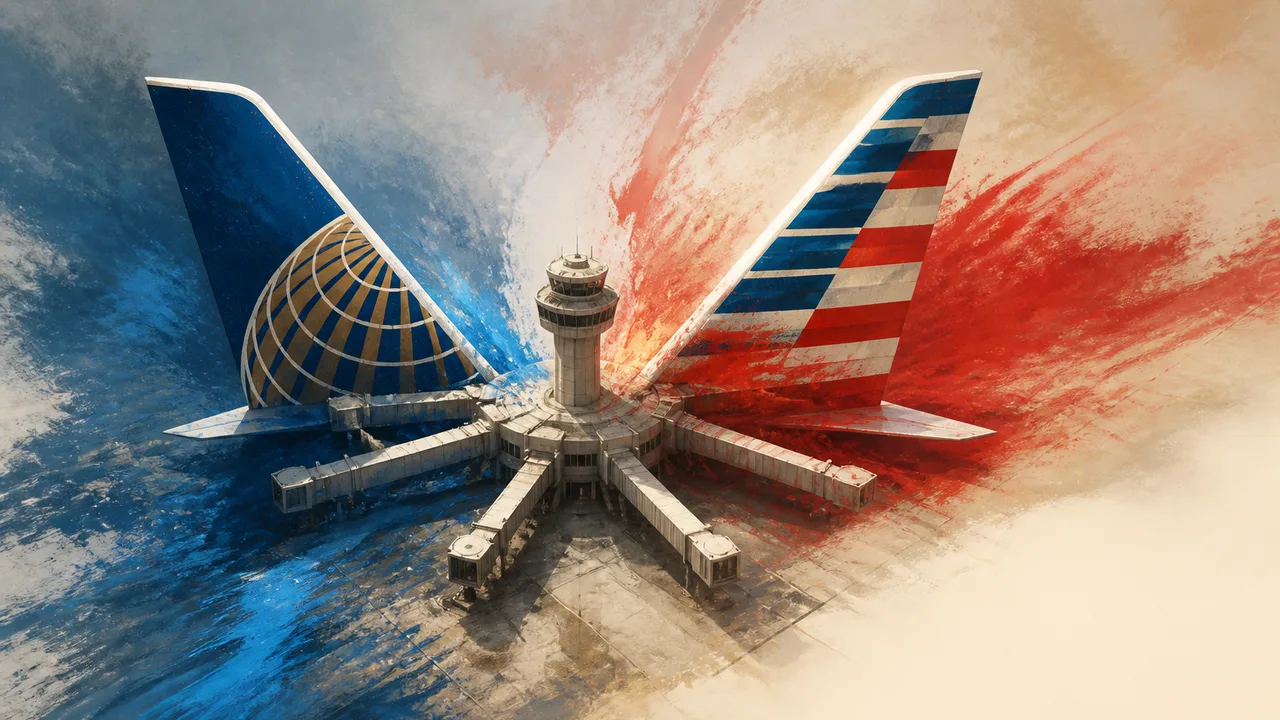
Photo: AI. Yuna Blackwood
O'Hare International Airport is, by one reasonable measure, the busiest airport in the world — a takeoff or landing roughly every 37 seconds in 2025, according to the Half as Interesting video that mapped out this rivalry in useful detail. That volume is the context for everything else. In a facility operating at that tempo, a gate is not just real estate. It is throughput. It is schedule density. And for the two airlines that dominate O'Hare, it is the physical expression of a much larger financial contest.
United Airlines holds 99 gates across terminals 1 and 2. American Airlines holds 66, concentrated in terminal 3. Everyone else — Delta included, with a handful of gates in a terminal the video describes as one "nobody seems to care about" — is essentially a footnote. This is a two-carrier war, fought in a city where both airlines have declared their sole Midwestern hub.
That framing matters. Neither carrier has a fallback in the region. Lose Chicago, and you lose the Midwest as a connecting architecture. Which is why the gate count at O'Hare is not a resource-management question. It is an existential one.
The Mechanism: Use It or Lose It
O'Hare's gate allocation system is elegantly simple and, it turns out, elegantly exploitable. Airlines submit requests for gates each year, the airport reviews actual usage data, and in June it redistributes gates for the following year — with the handover occurring in October. The logic is sound: gates should belong to whoever actually flies from them.
The problem is that "scheduled flights" and "operated flights" are different numbers, and for a brief window, the scheduling data — not the operational data — can be made to look impressive. Both United and American grasped this. In 2026, United filed a summer schedule featuring 34% more flights than the prior year, per the Half as Interesting analysis. American followed a similar, if less aggressive, strategy. Both carriers, the video notes, understood they could not actually operate all of those flights. That was not the point. The point was to manufacture a gate-need argument ahead of the annual reallocation.
The FAA eventually imposed a daily operations cap, requiring both carriers to trim their schedules. United's cuts were deeper, given how aggressively it had overscheduled. American's adjustments were comparatively modest, drawn largely from smaller markets receiving redundant service.
The outcome of that reallocation cycle — who gained gates, who held ground — was not publicly resolved in the source material. That ambiguity is, in some ways, the story. The fight is ongoing, and both sides are still finding the edges of what the system permits.
The Borderlands: Concourse G
Between terminals 2 and 3 sits Concourse G, which the Half as Interesting video calls "the borderlands" — a corridor of mixed-use gates, common-use space, and carrier-specific leases where both United and American hold positions in uncomfortably close proximity.
When Spirit Airlines collapsed, its four Concourse G gates became contested territory. American moved first, subleasing gates G8 and G10 for $30 million. United responded by subleasing G12 and G14 for $30.2 million, per the video's account. Two gates apiece. Sixty-plus million dollars combined. A net positional change of zero.
That transaction captures the dynamic precisely. The dollar figure is real. The strategic gain is marginal. And neither carrier appears willing to let the other claim even a symbolic advance.
United CEO Scott Kirby has been explicit about his intentions, pledging to push American into competing, in his framing, "for spill traffic among the likes of, I don't know, Frontier." American CEO Robert Isom has been equally direct about not leaving: "We're going to be roommates and we're not getting married." It is, as the video notes, not the most compelling pitch for domestic harmony — but as a statement of strategic intent, it is unambiguous.
Why Chicago, Specifically
Kirby spent years at American before departing and eventually landing at United. The video gestures at the personal dimension of this rivalry, and it is not implausible that executive history sharpens competitive instinct. But the more durable explanation is financial, and it runs through loyalty programs.
For major U.S. carriers, flight operations have long functioned closer to a marketing expense than a profit center in their own right. The actual margin engine is the co-branded credit card program — the fees, the interchange revenue, the sale of miles to bank partners. American has reported roughly $2 billion in annual profit attributable to its credit card program, according to the video's account. United's loyalty economics are structured similarly.
Here is where geography becomes destiny. American spent much of the 2010s, according to the video's reading, ceding ground in New York and Los Angeles — maintaining hubs there but investing more heavily in Philadelphia and Phoenix. From a pure network-efficiency standpoint, that is defensible. From a loyalty-economics standpoint, it is a more complicated call. New York and Los Angeles concentrate exactly the kind of high-spend cardholders who drive co-brand profitability.
If you have already given up meaningful share in those two markets, you cannot afford to also give up Chicago. A traveler who chooses an airline — really commits to it, enrolls in its loyalty program, carries its credit card, routes connections through its hub — is worth multiples of the ticket revenue they generate. Multiply that across a metropolitan area, and the gate count at O'Hare stops looking like an airport operations question and starts looking like a customer acquisition strategy.
United knows this. If it can reduce American to a carrier that Chicago-based travelers use as a last resort — for spill traffic, in Kirby's formulation — it captures that loyalty pool wholesale. American knows this too, which is why Isom's "roommates" framing is less about affection than about refusing to be displaced from one of the few remaining markets where the loyalty math still works in American's favor.
What the System Reveals
The scheduling-inflation episode is worth dwelling on, not because it resolved anything dramatically, but because of what it says about how these competitions actually function. Two carriers — both with serious operational obligations, both with passengers depending on them — deliberately overfiled their schedules not to fly more people places, but to generate paperwork that might shift a few gates in one direction.
The FAA's cap restored some order to the process, but the underlying incentive remains. As long as gate allocation at O'Hare is tied to scheduled volume rather than operated volume, or some other more manipulation-resistant metric, the temptation to overfile will persist. O'Hare benefits from flight density. It does not benefit from phantom schedules that vanish when operational reality sets in.
That tension — between the city's interest in genuine service and each carrier's interest in territorial positioning — is not unique to O'Hare. It is structural wherever two dominant carriers share a constrained airport and a "use it or lose it" allocation framework. Chicago is just where the stakes happen to be highest for both parties simultaneously.
The gate count at O'Hare will keep shifting in single-digit increments, each reallocation cycle producing modest positional changes and large expenditures. The credit card programs will keep generating the revenue that makes all of this fighting economically rational. And Scott Kirby and Robert Isom will keep not getting married, which is probably for the best.
More Like This

Apollo's EasyJet Buyout: What It Means for Workers
Apollo's £5.7bn EasyJet takeover is a win for shareholders. For cabin crew and ground staff across Europe, the calculus is far more complicated.

Sports Media Executive Skills Are Being Redefined
Rick Alessandri of ZRG Partners breaks down what sports media executives need now: DTC fluency, data analytics, AI literacy, and a global footprint.

Ford vs. Chevy: A Century of Automotive Rivalry
From the Model T to the Mustang, Ford and Chevy have spent 100+ years pushing each other. Here's how that competition actually played out.

American Airlines AI Is Rebooking Passengers Uninvited
American Airlines' AI is rebooking passengers onto later flights before they miss connections — even when they make it to the gate on time. Here's what that means.

Fast Food Price Increases and the Data Strategy Behind Them
Fast food prices have surged well past inflation—but labor costs are only part of the story. The bigger driver is a deliberate shift in business strategy and data.
JetBlue Buys Spirit's LaGuardia Slots for $58.5M
JetBlue won 22 Spirit Airlines LaGuardia slots for $58.5M. Here's what it means for fares, Frontier, and travelers who depended on cheap Northeast flights.

World Cup Ratings, MLB Labor, and Apple TV's F1 Problem
USMNT draws 23M viewers, MLB floats a cornerstone player clause, and Apple TV puts the Austrian GP in front of the paywall. The business of sports, June 26.

Alan Stein Jr. on Kobe Bryant, Discipline, and Elite Performance
Performance coach Alan Stein Jr. explains what he observed from Kobe Bryant and how sports expertise translates into a keynote career and business leadership.