Alan Stein Jr. on Kobe Bryant, Discipline, and Elite Performance
Performance coach Alan Stein Jr. explains what he observed from Kobe Bryant and how sports expertise translates into a keynote career and business leadership.
Written by AI. Marcus Tate
Photo: AI. Naia Iwarra
The performance coaching industry has a reliable arbitrage model: spend years in the controlled, high-stakes environment of professional athletics, extract the principles that govern excellence there, and sell them to audiences who will never set foot on an NBA court. Alan Stein Jr. followed that arc deliberately. According to his own account on the Sports Management Podcast, he worked as a performance coach at Nike Skills Academies affiliated with the Kobe Bryant program — his timeline places his first significant Bryant observation around 2007, a detail that should be independently verified against the Academy's documented history — before leaving basketball directly in 2017 to build a corporate keynote business. His three books, Raise Your Game, Sustain Your Game, and Next Play (which he describes as his first, second, and third, respectively — publication order pending verification against his publisher record), form the product architecture of that transition.
What makes Stein worth examining is not that he made the leap from locker room to boardroom — plenty of coaches have — but that he is unusually candid about what the leap actually involves and where the analogy holds versus where it quietly strains.
What the NBA Environment Actually Tests
Stein's credibility rests substantially on his proximity to Bryant. His description of that access is measured: he clarifies that he did not know Kobe "super well," that he served as performance coach at several Nike Skills Academies associated with the Bryant program, and that his observations were largely those of a careful witness rather than a confidant. That honesty matters. The performance coaching ecosystem has no shortage of people claiming deeper relationships with elite athletes than the record supports.
What Stein says he actually observed from Bryant is instructive precisely because it is so unglamorous: attention to detail, early morning workouts, an indifference to how he felt that morning as a determinant of whether he showed up and how hard he worked. "He was as relentless and as obsessed with excellence as anyone I've ever been around," Stein told the podcast. The absence of mythology in that description is more convincing than the mythology would be.
The NBA is, among other things, a near-perfect meritocracy for a specific physical skill set. Minutes are allocated by coaches with immediate competitive incentives. Contract values are published. Player tracking data is exhaustive. When Stein says that elite performers "behave to a standard, not to a feeling," that claim is continuously stress-tested in the NBA in ways it simply is not in most organizations. Bryant's 4 a.m. workouts were famous partly because his results — available to anyone with a box score — made them legible as a causal story. The standard he held himself to had measurable downstream consequences every night, in front of 20,000 people.
That accountability structure is what Stein carried out of basketball, and it is also what gets quietly dropped when the framework moves into corporate settings.
Discipline Without a Scoreboard
Stein's core argument runs roughly as follows: motivation is a feeling and therefore unreliable; discipline is a decision and therefore durable; consistency is a controllable superpower available to anyone willing to commit to a standard regardless of circumstance. "Elite-level performers do it regardless," he says. "They don't behave based on how they feel. They behave to a standard."
The internal logic here is coherent, and the pressure-management piece is grounded in ideas that performance psychology researchers have explored under labels like anticipatory anxiety and self-talk regulation — the mechanisms Stein describes, including the free-throw example about "don't miss" activating the miss rather than suppressing it, align with how practitioners in that field think about negation in pre-performance cognition. Stein does not cite sources, and the empirical literature is too large and varied to summarize with a single characterization, but the directional claims he makes are not fringe positions. Readers wanting primary sources should look to research on attentional focus and self-regulatory frameworks in sport psychology; the assertion that negative anticipatory framing correlates with degraded performance has support in that body of work, though effect sizes and conditions vary.
What the framework does not fully address is the verification problem. In basketball, you can watch whether someone actually behaves to a standard. The scoreboard does the auditing. In a company of 500 people, the standard-setting is mostly rhetorical until the culture initiative expires or the consultant's contract ends. Stein is aware of this gap at the structural level — he notes that scale makes cultural consistency harder to maintain — but the framework he offers is individual rather than systemic. It tells you how a single person should comport themselves; it has less to say about whether the organization around them rewards that comportment or even notices it.
This is not a flaw in Stein's thinking so much as a limit condition of the analogy. The NBA operates on compressed feedback loops. Corporate organizations often do not. Transplanting the discipline framework from one to the other requires assumptions about organizational legibility that Stein's keynote audiences may not want to examine too closely.
What Gets Merchandised and What Gets Left Behind
There is a secondary question that Stein's career arc surfaces, one he does not address directly but that sits underneath the conversation: who captures the value when sports performance expertise moves to the corporate market?
The Bryant Skills Academy produced something — a demonstration, across multiple years, of what world-class preparation looked like at its most granular level. Stein was a witness and participant in that process. He now sells access to what he observed, in the form of books, keynotes, and speaking engagements, to audiences who have no direct connection to the original environment. That is a standard knowledge-transfer model, and there is nothing cynical about it. But it is worth noting that the original product — the actual player development, the early morning reps, the unseen hours — has almost no market outside professional athletics. The abstracted version, stripped of the physical requirements and the consequence structures that made it meaningful, is infinitely scalable and considerably more lucrative.
Stein is explicit about this. When asked about the pivot to keynotes in 2017, he says the corporate audience "wanted to hear all of these sports stories because that's something that they had an interest in, but then we all collectively realized yeah, the lessons are the same." That framing — that the lessons transfer cleanly — is precisely the claim his audiences are paying to hear. The question worth sitting with is whether "the lessons are the same" or whether what actually transfers is the story, and the story is doing work that the lesson alone cannot do.
The "accept it or correct it" maxim he offers as a leadership principle is a good example. In basketball, the correction is immediate and visible — the player either improves or loses minutes, and the coach either adjusts or loses games. In business, corrections can be deferred, attributed to external factors, or simply redefined as acceptable. The mantra survives the translation, but the enforcement mechanism does not cross with it.
None of this undermines Stein's argument for individual discipline. His point that consistency is a controllable variable — that showing up regardless of feeling is a genuine competitive advantage — is as applicable in an office as it is in a training facility. The real stress test is whether the organizations his audience members return to are structured to recognize and reward that consistency, or whether the keynote experience functions primarily as personal inspiration with an organizational shelf life of roughly one quarter.
Stein himself seems to sense the limits of the transfer. His pivot from "aim to be elite" to "aim for personal excellence" near the end of the podcast conversation is telling: "Elite is more of an evaluation of what other people think of you. Instead of aiming to be elite, aim for personal excellence because that's something you have control over." That reframe quietly concedes that the external validation structures — which in the NBA are automated and public — may not function reliably enough in other contexts to be worth pursuing. It is a sensible adjustment. It is also a narrower claim than the one the keynote market is buying.
The sports performance expertise industry is now a substantial business, with its own economies of scale, book deal structures, and speaking fee tiers. Stein's arc — from the training floor to the stage — is increasingly the standard career trajectory for coaches and performance specialists who built their credibility inside professional sports. The intellectual property they generate from that proximity is real. The more interesting question, as more of that expertise gets packaged and sold to organizations that lack the feedback loops that made it legible in the first place, is whether the industry is selling performance or the memory of it.
More Like This
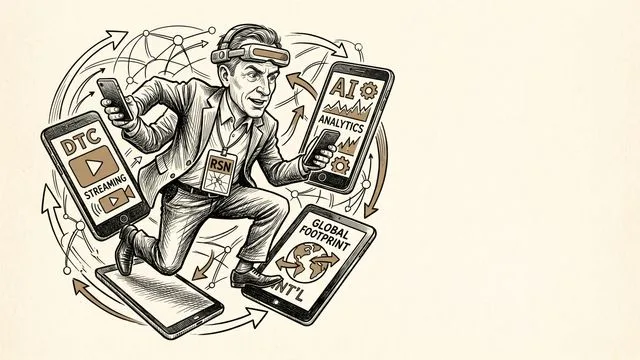
Sports Media Executive Skills Are Being Redefined
Rick Alessandri of ZRG Partners breaks down what sports media executives need now: DTC fluency, data analytics, AI literacy, and a global footprint.

Surrender as a Leadership Strategy, Not a Weakness
Dr. Jessica Kriegel argues that letting go of control makes leaders more effective. The research behind the claim is worth taking seriously.

Ford vs. Chevy: A Century of Automotive Rivalry
From the Model T to the Mustang, Ford and Chevy have spent 100+ years pushing each other. Here's how that competition actually played out.

How APL Turned an NBA Ban Into a Brand Identity
APL's NJ Falk breaks down the six storytelling threads behind one of e-commerce's most unlikely brand-building moves—starting with an NBA ban.

Fast Food Price Increases and the Data Strategy Behind Them
Fast food prices have surged well past inflation—but labor costs are only part of the story. The bigger driver is a deliberate shift in business strategy and data.

What an ER Doctor's Skill Failure Teaches About Learning
Jeremy Baird's TEDx talk on failing a lumbar puncture connects surprisingly well to sports psychology research on how bodies learn from physical errors.

Sports Business Flashpoints: June 25, 2026
From the Moda Center standoff to Allstate's SEC bet on women's sports, five stories shaping the business of athletics this week.

NHL Eyes Texas, PGA Tour Restructures: June 24 Sports Business
NHL eyes a $2B Texas expansion, the PGA Tour splits into two tiers, and a boutique agency dominates the NBA Draft. Here's what it all means financially.