Airport Behavior That Makes Flying Worse for Everyone
From gate lice to baggage claim crowding, Mark Wolters of Wolters World maps the airport habits that slow everyone down—and why they persist.

Written by AI. Mariel Fontaine
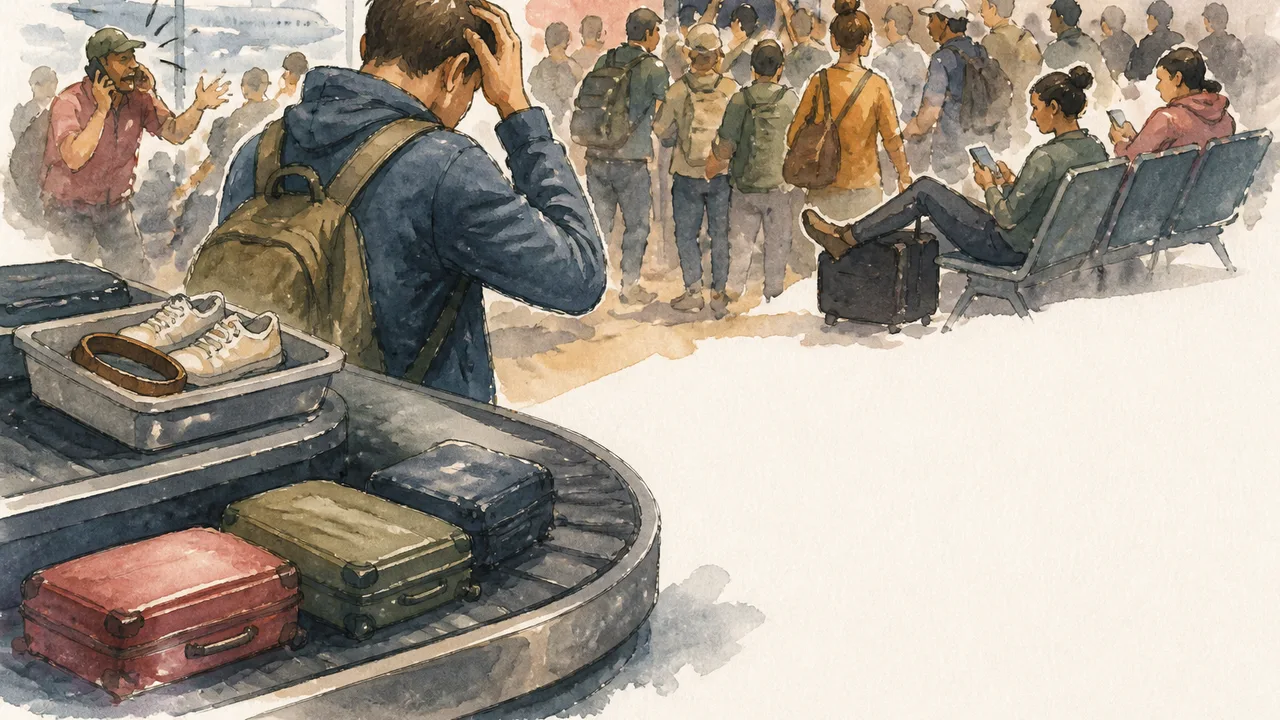
Photo: AI. Júlia Almeida
There is a particular kind of misery that belongs exclusively to the airport—not the delays, not the food prices, not the terminal carpeting that seems designed to make you feel vaguely unwell—but the accumulated friction of sharing a constrained, high-stakes space with people who appear to have never considered that other humans exist.
Mark Wolters of Wolters World has been cataloguing this friction for years, and a recent video filmed at Savannah's airport runs through the full taxonomy: speakerphone talkers, gate lice, terminal blockers, baggage claim huddlers, and the category he terms "living room lizards"—travelers who colonize four seats with their belongings and treat a public gate area as a private den. It is, on the surface, a vent session. But underneath that, it raises a question worth sitting with: why, in an environment specifically engineered for movement and throughput, do so many people behave as though they are the only ones trying to get somewhere?
The honest answer is probably not selfishness in the calculated sense. It is more likely a failure of spatial imagination—an inability to see oneself as a node in a system rather than the center of one.
The Infrastructure of Annoyance
Airports are not neutral spaces. They are deliberately organized to funnel large numbers of anxious people through a series of bottlenecks—security, boarding gates, baggage carousels—each of which requires some degree of collective cooperation to function at anything approaching its designed capacity. When that cooperation breaks down, the effects compound quickly.
Wolters is particularly pointed about the security line, where the breakdown is most measurable. The rules around liquids, electronics, and footwear have been consistent for the better part of two decades. They are posted on signs, announced overhead, and enforced by personnel at the front of the queue. And yet: "You will see people that have to go through security lines again and again and again because they don't take everything out." The frustration here is not merely aesthetic. Every person who triggers a secondary screening or argues with a TSA officer about a water bottle extends the wait for everyone behind them. The individual inconvenience becomes a collective tax.
The same logic applies to gate lice—the travelers who queue at the boarding door several boarding groups ahead of their own. Wolters notes that airlines including American are now enforcing group compliance at the scanner, turning away early arrivals and sending them back through what he diplomatically calls "the walk of shame." The problem is not simply that these people want to board first; it is that their early positioning physically blocks the gate area, making it harder for correctly-sequenced passengers to actually reach the door. The effect is to slow down the very process they are trying to accelerate.
Baggage claim operates on similar dynamics. Wolters' recommendation—stand two steps back from the carousel edge—is almost embarrassingly simple, but the pooled effect of everyone doing it would meaningfully reduce congestion at every belt in every terminal. It does not happen, mostly because no individual perceives that their own proximity to the carousel is the variable causing the problem.
The Speakerphone Problem, and Why It Has Gotten Worse
Of all the behaviors on Wolters' list, the speakerphone conversation has attracted something like formal institutional attention. He notes that airports are now posting signage and making announcements asking passengers not to conduct speakerphone or FaceTime calls at gate areas—a response that tells you something about the scale of the problem.
The speakerphone conversation occupies a particular register of intrusion because it is not passive. The person checking their phone in a middle seat is not asking anything of you. The person conducting a loud FaceTime call is filling the shared air with content you did not choose and cannot easily escape. Wolters frames it with characteristic directness: "The person you're talking to doesn't want everyone around you to know what their bursitis is doing to them, but also it's just rude for the people around you because they don't actually want to hear all the stuff that's there."
There is also something structurally odd about the FaceTime-but-not-looking phenomenon he describes—people conducting video calls without actually watching the screen, which manages to be both socially disruptive and pointless simultaneously.
The Behaviors That Are Partly Someone Else's Fault
To Wolters' credit, he does not confine blame entirely to individual passengers. The 30-minute incremental delay—where a two-hour delay is parceled out in half-hour installments, leaving passengers unable to commit to getting food or leaving the gate area—gets named explicitly as an airline failure. "If you know it's going to be a couple hours, airlines, just put in a couple hour delay so I can go get some food, go to the bathroom, do some other things." This is a reasonable request. The incremental delay strategy likely exists to minimize optics—a single large delay looks worse than several small ones—but the passenger experience is worse for it.
This is worth noting because the etiquette conversation tends to load all responsibility onto individual travelers, when some of the most aggravating airport experiences are the product of institutional choices. Pricing at airport concessions, toilet facility maintenance, gate area seating that forces people to choose between sitting on the floor and colonizing multiple chairs—these are design and policy decisions, not personal failures.
The Safety Dimension
One voice in the video reframes the discussion usefully. Jocelyn Wolters, speaking from her own experience traveling internationally with children, pushes back on the framing of unaccompanied toddlers in terminals as merely an annoyance: "It's not about annoying kids, it's about the fact that your toddler could very well be run over by a business person who is hustling to their next flight."
This is the right register. A crowded airport terminal is not a park. The motorized carts that move passengers with mobility needs through busy airports travel at speeds that can genuinely injure a small child who wanders into their path. The airport pedestrian-etiquette conversation—stand right on escalators, don't stop mid-corridor, hold your child's hand—is not primarily about inconvenience. It is about the physics of shared high-traffic space.
Similarly, Wolters raises the use of accessible restroom stalls by travelers who do not need them. The airport context makes this particularly acute: layover times are short, terminal distances are long, and the passenger who genuinely requires an accessible stall cannot simply wait until a preferable one opens elsewhere.
The Taxonomy as Mirror
What makes Wolters' list interesting beyond its immediate utility is what it reveals about the conditions airports create. Almost every behavior he describes is an individual's rational response to uncertainty—or at least, a comprehensible one. The gate lice are worried about overhead bin space, which airlines have incentivized by charging for checked bags. The baggage claim huddlers are worried about their luggage getting missed, or stolen, or lost in the carousel loop. The person who stops mid-terminal to check their phone has just received information they need to act on, and their instinct—however disruptive—is to stop and process it.
None of this excuses the behavior. But it suggests that some of what reads as inconsiderate is actually anxious, and that the airport is extraordinarily good at generating anxiety. When people are stressed and uncertain, they tend to contract—to focus on their own needs and lose peripheral awareness of others. The airport's design, its pricing, its opaque delay communications, and its baggage fee structures all contribute to that stress.
A more considerate traveler is genuinely possible, and Wolters' video is a reasonable contribution toward that end. But the airport itself is also a system that could be designed to produce less of the behavior it seems to inspire in abundance.
Whether the solution lies primarily in individual awareness or in how airports and airlines structure the experience is, perhaps, the more interesting question than which passenger category is most irritating. Though if you are standing on the left side of the escalator while you consider it, please move right.
More Like This
American Tourists in Europe: The Etiquette Gap
From date formats to tipping culture, the everyday customs that trip up American travelers in Europe—and what they reveal about deeper cultural differences.
EU Entry/Exit System: Border Delays and What They Mean
The EU's new EES biometric border system is causing summer travel delays. Here's what it asks of travelers, workers, and the institutions behind both.
Why Prepared Travelers Are Calmer at the Airport
Flight anxiety is common and real. Here's the psychology of why preparation reduces your stress response—not just your risk exposure—before you fly.
What Poles Actually Want Tourists to Know
From geography to drinking etiquette, here's what Polish locals wish visitors understood before arriving—and why it matters more than you think.
What Smart Travelers Do Right After Boarding a Plane
From seat checks to jet lag tricks, here's what experienced flyers actually do in the first few minutes after boarding—and why it matters.
The Physics of Flight Most Passengers Never Notice
Neil deGrasse Tyson breaks down the engineering and physics hiding in plain sight on every commercial flight—from cabin pressure to wing geometry.
Basic French Phrases That Help Tourists in France
A handful of French words can shift how locals treat you in France. Here's what actually matters, and why the effort carries more weight than fluency.

Romania Travel: What Visitors Love and Struggle With
From Carpathian forests to chaotic mountain roads, Romania rewards patient travelers. Here's an honest look at what works and what doesn't.