How Cruise Ships Stay Upright in Rough Seas
Cruise ships look impossibly top-heavy. The engineering that keeps them upright is layered, counterintuitive, and more fragile than the brochure suggests.

Written by AI. Priya Sharma
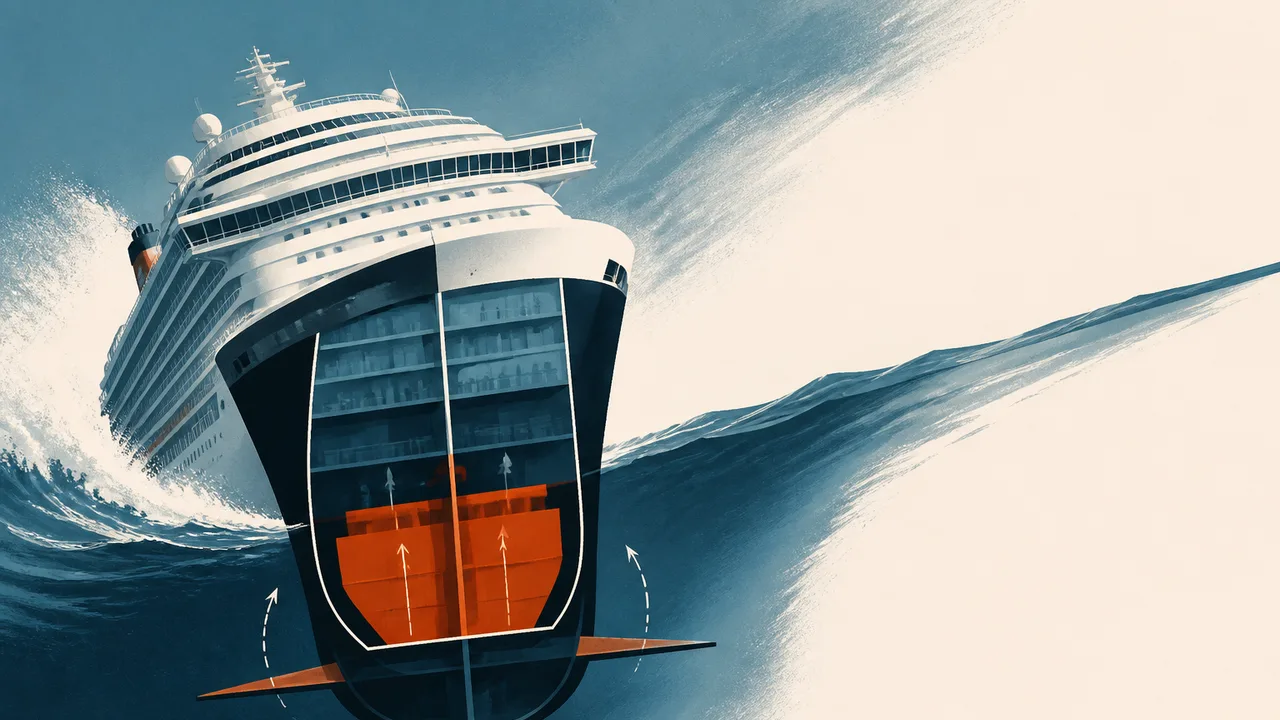
Photo: AI. Mika Sørensen
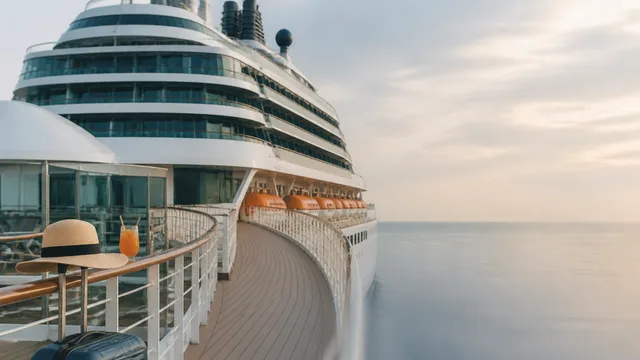
The Icon of the Seas is 1,198 feet long, rises 196 feet above the waterline, and carries up to 7,600 passengers across 20 decks, including seven swimming pools and a full water park mounted somewhere near the top. Your intuition, honed by a lifetime of watching tall things fall over, registers this as structurally absurd. A glass filled too high spills. A ladder leaned too far goes. The principle feels universal.
It is not universal. But the reason it isn't is considerably more complicated — and more conditional — than the cruise industry tends to advertise.
A recent video from The Ship Files with Larry breaks down the engineering systems that keep modern cruise ships stable, and the most valuable thing it does is refuse the simple answer. The simple answer is size. Big ship, hard to flip. That answer is incomplete in a way that makes the real answer far more interesting, as the video puts it, "because size alone does not make anything stable." What follows from that refusal is a layered account of how naval architects, stability officers, and bridge crews are all continuously working a problem that never fully resolves.
The number that governs everything
The foundation is a concept called metacentric height, abbreviated GM. It is the vertical distance between two invisible points: G, the ship's center of gravity, and M, the metacenter, a geometric point describing how buoyancy forces shift when the vessel tilts. When M sits above G — a positive GM — tilting the ship generates a restoring force that pushes it back upright. When G climbs above M, even briefly, that restoring force inverts. The ship no longer wants to return to center. It wants to continue rolling. Every hull has what engineers call an angle of vanishing stability: the heel angle at which physics stops working in the ship's favor and starts working against it. Cross that line and the ship will roll past horizontal. There is no recovery.
The International Maritime Organization sets minimum thresholds: metacentric height must not fall below 0.15 meters, and the righting lever — the effective arm of the correcting force — must remain above 0.20 meters at a heel of at least 30 degrees. Modern cruise ships are designed to exceed those floors substantially. The margin is the engineering goal, not compliance with the floor.
So far, the prescription seems obvious: maximize GM, push G as low as possible, build in the largest correcting force you can. Here is where the video earns its keep.
The stiff ship problem
Engineers do not want the largest possible GM. A ship engineered for maximum stability — what naval architects call a "stiff" ship — snaps back violently when disturbed. Glassware shatters. Passengers in corridors lose their footing. The corrective motion arrives not as a gentle recovery but as a physical jolt. As the video describes it, a stiff ship "is technically safer in pure physics terms, but it is operationally intolerable. It would injure passengers on normal sea days. Nobody would book it twice."
The alternative — a "tender" ship with lower GM — rolls more slowly and recovers with what most passengers register as a natural sway. It is also, by definition, operating with a smaller buffer between normal motion and the angle of vanishing stability. Every cruise ship is deliberately tuned somewhere in that range. GM, the video argues, "is not just a physics number. It is a hospitality decision disguised as an engineering parameter."
That reframing is worth sitting with. The safety margin on a cruise ship is not set purely by what physics permits. It is set by what the market will tolerate. The engineers satisfy the legal minimums, build in meaningful additional margin, and then locate the ship's operating parameters within a range that keeps drinks from sliding off tables. Those are not the same optimization target.
Five layers, two categories
The stability system underneath that GM trade-off has five distinct components, and the video draws a distinction between them that the industry's marketing rarely does.
The hull's beam — 225 feet on Icon of the Seas — is the first layer. Width determines the waterplane area, the footprint at the waterline. A wider ship generates asymmetric buoyancy forces earlier and harder when it heels, meaning meaningful correction begins before the tilt becomes alarming. That geometry is fixed before the ship is built.
The second layer is bilge keels: flat metal fins welded along the lower hull, unchanged in basic principle since roughly 1870. No motors, no sensors, no power draw. When the ship tries to roll, water must push past these fins, adding hydrodynamic drag that slows and dampens the motion. They work because physics works.
Third: ballast tanks. As fuel burns and provisions deplete across a voyage, the ship's weight distribution drifts. Ballast tanks — filled or emptied with seawater in real time by a stability officer — compensate continuously. The ocean, as the video notes, does not get a static ship. It gets one that is perpetually rebalancing itself.
Fourth: active fin stabilizers. These are the components passengers most often hear about — large retractable fins extending below the waterline, rotating to generate hydrodynamic lift against the roll, adjusting their angle hundreds of times per minute. On Icon of the Seas, each fin reportedly weighs around 350 tons. They are impressive hardware.
They are also, per the IMO's own framework, irrelevant to the ship's stability certification. Active stabilizers are not counted toward the official stability calculation. The hull must be fully stable without them. "Those fins do not make the ship stable," the video states plainly. "They make the passengers comfortable." If they were switched off tomorrow, the ship would remain upright. They exist to suppress motion that the hull's passive systems have already made survivable but that would still make a ten-day voyage miserable.
The fifth layer — anti-roll tanks, partially filled chambers of water tuned to the ship's natural rolling frequency — operates on the same comfort-engineering logic. When the ship rolls one direction, the water sloshes the opposite way. Passive, zero power, mechanically elegant.
The threat the brochure doesn't mention
Among the stability risks the video addresses, parametric rolling is the one most passengers will never have encountered. It has nothing to do with wave height. It is about timing. Every ship has a natural rolling period. If waves arrive at the bow at roughly twice that frequency, the hull geometry changes in a repeating pattern that amplifies each roll cycle instead of damping it. The ship does not get knocked over by a single catastrophic wave. It gets wound up by rhythm. Naval architects run computational fluid dynamic simulations across millions of wave encounter scenarios to model this before any steel is cut. The ocean, in their calculations, is treated as a statistical distribution of random forces — and the ship is built to survive the extreme tails of that distribution.
Those tails exist. In 1995, the Queen Elizabeth II encountered a wave in the North Atlantic estimated at roughly 95 feet — approximately nine stories. The ship survived. Passengers were injured. The hull held and the vessel remained seaworthy. That incident is documented in maritime records, and the engineering community's takeaway is precise: the stability systems work within an assumed envelope. There is a sea state beyond that envelope. The QE2 found the edge. It held. The edge still exists.
The layer that isn't mechanical
The final component of the stability system is the one no passenger sees or feels: route avoidance. Modern cruise ships don't wait to test their engineering against severe weather. Officers monitor satellite imagery, NOAA feeds, and wave modeling continuously. When a system is developing, the ship changes course. It slows down. It holds at port until a weather window opens. "Avoidance is not a backup plan," the video argues. "It is the primary layer of the stability system that passengers never see, never feel, and almost never think about."
That framing deserves some scrutiny, if only because it inverts the usual intuition about engineering hierarchy. We tend to think of the physical system as primary and operational decisions as supplementary. Here, the argument is that the navigation intelligence is doing the heaviest lifting — precisely because it prevents the physical systems from ever being tested at their limits. The engineering holds because the operators protect the margin. The margin holds because they understand the edge exists, even when passengers are reclining on sun decks with no particular reason to think about it.
The reason a cruise ship doesn't flip is that it was designed, ballasted, monitored, and navigated so that the point of no return stays so far from ordinary experience that the people most exposed to the consequences — the passengers — never have occasion to learn what metacentric height means.
That is either a remarkable feat of engineering confidence, or a very elegant description of how managed risk actually works. Probably both.
More Like This
Rogue Waves: The Ocean Phenomenon Science Got Wrong
For centuries, scientists dismissed rogue waves as sailor myth. Then one hit a North Sea oil platform and rewrote everything we thought we knew about the ocean.
Inside the Ship That Keeps Newfoundland Alive
The Canadian Coast Guard icebreaker Henry Larson doesn't just rescue trapped ships—it's the lifeline holding remote Newfoundland communities together.
Unlocking New Skills After 50: The 'Pillar & Playground' Approach
Explore how the 'Pillar & Playground' method helps those over 50 learn efficiently, leveraging crystallized intelligence and cognitive flexibility.

Exploring Black Holes and Asteroids with StarTalk
Neil deGrasse Tyson delves into black holes, asteroids, and more in StarTalk's latest Cosmic Queries episode with Chuck Nice.
What Experienced Cruisers Know Before They Board
Professor Melissa's 14-minute cruise guide distills hard-won tips on packing, pricing, seasickness, and gratuities that first-timers rarely hear before embarkation day.

Auditing Vibe-Coded Apps Without Reading Them
A Brainqub3 video argues you can safely ship 100k-line AI-generated codebases without reading them. The framework is sound. The business model behind it is worth examining.

How Plate Tectonics Shapes Earth's Past and Future
From the Ring of Fire to future supercontinents, plate tectonics explains how Earth's surface has been reshaping itself for 3 billion years—and what comes next.

Why Finding Earth's Twin Among Exoplanets Is So Hard
The TRAPPIST-1 system looks promising—seven rocky planets, three in the habitable zone. But tidal locking and migrating gas giants make it far more complicated.