Inside the Ship That Keeps Newfoundland Alive
The Canadian Coast Guard icebreaker Henry Larson doesn't just rescue trapped ships—it's the lifeline holding remote Newfoundland communities together.

Written by AI. David Oyelaran
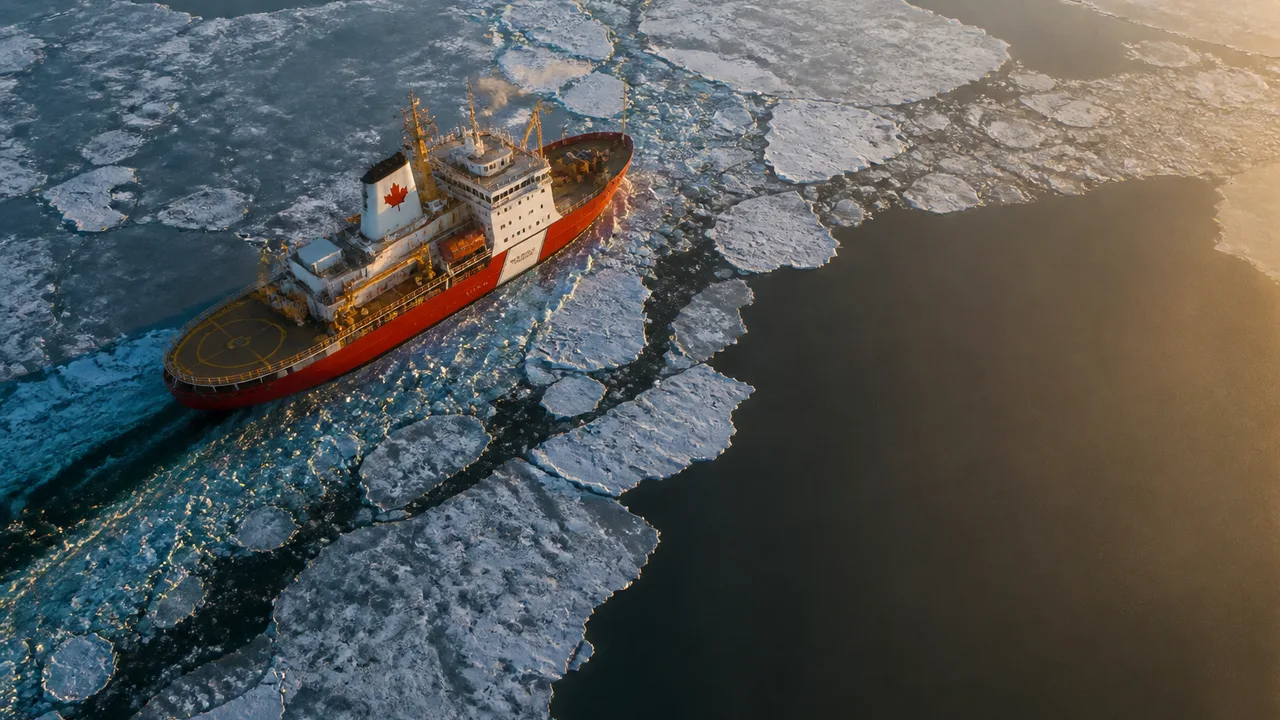
Photo: AI. Rio Sanchez
There's a moment in the documentary following the Canadian Coast Guard icebreaker Henry Larson where Captain John Vanthal is on the radio with the crew of a trapped cargo ship, rehearsing signals—flashing red light, icebreaking horn, full stop—before attempting a rescue in failing light. His voice is careful, patient. Then he says, almost as an aside: "We have to understand each other 100%. Quite often we do have ships coming into this area where English is not their first language. So sometimes there is communication difficulty."
That small admission carries a lot of weight. This is not a system with much margin for ambiguity. The Henry Larson is an 8,000-ton, 100-meter icebreaker operating in the North Atlantic off the northeast coast of Newfoundland—one of the most hostile marine environments on the planet. She generates 12 megawatts of power, enough to light 7,000 homes, and delivers 16,000 horsepower to her twin propellers. She can punch through ice three meters thick. And when she's working a rescue, if the trapped vessel follows too closely, it rear-ends her; too far behind, the ice closes back in. The window of safe operation is measured in meters and seconds, and it sometimes hinges on whether a foreign crew understands what a flashing red light means.
That tension—between enormous capability and razor-thin margins—is what the documentary keeps returning to, whether it means to or not.
One Ship, Many Jobs
The Henry Larson doesn't do one thing. On any given stretch of her patrol, she might be clearing a channel for the Fogo Island ferry, mid-rescue of a cargo ship, training a cadet at the bridge, running a helicopter reconnaissance of a pressurized ice ridge, and bracing for a blizzard—sometimes in that order, within 24 hours.
The Fogo Island ferry, MV Bowmont Hamill, runs five trips a day between the island and the mainland. Captain Charlie James, the longest-serving Newfoundland ferry captain currently at sea, puts it plainly: "I'd be retired today if I didn't like it." But the ferry can't operate in ice without Larson breaking the channel first. The ferry docks are in water too shallow for the icebreaker, which means at a certain point—midway through the route, at the Change Islands—the ferry is on its own. The Larson can only do so much.
This is the infrastructure reality of remote island communities that rarely makes the news: the entire connective tissue between Fogo Island and the rest of the world runs through one ferry, and that ferry runs because one icebreaker clears the way. Everything the islanders depend on—people, vehicles, food, medicine, manufactured goods—moves through that channel. When a blizzard pins the ferry for 36 hours, nobody comes and nobody goes. The island doesn't have a backup plan, because there isn't one.
The Technology Gap
The Larson carries what the documentary calls a "secret weapon": a twin-engine helicopter used for ice reconnaissance. Ice observer Denny Lambbear—the ship's "ice pick"—explains why satellite data alone isn't enough: "With the radar-sat image there, you know where the ice is located, but it's hard to tell what ice type it is." From the helicopter, he can assess whether a ridge is under pressure, how thick it is, what it's actually made of. That distinction matters enormously. A pressurized ice ridge can be up to 10 meters high above the waterline—and up to five times that depth below it. The submerged mass is the real threat, and satellites can't read it.
What's interesting here is less the technology itself than what it reveals about the limits of remote sensing. The Larson operates with 66 air-bubbling nozzles below the waterline to reduce hull friction, ice-hazard radar that helps plot a "herring bone" cutting technique through pressure ridges, and satellite imagery updated regularly. And still, the most reliable intelligence comes from a man leaning out of a helicopter, looking at the ice with his own eyes.
Pilot Jim Myra, landing that helicopter back on a moving icebreaker in a 25-to-30-knot wind, describes it as "probably on the upper end of what I would land on the ship with." The documentary frames this as thrilling. It's also just Tuesday.
The Cost of Readiness
The documentary spends real time on drills—lifeboat launches, fast rescue craft exercises, man-overboard simulations, first aid scenarios, a surprise night-airlift drill run by the 103 Search and Rescue Squadron out of Gander. What emerges is a picture of a crew in near-constant training for events that, if they happen, will happen fast and in brutal conditions.
Some of the details are quietly alarming. A lifeboat dropped onto frozen water hits like concrete and shatters. Without a survival suit, the North Atlantic induces cold shock within two minutes—and swimming, the instinctive response, only accelerates hypothermia. The documentary mentions, almost in passing, that the previous year 21 people were overcome by exhaust fumes during a lifeboat drill elsewhere—not Coast Guard, but the danger is noted and taken seriously.
Quartermaster Shannon Shepard and cook Ronda Mercer form the ship's rescue specialist team. The documentary describes them as throwing on their "superhero identities." That framing is a bit much, but the underlying point holds: on a ship operating in this environment, job titles blur under pressure. The cook and the quartermaster are also your search-and-rescue team.
Thirteen Hours in the Ice
The Larson's rescue of the Finnwood—a Swedish-owned cargo ship trying to reach Botwood through a pressure ridge three kilometers wide—is the documentary's centerpiece, and it's instructive precisely because it's not dramatic in any cinematic way. It's methodical. Captain Vanthal works the herring bone technique through the night, swinging port and starboard to widen the channel his bow has cut down the middle, pushing ice into open water with the stern. He's been at it for 13 hours when he finally radios Finnwood: "We have made a track through the pressurized ice. You can now proceed."
Then he immediately worries the path won't be wide enough at the critical turn. So he widens it some more.
There's something worth sitting with in that sequence. The Larson spent 13 hours clearing a path for one cargo ship carrying pulp and paper to Botwood. That's the job. There's no ceremony, no particular acknowledgment that this was exceptional. The storm was coming. The path needed cutting. Cut it.
The documentary's framing is celebratory throughout, and understandably so—the crew is skilled, the mission is real, and the stakes are not manufactured for television. But the celebration also quietly papers over a question the footage keeps raising: what happens when the Larson isn't there?
The documentary mentions that if these two ships had collided during the Joe Gorthon rescue, there was no other icebreaker available to help them. Canada's Arctic and sub-Arctic coastlines are long, and the Henry Larson is one vessel. The crew trains relentlessly for scenarios they hope never occur, maintaining readiness for a system that has very few redundancies built in.
Whether that's an acceptable arrangement—given the communities depending on it, the commercial traffic moving through these waters, and the climate pressures reshaping ice patterns every season—is a question the documentary doesn't ask. It's worth asking anyway.
More Like This
Inside the $65M Car Carrier Crossing the North Atlantic
The Faust carries $65M in luxury cars across a winter North Atlantic. What the documentary reveals about the people and systems keeping it all afloat.
Luxury Icebreaker Cruise: A Journey to the North Pole
Explore the Arctic on a 14-day luxury cruise. Discover polar bears, stunning views, and life on board a state-of-the-art icebreaker.

Air New Zealand's Business Class Dilemma
Air New Zealand's new business class faces criticism for its lack of privacy and direct aisle access, raising questions about its competitive edge.
Inside Argentina's 7-Generation Working Estancia
Estancia La Tomasa near Buenos Aires has welcomed guests since 2023. Here's what a weekend on this 140-year-old working ranch actually looks like.
The WWII Flying Boat Still Fighting Wildfires Today
The Martin Mars water bomber—a WWII relic with a 60m wingspan—is fighting Mexico's worst wildfires in 30 years. Here's how it actually works.
California's Forgotten Places and What They Cost
From a Nazi compound in the Pacific Palisades to a toxic mercury mine, California's abandoned places reveal what the state built, forgot, and left behind.
DNA Names a Revolutionary War Teen Soldier After 245 Years
Genetic genealogy has identified Private John Pumphrey, a Maryland teen who died at the Battle of Camden in 1780 — one of America's oldest John Doe cases.

Cicero and the Fall of the Roman Republic
Marcus Tullius Cicero defended Rome's Republic with words alone—and paid with his life. A look at history's most consequential orator and his impossible political moment.