Webb Finds the Farthest Fast Radio Burst’s Dwarf Host
Webb measured the host of the farthest fast radio burst. Its dwarf galaxy and dispersed signal offer different clues about the burst and matter along its path.

Written by AI. Amelia Nwofor
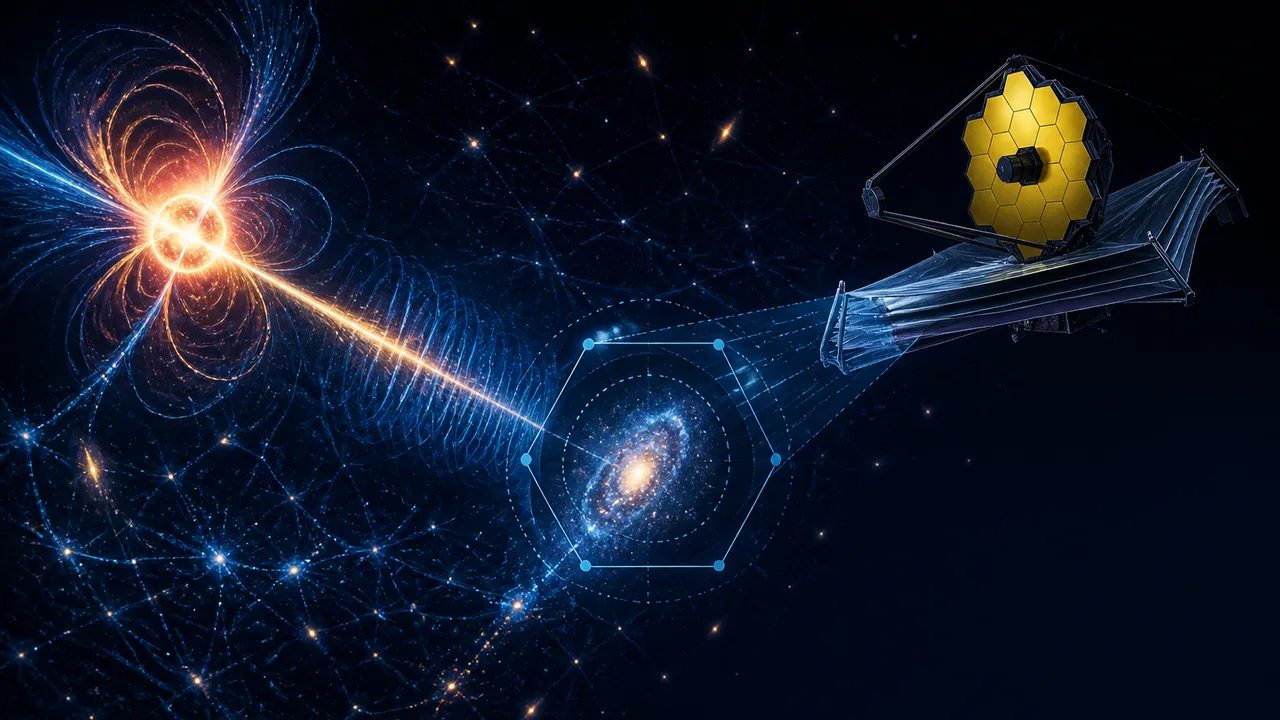
FRB 20240304B reached a radio telescope in South Africa after traveling for more than 10 billion years. The flash lasted milliseconds. Astronomers then found its host galaxy with the James Webb Space Telescope: a faint dwarf galaxy forming stars when the universe was about 3 billion years old. It is the most distant fast radio burst yet detected.
That discovery gives researchers two different questions to work on. What could have produced the flash in such a small galaxy? And what did its radio waves encounter on the way here? The host offers a clue about the first question; the signal carries information about the second. Neither requires a tidy answer to be useful.
Finding a Galaxy After the Flash
South Africa’s MeerKAT radio array detected the burst in March 2024. The MeerTRAP project located it precisely enough for follow-up observations, but even large ground-based telescopes could not see a galaxy at that position. Webb’s Near-Infrared Camera found a faint one there. Its Near-Infrared Spectrograph then measured the galaxy’s redshift at 2.148.
The sequence is central to the distance claim. A radio signal’s dispersion suggested that this burst had traveled far, but the host galaxy supplied a more precise cosmic address. Hydrogen and oxygen features in its spectrum appeared at wavelengths stretched by the universe’s expansion. Comparing those features with their known wavelengths yielded the host’s redshift measurement. The team could then place the galaxy, and the burst associated with it, in the early universe.
Fast radio bursts were first discovered in 2007. Astronomers have since detected thousands, yet their millisecond duration makes it difficult to pin down where individual flashes begin. A precisely located burst makes follow-up possible; a galaxy spectrum supplies a distance that a large radio delay alone cannot settle. For this event, seeing the host required Webb after ground-based searches found no galaxy at the burst’s position. Finding the flash and finding its home were separate observational jobs.
The previous distance record provides a useful comparison. The burst FRB 20220610A was detected with Australia’s ASKAP radio telescope, and the European Southern Observatory’s Very Large Telescope helped identify its host. Its light had traveled about eight billion years to reach Earth; the associated study described a burst probing the universe at redshift 1. The pulse was also used to study ionized material between galaxies. FRB 20240304B extends the search into an earlier epoch, with a host measured at redshift 2.148.
A Small Host, and a Question About Timing
The galaxy Webb found is small, poor in elements heavier than hydrogen and helium, and actively forming stars. It was about 1,000 times less massive than the team expected. That figure compares the host with a research expectation; it does not assign the same mass to every other FRB host. The researchers’ description of its metal-poor, star-forming environment adds a second clue alongside its size: stars are still being made there.
Star formation makes one proposed engine plausible. A massive star can explode and leave behind a magnetar, a neutron star with an exceptionally strong magnetic field. In a young, busy stellar population, such an object could form and produce a burst without a long wait. The team also considered a merger involving older neutron stars, an explanation associated with more evolved stellar populations. Study leader Manisha Caleb said the findings make a merger unlikely for this burst.
A galaxy’s overall star formation describes an environment; Webb did not catch the object that emitted the radio flash in the act. The small host favors a relatively prompt origin in the team’s interpretation, but one event cannot establish that all fast radio bursts have the same engine. Future distant hosts could show whether this dwarf belongs to a wider early-universe population or is an unusual case that telescopes were finally sensitive enough to find.
There is a useful check against treating its small size as a unique fingerprint. A recent CHIME/FRB Outrigger host study examined eight hosts associated with one repeating and seven apparently non-repeating bursts, newly classifying five hosts as dwarfs. Combining its host measurements with earlier work, the authors reported different metallicity distributions for repeaters and apparently non-repeating bursts. Most hosts identified across accumulated surveys have been star-forming galaxies of moderate stellar mass. The new study is a preprint built around a targeted dwarf-host search, so its eight hosts are no census of all FRBs; the repetition status of FRB 20240304B remains unspecified here.
That comparison sharpens the question raised by Webb’s galaxy. If host environments differ among bursts, a distant dwarf can help test proposed links between stellar populations and FRB engines. Its low metal content alone cannot place it in the repeating group or name the object that flashed. Astronomers need more hosts, and more information about the bursts associated with them, to separate an environmental preference from the effects of which galaxies their instruments can detect.
What the Signal Met Between Galaxies
The burst has a second use that does not depend on identifying its engine. Radio waves of different frequencies travel through diffuse plasma between galaxies at slightly different speeds. Lower-frequency, longer-wavelength waves arrive later than higher-frequency waves, an effect called dispersion. The frequency-dependent delay reflects electrons along the route; an astronomical study of dispersive timing describes the delay’s dependence on frequency and the column of electrons encountered. Measuring it helps astronomers investigate intervening material that is difficult to observe directly.
The team also identified the imprint of cosmic structures on FRB 20240304B’s signal, including a previously unknown galaxy cluster at a redshift of 0.3. The long journey crosses structure as well as apparently empty space. Mapping matter across many directions would require bursts at multiple positions and distances, with host distances measured well enough to interpret their radio delays.
Those two measurements answer different questions. Webb’s spectrum establishes when the host galaxy existed; dispersion describes material the radio signal traversed after leaving it. The first helps researchers compare possible birthplaces. The second helps them investigate the space between those birthplaces and Earth. Treating the delay alone as a precise distance, or treating the dwarf galaxy as a photograph of the burst’s engine, would ask either measurement to do work it cannot do.
Nanayakkara’s team plans to use Webb for further ancient FRB hosts after radio telescopes find and locate suitable bursts. Each successful pairing can add a host to the origin question and another long route through intergalactic matter. For FRB 20240304B, astronomers have located an early-universe home for a millisecond flash and recovered information from a signal that spent more than 10 billion years reaching us.
More Like This
Astronomers Catch a Wandering Black Hole Feeding Far From Home
A supermassive black hole has been spotted roaming its galaxy's outskirts while actively feeding. What the observation shows, and what follow-up work must confirm.
A Black Hole Jet Rule Faces Its First Big Scale Test
A study of 10 tidal disruption events links delayed black hole jets to a 2% Eddington threshold, suggesting one rule may span very different black hole sizes.
Gravitational-Wave Astronomy's Next Frontier
Space-based optical clock networks could unlock the millihertz band, opening a new chapter in gravitational-wave astronomy beyond what LIGO and Virgo can reach.
The Wow! Signal at 47: What We Know and Don't
47 years after the Wow! signal stunned radio astronomers, it remains unexplained. Here's what the data actually shows—and what it still can't tell us.

TON 618: The Black Hole That Defies Its Own Physics
TON 618 weighs 66 billion solar masses—more than current black hole growth models can explain. Here's what that gap in our knowledge actually means.
JWST's Little Red Dots May Be Cocooned Black Holes
New JWST spectral data on a single "little red dot" galaxy offers the strongest case yet that they're supermassive black holes wrapped in dense gas cocoons.

How Tectonic Forces Shaped the European Continent
From 3-billion-year-old Norwegian rocks to the Alps still rising today, Europe's geological story is wilder than any human history we know.
Why Physics Still Cannot Explain What Time Actually Is
Philosopher Simon Saunders tells Curt Jaimungal why time remains physics' most poorly understood concept—and why our models may never capture its felt reality.