JWST's Little Red Dots May Be Cocooned Black Holes
New JWST spectral data on a single "little red dot" galaxy offers the strongest case yet that they're supermassive black holes wrapped in dense gas cocoons.

Written by AI. Amelia Nwofor
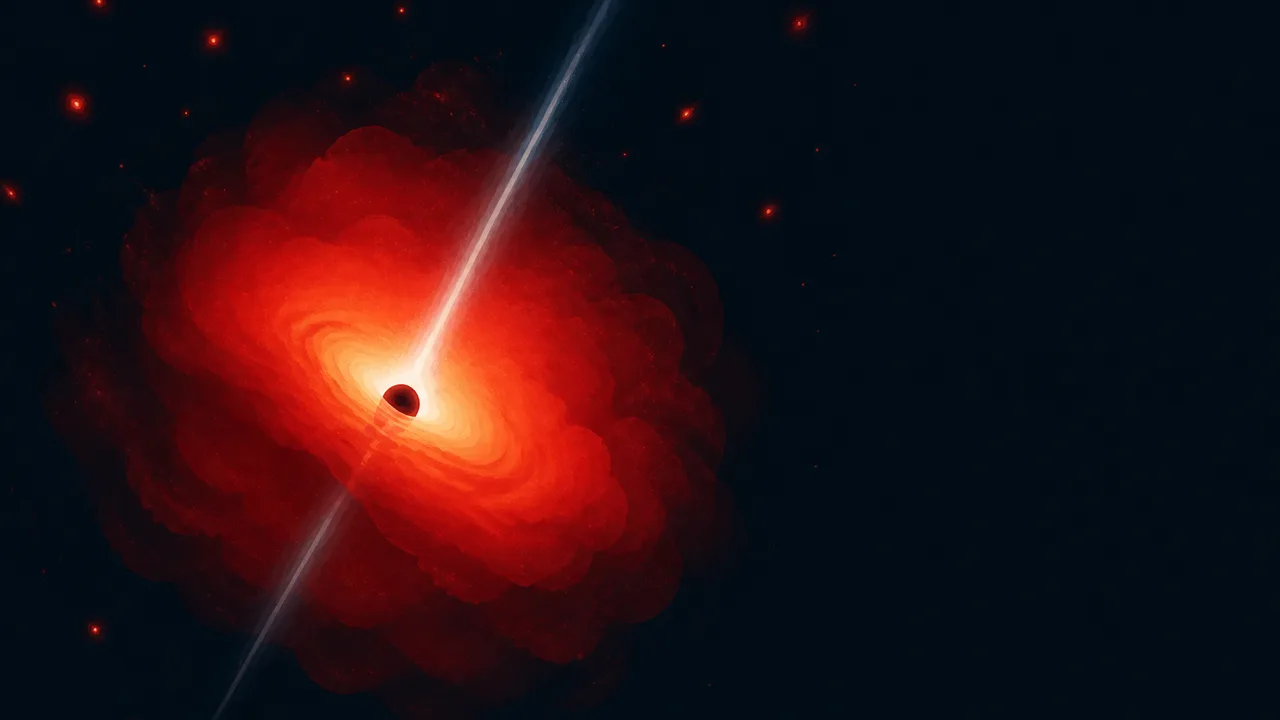
Photo: AI. Mika Sørensen
Twenty hours. That's how long astronomers stared at a single faint smudge in the early universe—a galaxy called GLIMPSE-17775, roughly 11–12 billion light-years away—before the data started to talk back coherently. What the James Webb Space Telescope returned from that long stare is the most detailed spectrum ever obtained of one of the objects astronomers have spent the better part of three years trying to explain: the so-called "little red dots."
The new analysis, from Kokorev and collaborators (2026), is not a solved mystery. But it is the closest thing to a smoking gun the field has produced so far, and it's worth understanding precisely what it does and doesn't establish.
What the little red dots actually are (or might be)
When JWST first came online and started collecting spectra of the distant universe, researchers noticed something odd: a population of compact, red-tinted sources that didn't fit neatly into any existing category. Some of them showed "broad lines" in their spectra—the spectral fingerprint of gas moving at extreme velocities around a growing supermassive black hole, Doppler-smeared into wide peaks. That made them candidate AGN, active galactic nuclei. Standard stuff, in principle.
Except that when astronomers went looking for the X-ray and radio emission that a growing black hole should produce, it mostly wasn't there. And the sources had this peculiar V-shaped spectrum—bright in blue light, bright in red, with a dip in between—that didn't match any clean model. And there were thousands of them, which ruled out any explanation involving extreme rarity.
Three competing hypotheses emerged. First: massively star-forming galaxies, huge blobs of stars that assembled extraordinarily quickly in the early universe. The problem, as astrophysicist Dr. Becky Smethurst explains in her June 2026 Night Sky News video, is that "the mass you need in stars to make that work is just so enormous that it would break our best models of the universe. It just shouldn't be possible for that many stars to form that quickly." This connects to a broader JWST tension around galaxies that challenge our understanding of how quickly the early universe assembled structure—a problem that predates the little red dots and hasn't gone away.
Second hypothesis: dust. Heavy molecules that preferentially block shorter, bluer wavelengths while letting infrared through. A dusty star-forming galaxy could plausibly look red and compact. But dust hot enough to block that much light should also glow in longer infrared wavelengths. When Casey and collaborators looked for that signal in 2024, it wasn't there at detectable levels. So, probably not dust.
Which leaves the third option, the one that keeps reasserting itself despite its own complications: these are supermassive black holes in the early universe, actively accreting, but hidden inside an extraordinarily dense cocoon of gas. The gas scatters X-rays so aggressively that by the time that radiation escapes the system, it's lost most of its energy and re-emerges in the ultraviolet or visible range. No X-rays detected. V-shaped spectrum partially explained. The model even has a name—"the black hole star model," notated BH* in the literature, a naming convention Smethurst calls "annoyingly" confusing because it has nothing to do with stars.
What 20 hours of staring revealed
The Kokorev et al. (2026) paper is the most direct test of the dense-cocoon hypothesis yet attempted. Using JWST's NIRSpec instrument on GLIMPSE-17775—a little red dot observed when the universe was just 2 billion years old—they extracted a spectrum containing over 40 emission and absorption features. Compare that to the handful of features detectable in the noisier survey-mode spectra the field has been working with, and you get a sense of the resolution jump involved.
What did those 40-plus features reveal? Four distinct lines of evidence, each pointing in the same direction:
The shape of the emission lines themselves was unusual. Rather than the smooth, symmetric broadening you'd expect from Doppler shifts in an accretion disc, the lines had extra "wings"—a morphology that, as Smethurst describes it, is "the fingerprint of this light has been scattered through some very dense gas."
The spectrum also showed strong helium emission that, according to the team, "only can happen in very dense gas regions." Similarly, a pair of oxygen emission spikes arose from fluorescence driven by the combination of extreme orbital velocities and reprocessing through dense gas. And the pattern of iron emission spikes matched predictions for what you'd see from a supermassive black hole surrounded by very dense material.
Add the characteristic blue-light drop-off to those four features, and you have five independent lines of evidence converging on the same picture: a growing supermassive black hole, cocooned in gas so dense it transforms the outgoing radiation before it ever reaches us.
"This dense cocoon scenario might just be the way that the majority of black holes in the early universe grow to become so super massive," Smethurst says—"rapidly and messily hidden behind all of this gas that blocks X-rays and makes them look nothing like the supermassive black holes that we see around us today."
What it doesn't establish
Here's the part that matters as much as the finding itself: none of this is yet confirmed as representative. GLIMPSE-17775 is one object. It could, as Smethurst acknowledges directly, "turn out to be a bit of a weirdo." The little red dot population numbers in the thousands; a single deep spectrum, however detailed, doesn't speak for all of them.
What makes the Kokorev result compelling despite that limitation is that the five pieces of evidence it assembled in one clean package have each shown up separately in the noisier spectra of other little red dots. This isn't a set of features that appeared out of nowhere in one peculiar object. It's a set of features that kept appearing individually, fragmented across a population, and that a 20-hour integration finally allowed researchers to see all at once in a single source. That's a meaningful difference.
It's also worth noting that the broader pattern of JWST surprises gives some context for why these objects matter beyond their own weirdness. JWST has been systematically surfacing objects in the early universe that are harder to explain than expected—galaxies too massive, too luminous, too structured for their age. The little red dots fit that pattern, and if the dense-cocoon model holds, it implies black holes were growing faster and more chaotically in the early universe than current models predict. That's not a solved problem. It's a constraint on the solution space.
The question the data opens
The dense-cocoon hypothesis, if it generalizes, reframes how we think about supermassive black hole growth. The black holes we observe in the nearby universe—including the one at the center of the Milky Way—built up their mass over billions of years in ways we're beginning to understand. If the little red dots represent a different growth channel, a rapid, gas-smothered, X-ray-invisible phase of early black hole assembly, then our picture of how these objects form is substantially incomplete.
Kokorev et al. (2026) doesn't close that question. It sharpens it considerably. The next step is more integrations like this one—more 20-hour stares at individual objects—to see whether GLIMPSE-17775's fingerprints repeat across the population or whether this one dot really is an outlier. That's slow, expensive, telescope-time-intensive work. The kind of science that rarely makes headlines until it suddenly does.
More Like This
The Deeper Geometry Behind the Pythagorean Theorem
Explore why the Pythagorean Theorem appears in unexpected places, from geometry to relativity.
James Webb Challenges Dark Matter Beliefs
James Webb Telescope data questions the Bullet Cluster's role as dark matter proof, suggesting complex galaxy interactions.
Betelgeuse's Hidden Star: Solving Celestial Mysteries
Unveiling Betelgeuse's hidden companion star reshapes our understanding of stellar evolution and supernova precursors.
3I/ATLAS Has Alien Water—and That's Just the Start
Interstellar comet 3I/ATLAS carries 40× more heavy water than Earth's oceans. Here's what that chemistry tells us—and what we still can't explain.
JWST's Latest Discoveries Are Breaking Cosmology
JWST is finding galaxies too big, too bright, and too early. From dark stars to interstellar comets, here's what the data is actually telling us.
When Black Holes Collide: Energy, Mass, and Mystery
What really happens when two supermassive black holes merge? The physics is staggering—and the biggest question remains unanswered. Here's what we know.
Nanodomains, Pulsars, and What We Can't See Yet
Izzy Jayasinghe and Alfredo Carpineti discuss heart disease, invisible light, and what super-resolution microscopy reveals about the body's smallest structures.
Intelligence Beyond the Brain: Michael Levin's Radical Rethink
Biologist Michael Levin argues intelligence exists on a continuum reaching down to cells and molecules. Here's what the evidence actually supports—and where it gets murky.