Astronomers Catch a Wandering Black Hole Feeding Far From Home
A supermassive black hole has been spotted roaming its galaxy's outskirts while actively feeding. What the observation shows, and what follow-up work must confirm.

Written by AI. Mike Sullivan
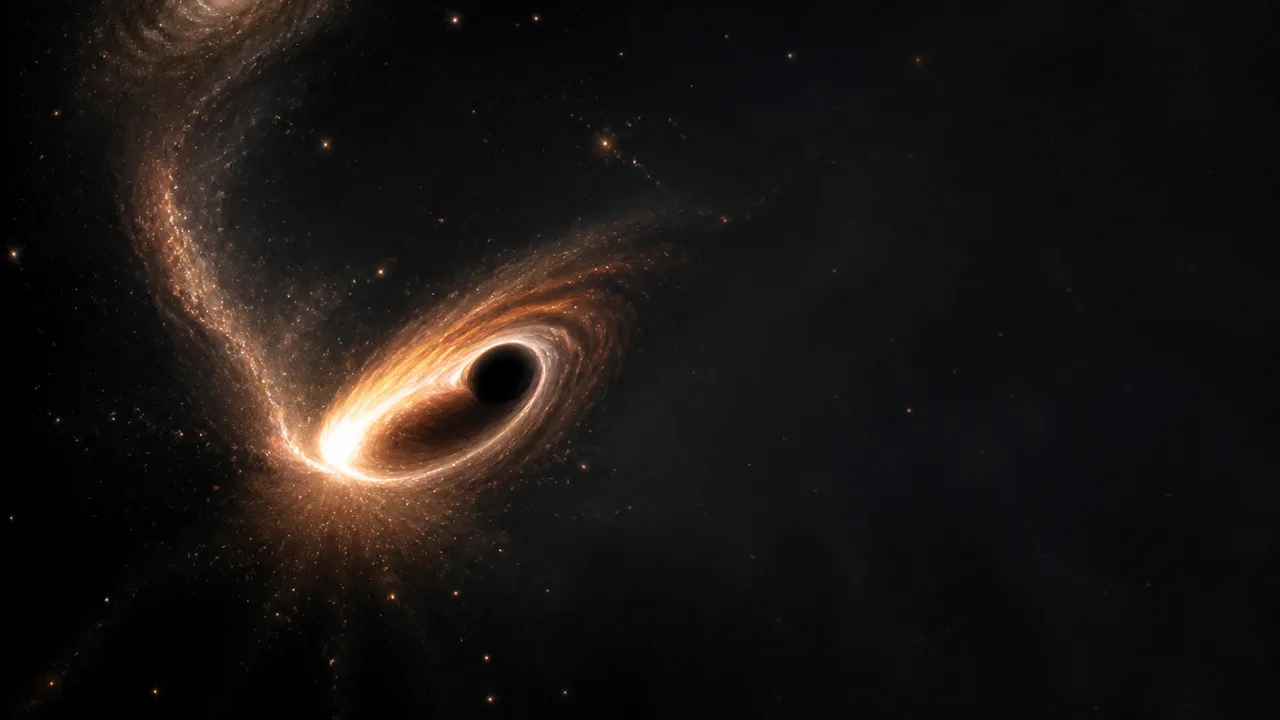
In August 2026, astronomers reported evidence of a supermassive black hole feeding while it wanders far from its galaxy's center, according to phys.org. That is an odd sentence to write, and an odder one to read, because black holes are usually studied as the fixed furniture of the universe: the anchor at the middle of a galaxy, or the tethered partner in a binary system. This one appears to be off doing laps in the suburbs.
Space.com went with "cosmic indigestion," which makes astronomers wince and makes the rest of us click.
Beneath the snack jokes is a finding with real observational weight, and also real caveats. Here is what the reports actually establish, what they do not, and why the follow-up matters more than the fireworks.
How You Photograph Something that Eats Light
A black hole emits nothing. You find one the way you find a burglar in a dark house: by what goes missing and what gets knocked over. When a black hole passes through a cloud of gas, the gas accelerates, heats, and glows in characteristic ways. When it passes near a star, the star can be torn apart in a tidal disruption event, a stretch-and-shred process that produces a flare of radiation as the debris spirals in.
That is what these reports describe: a compact object revealed by the behavior of matter and radiation around it, with the motion of that matter suggesting the object itself is moving through its host environment, as phys.org explains. The feeding is the flashlight. The wandering is the news.
Most of the black holes astronomers have catalogued sit where theory says they should. Supermassive ones anchor galactic centers, including Sagittarius A* at the middle of our own Milky Way. Stellar-mass ones mostly sit in binaries, stripped down and fed by a companion. A black hole roaming a galaxy's outskirts with an accretion disk running is a different animal, and the reports agree on that framing even where they differ in tone.
How Does a Black Hole End Up in the Sticks?
The interesting question is not that it exists but how it got there, and the reports leave the mechanism open. Two broad routes appear in the research literature on off-nuclear black holes.
The first is a kick. When two black holes merge, the merger can asymmetrically radiate momentum, recoiling the remnant at thousands of kilometers per second, fast enough in principle to eject a supermassive black hole from its galaxy's core. Gravitational-wave detectors have measured recoil in smaller systems; whether it explains a wandering supermassive object requires measuring this one's trajectory.
The second is a hostage. During galaxy mergers, a smaller galaxy's central black hole can be dragged into a larger one and then linger in the outskirts for a long time before sinking to the center. Some off-nuclear black holes are probably migrants still in transit; others may be stranded satellites.
A third possibility deserves honest airtime: it may not be moving at all. The reports are upfront, per phys.org, that many candidate signals for wandering black holes can be produced by other energetic astrophysical events. A flaring object in a crowded, dusty region can mimic the signature of a traveling accreting black hole. Follow-up observations across multiple wavelengths are the test, because a genuine mover should show consistent kinematics across independent measurements.
Why the Feeding is the Story
It is tempting to file this under "space is cool" and move on. The accretion is where the science lives, for two reasons.
First, the feeding is what makes the object detectable and measurable at all. A quiet wandering black hole is invisible; a feeding one hands astronomers a spectrum, a light curve, and eventually, with enough data, a velocity. The snack is the instrumentation.
Second, feeding supermassive black holes in unexpected places stress-test our models of galaxy evolution. The standard picture ties black hole growth to galaxy centers, where gas density is highest and feedback loops between the black hole and its host shape how galaxies grow. Black holes that feed outside that environment are data points the models did not budget for. If a meaningful population of them exists, galaxy-formation simulations have to account for black holes that grow in the boondocks.
Space.com's "cosmic indigestion" framing, a feeding frenzy that ends badly for the surrounding matter, points at something the other reports touch more lightly: these events are transient. A tidal disruption flare fades. If astronomers caught this one mid-meal, the window for detailed observation is closing, which is exactly why the multi-wavelength follow-up pushed in the reports is urgent rather than routine.
What We Still Do Not Know
The record here is thin in specific ways, and it is better to say so than to paper over it. None of the five reports provides the object's mass, its host galaxy's name, its measured velocity, or the size of its offset from the galactic center. Those numbers will decide whether this is a recoiled monster, a captured satellite, or a misidentified flare. Until they exist, the honest framing is: evidence of a compact object feeding at a large offset from its galaxy's nucleus, with motion suggested but not yet pinned down.
I would also flag the epistemology, because it matters for how you read future headlines. Wandering black hole claims have a history of wobbling. Earlier candidates announced as runaway black holes were later reinterpreted by other teams as something stranger or more mundane. It is how the field works when the signal is faint and the alternatives are many. Treat this report as a strong opening argument, not a closed case.
The Follow-Up that Decides It
The next steps are concrete. Spectroscopy over time can reveal whether the accreting gas is Doppler-shifted consistently with a moving object. X-ray and radio observations can characterize the accretion flow and rule out competing explanations like a supernova or an active galactic nucleus seen through confusing geometry. If the motion holds up, measuring the trajectory tells you which origin story fits: a kick leaves a specific velocity signature, a merger remnant another.
There is a pleasant symmetry in watching this story land in 2026. Every generation of astronomy gets a discovery that rearranges where we expect things to be. Pulsars were once mistaken for little green men. Galaxies were once thought to be smudges inside the Milky Way. Now the universe's heaviest objects, the ones we assumed were bolted to the floor, turn out to have at least one member out wandering the yard with its sleeves rolled up and dinner in hand.
Whether it stays a curiosity or rewrites a chapter of galaxy evolution depends on data still being gathered. The black hole, meanwhile, does not care how the paper turns out. It is eating.
More Like This
Can Unreal Engine 5 Run on a $500 MacBook? Sort Of.
Testing Unreal Engine 5.7 on the MacBook Neo reveals what happens when professional software meets budget hardware—and why friction matters.
Do You Really Need an $80 HDMI Cable? Maybe Not
Tech reviewer Adam tests a premium HDMI 2.1 cable. We examine what you're actually paying for and whether most users need it.
The YouTube 'Content Wall' Strategy: Does It Actually Work?
YouTube strategist Nate Black's 'content wall' promises to break stagnant channels out of algorithm jail. We examine the claims and the reality.
CERN Picks Debian, Ubisoft Blocks For Honor on Linux: Week in Review
CERN ditches RHEL for Debian on accelerator systems, California exempts open source from age checks, and Ubisoft blocks For Honor. Mike Sullivan sorts it out.
TON 618: The Black Hole That Defies Its Own Physics
TON 618 weighs 66 billion solar masses—more than current black hole growth models can explain. Here's what that gap in our knowledge actually means.

VPNs in 2026: Useful Tool or Overhyped Security Fix
NetworkChuck got paid by NordVPN to make a VPN video, then tried to be honest about it. Here's what he actually got right—and what the industry still won't tell you.

AMD Dominates CPU Sales While Nvidia Enters the Ring
AMD holds all 15 top CPU bestseller spots. Nvidia's RTX Spark enters ARM computing. A new memory standard may outperform a CPU upgrade. Here's what's actually happening.