JWST Spots a Black Hole Star in the Early Universe
JWST has spotted a strange object—part black hole, part star—that may explain why supermassive black holes existed so soon after the Big Bang.

Written by AI. Amelia Nwofor
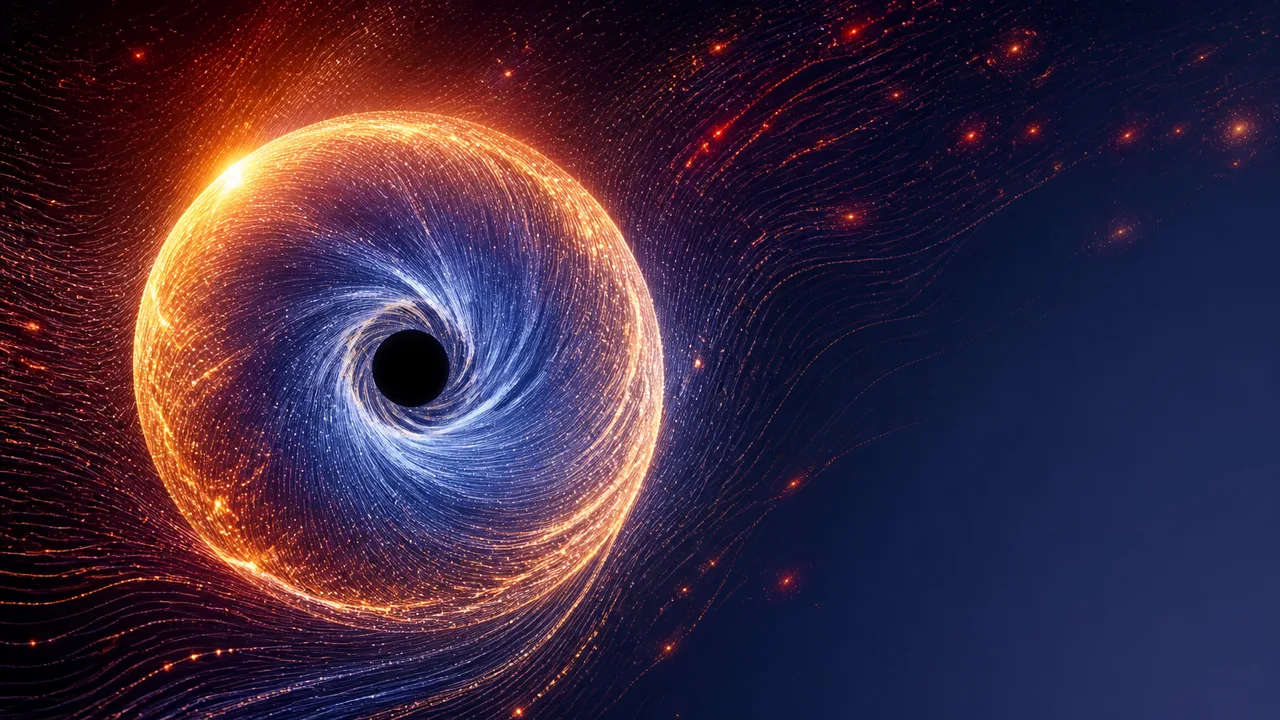
Photo: AI. Dexter Bloomfield
Here is the problem in its cleanest form: we keep finding billion-solar-mass black holes in a universe that, at the time we're observing them, was only a few hundred million years old. The math doesn't work. Even if you start with the largest plausible seed black holes—remnants of the first generation of enormous stars, maybe 100 times the mass of the sun—and run them at their theoretical maximum feeding rate, you still can't get to a billion solar masses fast enough. The first stars themselves took at least 100 million years to form after the Big Bang. There isn't enough runway.
This is not a new tension. Astronomers have been stress-testing their formation models since the first outsized high-redshift quasars turned up around the turn of the millennium. But it was manageable—uncomfortable, but manageable. Then the James Webb Space Telescope started returning data, and the problem got considerably worse.
The "little red dots" problem
JWST began surfacing a class of faint, compact, extremely red objects in the distant universe—quickly dubbed "little red dots." Many of them display broad hydrogen emission lines, which is a classic signal of gas moving at enormous velocities around an accreting black hole. Measure the width of those lines, assume the gas is in orbital motion, and you can back-calculate the black hole's mass. The numbers that came out ranged from millions to hundreds of millions of solar masses. In a universe barely a few hundred million years old.
Worse, those black holes are grotesquely oversized relative to their host galaxies. In the modern universe, black hole mass and galaxy mass scale together with reasonable tidiness—bigger galaxy, bigger central black hole. The little red dots blow up that relationship entirely. Their black holes appear to have lapped their own galaxies by an enormous margin, which implies either that the black holes grew absurdly fast or that they started absurdly large. The JWST data on early galaxies has been piling up this kind of challenge to standard cosmological models for a while now, but the little red dots felt particularly pointed.
As PBS Space Time's Matt O'Dowd put it in a recent episode: "Even exponential growth doesn't seem fast enough to explain how these monsters formed."
Enter BH1★
In 2023, JWST's PRIMER survey flagged one particular little red dot as genuinely strange. The object, designated BH1★ (pronounced BH1-star), existed just 660 million years after the Big Bang. Researcher Rowan-Nadu and collaborators followed it up with spectroscopy and published their results in Nature.
What they found is described by Smithsonian Magazine as a potential "new kind of celestial object." The spectrum of BH1★ pulls in two directions at once.
On one hand, it has the broad emission lines you'd expect from a quasar—hydrogen gas apparently moving at more than 3,000 km/s. On the other hand, it has a pronounced Balmer break: a sharp spectral feature at 364.6 nanometers where hydrogen absorption cuts out a large chunk of the object's light. The Balmer break is what stellar atmospheres do. It is, very specifically, not what quasars normally do.
One obvious explanation: the Balmer break is coming from the galaxy surrounding the quasar. Galaxies are full of stars; stars have Balmer breaks. But the hydrogen absorption lines in BH1★'s spectrum don't look like a galaxy's worth of stars. They suggest an enormous, uniform column of hydrogen gas at densities between a billion and 100 billion atoms per cubic centimeter—solar-system-scale in size, but with the spectral signature of a single continuous atmosphere. As O'Dowd described it: "The thing looks like a single giant atmosphere surrounding something. Presumably the black hole."
The researchers' interpretation: BH1★ is a black hole cocooned inside a dense shell of infalling gas so thick it mimics stellar structure. A black hole star. Knowridge Science Report describes it as "mysterious" and notes its potential to reshape how we understand early black hole formation—which, if the interpretation holds, is exactly right.
Why the cocoon matters—twice over
If this object is what the researchers think it is, the cocoon isn't just aesthetically interesting. It does two separate things that together start untangling the early black hole problem.
First, it enables super-Eddington accretion. The Eddington limit is the theoretical ceiling on how fast a black hole can grow. As infalling material heats up, it radiates, and that radiation pushes back against the incoming gas. There's a clean equilibrium point—above it, the radiation pressure halts accretion. Almost every accreting black hole we've measured sits below this limit.
The limit assumes, however, that radiation ultimately escapes the system. In an extremely dense cocoon, photons can take longer to fight their way out than it takes the surrounding gas to fall in. Those photons get swallowed before they can do their full braking work. The outward pressure drops; the black hole can eat faster. As O'Dowd noted, BH1★ may be "the most direct evidence we've discovered" for super-Eddington accretion—an idea astrophysicists have theorized about for years but struggled to observe directly. Our prior coverage of JWST's little red dots traced the spectral case for cocoons; BH1★ appears to push it considerably further.
Second, it may be inflating our black hole mass estimates across the board. This is the part of the study I find most methodologically interesting. The standard technique for measuring distant black hole masses relies on the width of emission lines—wider line, faster gas, bigger implied black hole. But in a cocooned object, photons don't travel in straight lines out. They scatter repeatedly through dense gas, and that scattering blurs spectral lines the same way orbital velocity would.
The study authors modeled this effect and found that the scattering alone could make a gas velocity of 600 km/s look like 3,000 km/s. Since black hole mass scales as velocity squared, a million-solar-mass black hole—borderline supermassive, plausible for its cosmic age—could be misread as a 25-million-solar-mass object. Suddenly the little red dots' black holes look less impossibly large.
"A million solar mass black hole is still technically super massive, but it's borderline," O'Dowd observed. "It's much more reasonable for such an early cosmic age and such a small host galaxy."
What to do with a single data point
The honest answer to "does this solve the early black hole problem?" is: not yet, and possibly not entirely. BH1★ is one object. One spectacular, well-characterized object, published in Nature by a team that has clearly thought carefully about alternative explanations—but still one object.
The mass-measurement inflation hypothesis, if it applies broadly to the little red dot population, would meaningfully reduce the severity of the early black hole problem. It wouldn't eliminate it. Super-Eddington accretion, even if BH1★ is a clean demonstration of the mechanism, still needs to be reconciled with formation timelines—you still need seeds, and you still need them to form early enough. The broader JWST picture of an early universe stuffed with oversized, over-evolved structures isn't explained by any single finding.
What BH1★ offers is something more specific and arguably more valuable: a mechanism made visible. Astrophysicists have been arguing about super-Eddington accretion largely on theoretical grounds. Here is an object whose spectrum may be showing us the process in action—a black hole eating through its own radiation pressure because its gas cocoon is thick enough to trap the photons that would otherwise slow it down.
Whether BH1★ turns out to be a smoking gun or an interesting edge case depends entirely on what comes next. Finding more objects with the same spectral signature, mapping how common they are in the early universe, testing whether the emission-line-broadening effect is as large as the modeling suggests—that's the work. The interpretation, as O'Dowd was careful to note, is still an interpretation.
But the name might stick. "Little red dot" was always a placeholder; "black hole star" is at least descriptive of the thing it actually appears to be: an accreting black hole wrapped in something that looks, from 13 billion light-years away, uncannily like a star.
More Like This
Sterile Neutrinos: A Particle Physics Puzzle
Recent experiments challenge the existence of sterile neutrinos, reshaping our understanding of the universe.

James Webb Challenges Dark Matter Beliefs
James Webb Telescope data questions the Bullet Cluster's role as dark matter proof, suggesting complex galaxy interactions.
Did Our Universe Bounce Into Existence Inside a Black Hole?
A new preprint proposes the Big Bang was actually a bounce inside a black hole. Here's what the model claims, what it can't yet prove, and why it won't leave me alone.
Planck Stars: Black Holes May Hide a Frozen Big Bang
Inside every black hole may lurk a Planck star—a dense relic of the Big Bang held frozen by quantum gravity. Here's what that means for physics.
LIGO May Have Found a Primordial Black Hole
LIGO's latest catalog may contain a sub-solar-mass black hole that couldn't form from a star—and what that means for our understanding of the early universe.
A Black Hole Just Rewrote Galaxy Formation Rules
A supermassive black hole is blasting energy 300,000 light-years into space—and it's forcing scientists to rethink how galaxies form and evolve.
A Black Hole Photon Ring Inspired a New Laser Design
Researchers built a laser using the light-trapping geometry of black hole photon spheres. Here's what the experiment actually shows—and what it doesn't.

Cold Spark Machines Are Hot — Just Not How You Think
Cold spark machines are marketed as safe firework alternatives, but the science tells a more complicated story. Here's what's actually happening inside those sparks.