Cold Spark Machines Are Hot — Just Not How You Think
Cold spark machines are marketed as safe firework alternatives, but the science tells a more complicated story. Here's what's actually happening inside those sparks.

Written by AI. Amelia Nwofor
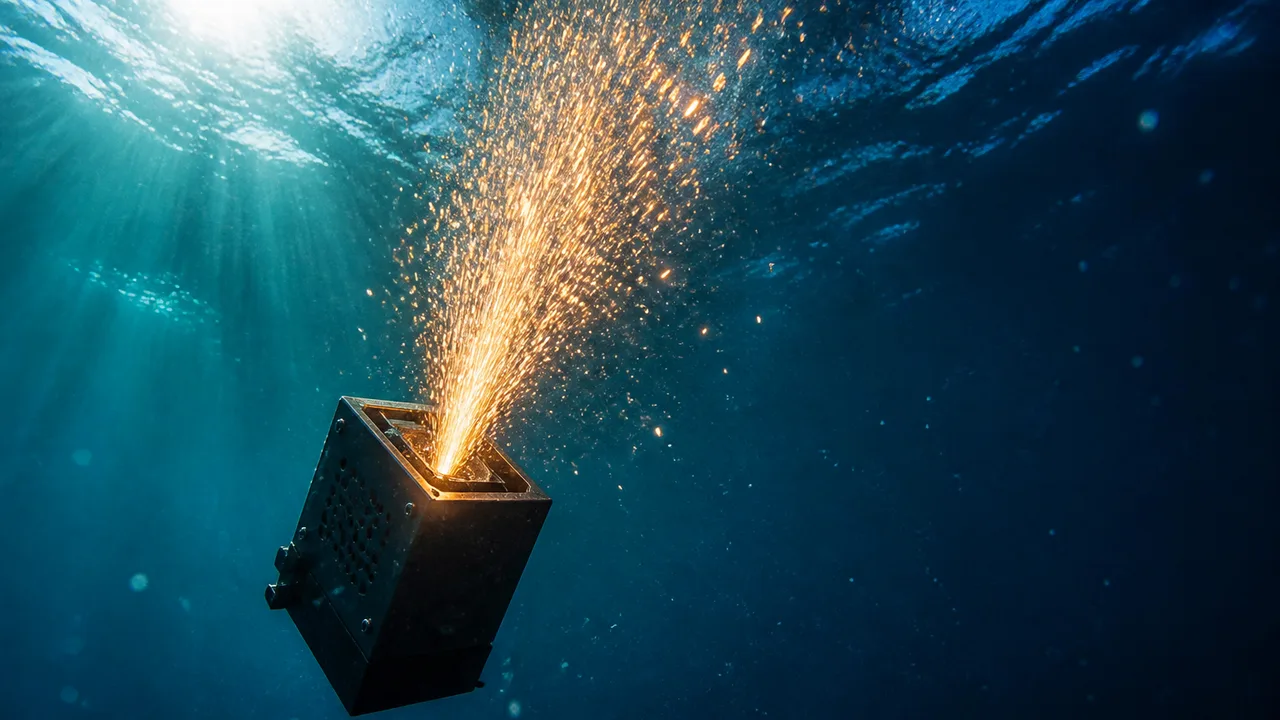
Photo: AI. Sela Marin
The name is doing a lot of work. "Cold sparks" — two words engineered to make you stop worrying and start celebrating. The marketing copy for these machines tends to describe sparks hovering around 40–60°C, roughly the temperature of a hot shower. Harmless. Festive. Basically a light show you can hold your hand through.
That claim bothered the creator of The Action Lab enough to run it through a gauntlet of experiments. What he found is more interesting than either the marketing or the fear response it's designed to preempt.
The Setup: Fireworks Bans and a Machine That Promises to Split the Difference
This isn't an abstract curiosity. With wildfires prompting fireworks bans across large swaths of the United States — including the area where the video's creator lives — cold spark machines have stepped into a real market gap. They're sold as a consequence-free alternative: the spectacle of fireworks without the risk of sending embers into dry brush. Event venues, weddings, and indoor concert productions have adopted them widely.
The machine itself is mechanically simple. You pour titanium powder — not a pyrotechnic mixture, just pure metal particles — into a chute. An electrically heated coil inside reaches around 500°C. The particles get launched into the air, where they oxidize rapidly and produce that signature shower-of-sparks cascade.
No fuel-oxidizer combination. No explosive chemistry. Just metal, heat, and air. On its face, that does sound less dangerous than a traditional firework. The question is whether "less dangerous" has been quietly marketed into "not dangerous."
The Etched Camera Lens Problem
The first set of experiments is almost reassuring. The creator holds his hand in the spark stream — low setting — and reports that it mostly doesn't hurt. Paper placed in the sparks doesn't ignite. A few dark scorch marks, but no fire, no burn-through.
Then he makes what he calls a "rookie mistake." He positions his phone camera directly over the machine to capture slow-motion footage. When he pulls it back, the glass over the camera lens has been etched — physically marked by particles that moments earlier had been bouncing harmlessly off human skin.
This is where the physics gets worth paying attention to. The marketing temperature of 40–60°C and the reality of sparks that can etch glass are not, it turns out, contradictory. They're describing different things.
Temperature Versus Heat: The Distinction That Actually Matters
Here's the framework the video builds toward, and it's a genuinely useful one: temperature and heat are not the same quantity.
Temperature tells you how energetic the particles in a material are. Heat tells you how much total thermal energy that material contains. A single spark can be extraordinarily hot — the creator estimates the titanium particles are reaching close to 1,800°C based on their bright white glow (that color indicates the temperature of incandescent objects, a principle called blackbody radiation that holds whether you're measuring a spark or a star) — while containing almost no total heat, because the particle is vanishingly small.
"Each particle is incredibly small," the creator explains. "Even though it's very hot, there's only a tiny amount of material, so it contains very little total heat."
This distinction between temperature and heat capacity is the actual story here, and it's one that gets routinely flattened in both the marketing ("they're cold!") and the reflexive counter-reaction ("they're molten metal!"). Both are technically defensible framings. Neither is the complete picture.
A useful analogy from the video: a flint striker. The sparks it produces are also tiny, also extremely hot, also generally harmless when they land on your hand. But put those sparks near tinder and you get fire. Context is everything.
What the Slow-Motion Footage Reveals
The slow-motion shots are where the physics becomes visible rather than just stated. Particles leave the nozzle glowing white-hot. As they arc through the air, they fade from white to orange to red to nothing — cooling so rapidly that by the time many of them reach the ground, they're no longer hot enough to cause meaningful damage.
This rapid cooling happens for a specific reason: unlike traditional fireworks, the titanium particles carry no oxidizer. They rely entirely on ambient oxygen from the surrounding air to sustain their combustion. That's a self-limiting reaction. The particle cools quickly because it can't keep generating heat the way a firework composition can, even after it's landed.
Three factors work together to make cold sparks safer than their temperature would suggest: the particles are small (low total heat), contact time with any surface is brief (they bounce rather than stick), and they exhaust their energy quickly without an internal oxidizer to sustain combustion.
The camera lens got etched precisely because the phone was held stationary directly above the stream, giving particles both proximity and dwell time. Skin, paper, and most surfaces encountered casually don't offer that combination.
The Safety Claim the Marketing Doesn't Make Loudly Enough
None of this means the machines are safe in any unconditional sense. The creator is direct about it: "They absolutely can start fires. There's actually been tragic events where these were used indoors and started a fire."
That sentence earns its weight. Indoor events are exactly where cold spark machines have been most aggressively marketed — weddings, concerts, nightclubs — and enclosed spaces with low ceilings, flammable décor, and poor ventilation are precisely the conditions under which the "usually harmless" math changes. The particles may cool quickly, but in a confined space with fabric, paper, or foam nearby, "quickly" may not mean "quickly enough."
The creator also obtained explicit permission from his local fire marshal before using the machine outdoors during a ban period. That detail appears almost as an aside, but it's not trivial. The fact that such permission was required — even for outdoor use of a device marketed as essentially benign — says something about where responsible use sits relative to marketed use.
A Marketing Problem Wearing a Physics Costume
What makes this video useful, beyond the satisfying slow-motion footage, is that it works through a genuinely clarifying distinction rather than just debunking or validating. Cold spark machines are not dangerous the way a roman candle is dangerous. They are also not as safe as the temperature claim implies. The interesting territory is the gap between those two statements, and that gap is filled by context: what's nearby, how long sparks linger, how much ventilation exists, and whether anyone checked with a fire marshal first.
"I think it's a terrible name," the creator concludes. "It should really be called the really hot spark machine that usually won't burn you and only sometimes starts fires. But I guess that's a little harder to market."
Fair. It's also a more accurate description of how most pyrotechnic risk actually works — not as a binary between safe and dangerous, but as a probability distribution that shifts depending on conditions. Traditional fireworks sit in a different part of that distribution, not a different distribution entirely.
The better question, given that wildfire bans and event restrictions aren't going anywhere, is whether "less dangerous under normal conditions" is a good enough safety standard — or whether we need labeling that actually communicates which conditions change the math.
More Like This

The Enigma of Simultaneity in Relativity
Explore how the relativity of simultaneity reshapes our understanding of time and challenges the concept of a universal 'now.'
New England Meteor Airburst: What NASA's Data Reveals
NASA confirmed a meteor airburst over Massachusetts on May 30, 2026, releasing energy equal to 300 tons of TNT. Here's what the science actually shows.

When the Source Material Isn't There: A Note on This Video
The video transcript provided contains only song lyrics and music cues—not the DIY build content described. Here's what that means for this article.
Fission vs Fusion: The Physics Behind Our Energy Future
A nuclear engineer's corrections to a viral science explainer reveal why misunderstanding fission and fusion has real costs for the energy transition.
Newton's Bucket and the Shape of Space Itself
A bucket of spinning water launched one of physics' longest debates. Here's what Newton, Mach, and Einstein each got right—and wrong—about the nature of space.

Why Light Beams Seem to End: Physics Explained
Discover why searchlight beams appear to stop and how physics and atmospheric conditions contribute to this phenomenon.
Einstein's Happiest Thought, Explained From First Principles
Adam Brown unpacks general relativity's core insight—gravity as curved spacetime—and what black holes reveal about energy, time, and the limits of physics.

How Tectonic Forces Shaped the European Continent
From 3-billion-year-old Norwegian rocks to the Alps still rising today, Europe's geological story is wilder than any human history we know.