A Black Hole Photon Ring Inspired a New Laser Design
Researchers built a laser using the light-trapping geometry of black hole photon spheres. Here's what the experiment actually shows—and what it doesn't.

Written by AI. Amelia Nwofor
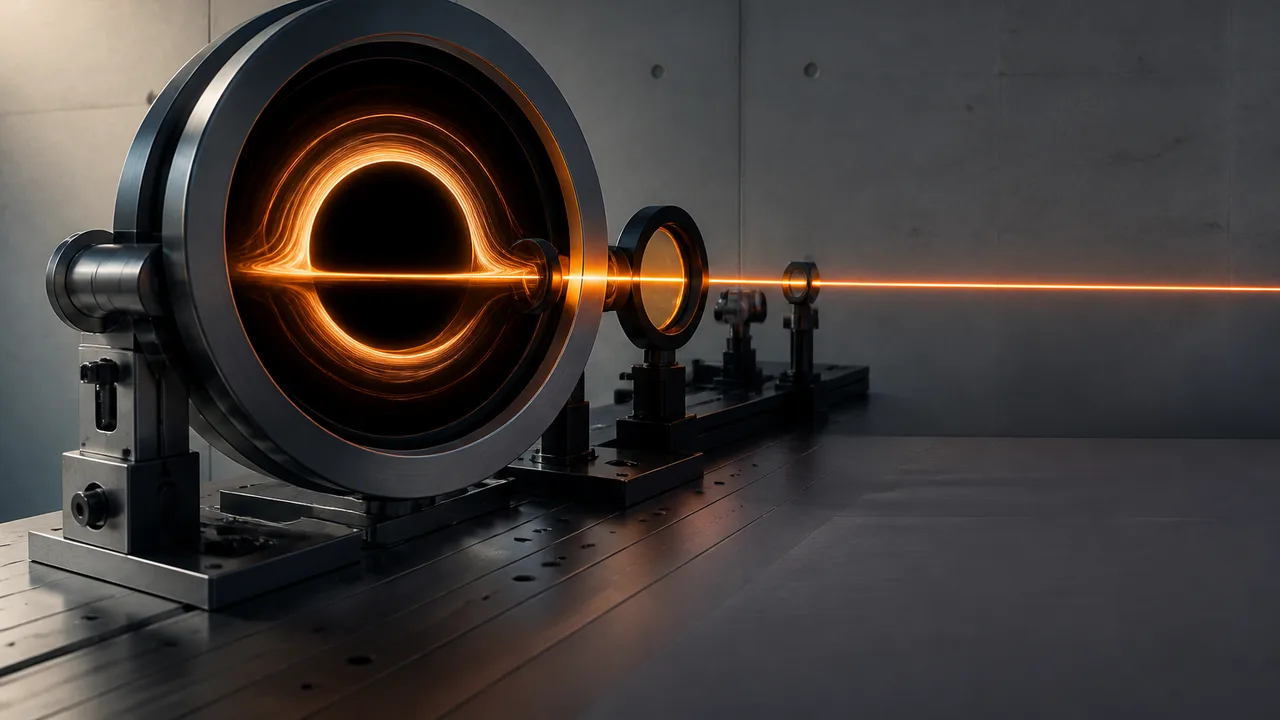
Photo: AI. Hayden Cross
The photon sphere is not the event horizon. It's worth starting there, because almost every piece of popular science imagery conflates the two—and getting this wrong makes the new laser paper either more or less interesting than it actually is, depending on which direction you flub it.
Here's the actual geometry: a black hole's event horizon is the inner boundary, the surface from which nothing returns. The photon sphere sits outside that, in what looks to the eye like the dark halo surrounding the bright accretion disk in those famous images from the Event Horizon Telescope. That glowing ring? That's light that has been bent so severely by spacetime curvature that it loops around the black hole—photons in unstable orbit, effectively piling up in the same region. As physicist and science communicator Sabine Hossenfelder explains it: "It's not like a lens. A lens has a focus point or a plane and then the light diverges again. Here you have something like an attractor for the light."
That word—attractor—is what the researchers behind a new paper published in Advanced Science latched onto. Not the drama of the event horizon, not Hawking radiation, not the singularity. Just the quiet geometric fact that light in strongly curved spacetime behaves like it's being corralled, not focused. And they asked whether that corralling mechanism could be reproduced, engineered, and made useful.
What they actually built
The device itself is, in the best tradition of important proof-of-principle experiments, deeply unimpressive to look at: a small 3D-printed polymer structure infused with a laser dye. The structure's geometry is designed to mimic—in two dimensions—the curvature experienced by light near a photon sphere. When you pump the dye with light at one frequency, the dye molecules absorb and store that energy. Hit them with a second frequency, and you trigger stimulated emission: a cascade of coherent, amplified photons. That's a laser. The difference from conventional laser design is what's doing the trapping.
In a standard laser cavity, you trap and amplify light using mirrors—bounce it back and forth until you have enough coherent emission to extract a useful beam. The new design replaces the mirror cavity with geometry. The 3D-printed structure creates curved optical paths that keep light circulating the way the photon sphere keeps orbiting photons circulating. The "walls" aren't reflective surfaces; they're the shape of the medium itself.
This distinction matters more than it might sound. The photon sphere's orbits are unstable—a photon at that radius doesn't stay there indefinitely, it eventually escapes or falls inward—but in the miniaturized material, the orbital scales are small enough that light behaves as a wave rather than a particle, forming standing wave patterns. Those standing patterns are what the researchers can selectively excite and extract. Hossenfelder again: "What they have is a new way to trap and amplify the light."
Whether this translates into devices you can buy—better laser pointers, improved optical fiber components, something you haven't imagined yet—is genuinely unknown. Hossenfelder is careful to say this is a "lab demonstration, a proof of principle," and there's no reason to think better lasers are arriving next year. The honest read is that researchers have demonstrated a mechanism. What the mechanism is useful for is a separate question that applied physics will have to answer later.
The analog gravity question is the actually interesting part
The paper sits within a research area called analog gravity—the practice of recreating the mathematical behavior of curved spacetime inside a physical medium. The key insight is that the equations governing how waves (light, sound) propagate through a carefully designed medium can be formally identical to the equations governing those same waves in a curved spacetime. They're not simulating a black hole the way a computer might; they're building a system where the underlying mathematics is, in a meaningful sense, the same.
This is a field with a track record. Analog gravity experiments have been used to probe the physics of the early universe's expansion and, more remarkably, to test Hawking's prediction that black hole horizons produce pairs of entangled particles—a result notoriously difficult to observe directly. In laboratory analogs using flowing fluids and optical media, researchers have found signatures consistent with Hawking's prediction, which is both a validation of the technique and a quietly extraordinary result in its own right.
The deeper implication—the one that makes physicists sit with it a little longer—is what Hossenfelder raises almost as a philosophical aside: if light in a medium behaves exactly as it would in curved space, what does that tell us about what curved space is? Could spacetime itself be some kind of medium, an emergent structure rather than a fundamental backdrop? It's a serious question in theoretical physics, not a crackpot one, though it's far from settled. Analog gravity experiments can't resolve it, but they keep it honest—they demonstrate that the mathematical equivalence is not just a coincidence of notation.
Where the black hole framing earns its skepticism
None of this means the "black hole laser" headline is exactly clean, and Hossenfelder—who rates the paper a 2/10 on her hype meter—doesn't let it pass unchallenged. Her critique is methodological rather than hostile: the link to actual black holes is real but limited, and the framing tends to overstate it. The photon sphere around a real black hole is a three-dimensional structure; the experiment's analog is effectively a ring, a lower-dimensional simplification. That's not unusual for analog gravity work—these systems almost always trade dimensionality for tractability—but it means the geometry isn't as faithful a reproduction as the headlines imply.
That's a useful distinction to hold. The researchers' inspiration from black hole physics appears genuine. The mechanism they've built is novel and the proof of principle is real. But "based on black hole physics" and "a functional model of a photon sphere" are not the same claim, and conflating them does a disservice to both the experiment and the astrophysics.
What the paper actually demonstrates is more modest and more durable than the headline suggests: that the geometric attractor property of the photon sphere can be abstracted away from the astrophysical context, encoded in a manufactured material, and made to do useful optical work. That's a legitimate scientific contribution. It's also a textbook example of how abstract physics eventually finds its way into practical application through steps that no one fully anticipated in advance—each one looking, at the time, mostly theoretical.
Analog gravity is a research program built on taking mathematical analogies seriously enough to test them in the lab. The photon sphere laser is the latest data point in that program. Whether it leads to new optics technology, new insights into spacetime physics, or quietly sits in the literature as a clever proof of concept, it's a reminder that the question "what is this observation actually good for?" often takes decades to answer—and sometimes the answer shows up in places nobody expected.
More Like This
The Deeper Geometry Behind the Pythagorean Theorem
Explore why the Pythagorean Theorem appears in unexpected places, from geometry to relativity.

Can Quantum Physics Really Send Messages to the Past?
An MIT group published a paper in Physical Review Letters claiming messages can be sent to the past. The math works. The interpretation is where things get complicated.
Subcritical Reactors: Nuclear Power's Safety Fix?
A new generation of subcritical reactors promises to make nuclear meltdowns physically impossible. But can they deliver on cost, scale, and timeline?
How Fermilab Proved Einstein's Speed of Light Theory
Particle physicist Don Lincoln explains how Fermilab experiments confirmed Einstein's constant speed of light — and why c is now a defined value, not a measured one.

Casimir Inc Raised $12M on Quantum Vacuum Claims
Casimir Inc claims its microchip harvests unlimited energy from the quantum vacuum. The physics says otherwise—and $12 million is riding on that gap.

Why Light Beams Seem to End: Physics Explained
Discover why searchlight beams appear to stop and how physics and atmospheric conditions contribute to this phenomenon.
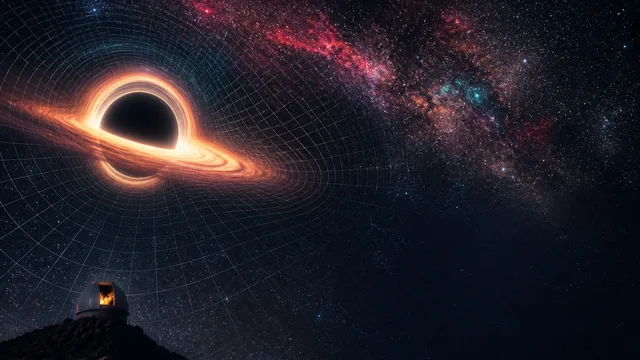
Einstein's Happiest Thought, Explained From First Principles
Adam Brown unpacks general relativity's core insight—gravity as curved spacetime—and what black holes reveal about energy, time, and the limits of physics.
How Tectonic Forces Shaped the European Continent
From 3-billion-year-old Norwegian rocks to the Alps still rising today, Europe's geological story is wilder than any human history we know.