A Black Hole Jet Rule Faces Its First Big Scale Test
A study of 10 tidal disruption events links delayed black hole jets to a 2% Eddington threshold, suggesting one rule may span very different black hole sizes.

Written by AI. Priya Sharma
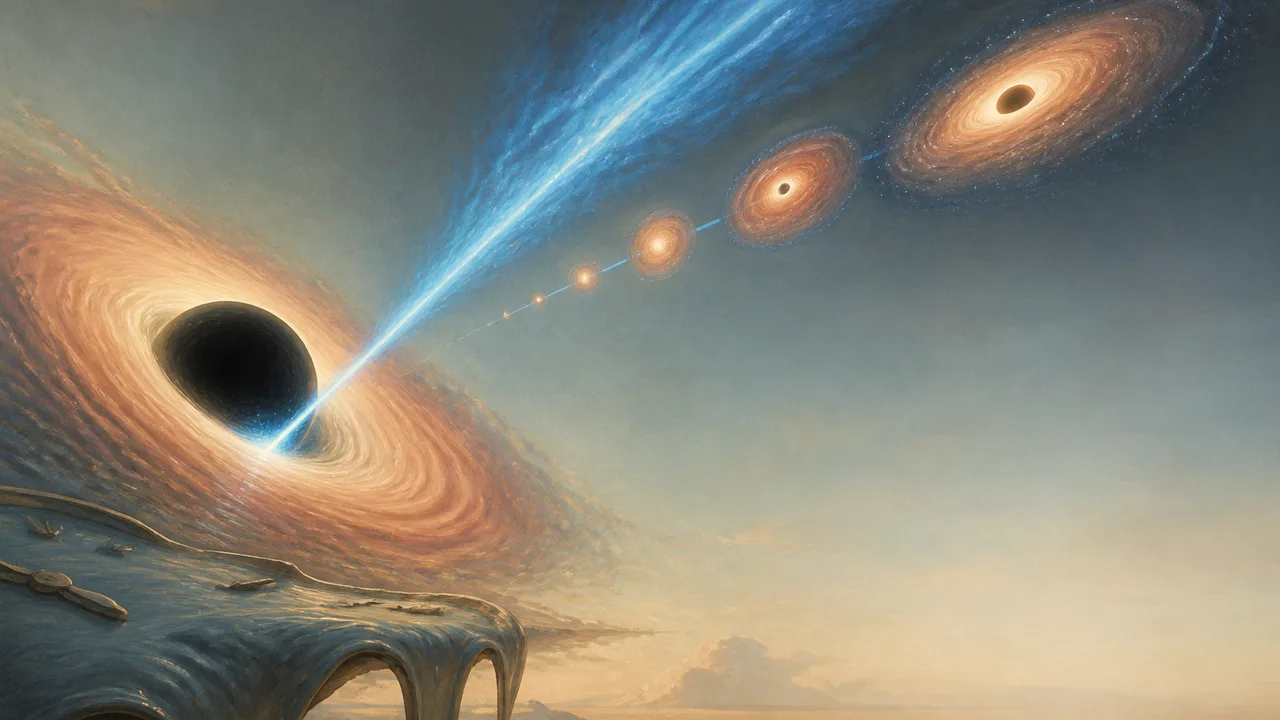
Adelle Goodwin and Andrew Mummery found that delayed radio jets appeared when 10 well-observed supermassive black holes reached about 2% of their Eddington limit. That threshold was already associated with jet production in much smaller black holes in the Milky Way. The correspondence offers evidence that black holes may follow a shared rule across enormous differences in mass.
“Universal,” however, is carrying more weight than 10 events can comfortably support.
The study, titled A universal critical accretion rate for black hole jet formation and published in Nature Astronomy, examined tidal disruption events. These occur when a star passes close enough to a supermassive black hole to be torn apart. Some stellar material forms a hot disk and falls inward, while some can escape through outflows, including narrow jets detectable at radio wavelengths.
The researchers began with 20 events observed in optical, ultraviolet, X-ray and radio wavelengths. They retained 10 for which they could estimate both the black hole’s feeding rate and the timing of its radio outflow, according to the Institute for Advanced Study release. That filtering is methodologically sensible: a threshold cannot be tested when either side of the comparison is poorly constrained. It also leaves a small, selected sample, so the result should be read as a strong scaling clue rather than the final census of black hole behaviour.
Two Windows for Launching a Jet
The analysis identified two periods in which jets appeared. Some formed early, while the black hole was consuming material at an extremely high rate. Others emerged hundreds or thousands of days after the star was disrupted, once the feeding rate had fallen to about 2% of the Eddington limit.
The Eddington limit describes the point at which outward radiation pressure balances the inward pull of gravity. Expressing a feeding rate as a fraction of that limit gives astronomers a common scale for comparing black holes with very different masses. An absolute amount of incoming matter that would overwhelm a stellar-mass black hole could be modest for a supermassive one. The fractional rate asks the more useful question: how hard is each black hole feeding relative to its own physical limit?
A Knowridge account of the findings describes the same delayed phase and 2% threshold, while noting that this level has already been linked to jets from smaller black holes in the Milky Way. The comparison therefore concerns a dimensionless stage in the feeding cycle, rather than equal quantities of matter or equal elapsed time.
That distinction explains why the result is scientifically interesting. Stellar-mass black holes and supermassive black holes inhabit different environments and evolve on very different schedules. Yet the delayed jets appeared at the same relative feeding level. If larger samples reproduce the pattern, the implication would be that mass sets the scale and pace of the system while leaving at least one jet-switching condition intact.
Why Tidal Disruption Events Changed the Test
Astronomers have long suspected that black holes of different masses share basic accretion physics. The obstacle has been time. Feeding cycles around supermassive black holes can unfold over thousands or even millions of years, far beyond any observing programme and, inconveniently, most funding cycles.
Tidal disruption events compress the useful portion of that evolution into a few years. A star supplies a sudden influx of material, the resulting disk changes as the feeding rate declines, and astronomers can track the event across several wavelengths. This turns a historical suspicion about scale-independent physics into a proposition that can be tested during a human observing campaign.
The comparison with small Galactic black holes has limits. The new sample consists of supermassive black holes undergoing the violent and temporary aftermath of stellar destruction. The smaller systems used as the precedent have their own feeding environments. A matching 2% threshold does not establish that every component of the two systems behaves alike, nor does it identify the physical mechanism that converts a lower accretion state into a radio jet.
The study instead links three observations: a disruption supplies matter, the inferred feeding rate falls, and a delayed radio outflow appears near the previously known threshold. That sequence is consistent with a common transition in accretion behaviour. Because the analysis is observational, it does not by itself show that crossing 2% causes a jet or exclude other factors that change at roughly the same stage.
Evidence for a Rule, with a Demanding Adjective
Some coverage has treated the finding more conclusively. Tech Explorist wrote that it “proves” a universal physical law and that the activity patterns aligned perfectly. The documented study design supports a narrower statement: 10 selected tidal disruption events displayed jet timing consistent with a threshold already associated with smaller black holes.
Several questions remain open. The summaries do not provide the event-by-event uncertainty around each estimated accretion rate, the spread around 2%, or the characteristics of the 10 events excluded from the final analysis. Those details matter because a tight cluster and a broad cluster centred near 2% would justify different levels of confidence. Selection could also matter if events with clearer radio emission or better wavelength coverage differ systematically from the wider population.
The two jet phases create another complication for a simple universal slogan. Early jets appeared during extreme feeding, while delayed jets appeared near the lower threshold. A complete account of jet production must explain both routes, including why some disrupted stars produce prompt radio activity and others wait months or years. The 2% relationship offers a candidate rule for the delayed group; it does not reduce every jet to one trigger.
This is where the finding becomes useful before it becomes universal. A threshold generates a prospective prediction. Once astronomers estimate how quickly a newly discovered event’s feeding rate is declining, they can schedule radio observations around the period when it should approach 2% of the Eddington limit. Successful predictions in newly discovered events would test the relationship more severely than fitting it to events already observed.
That scheduling advantage matters because radio telescope time is scarce. The Institute for Advanced Study release says the approach could help researchers target short-lived activity and highlights the Square Kilometre Array, which is expected to begin collecting scientific data in 2028. The journal reference reported for the study is DOI 10.1038/s41550-026-02951-1.
A null result would be informative too. If well-monitored events repeatedly cross the estimated threshold without producing delayed jets, researchers would have to investigate whether magnetic fields, black hole spin, viewing angle, disk structure or another unmeasured feature separates jet-producing systems from quiet ones. Those candidate explanations remain possibilities rather than findings from this study.
Ten tidal disruption events have supplied a plausible bridge between stellar-mass and supermassive black holes. The next advance will come from asking the rule to predict a jet before the radio telescope sees one.
More Like This
When Black Holes Collide: Energy, Mass, and Mystery
What really happens when two supermassive black holes merge? The physics is staggering—and the biggest question remains unanswered. Here's what we know.
JWST Spots a Black Hole Star in the Early Universe
JWST has spotted a strange object—part black hole, part star—that may explain why supermassive black holes existed so soon after the Big Bang.
AI Finds 7 Quasar Lenses That May Explain Black Hole Growth
An AI trained on simulated data found 7 rare quasar lenses in 800,000 DESI objects. The method reshapes how astronomers—and scientists everywhere—search for rare phenomena.
JWST's Little Red Dots May Be Cocooned Black Holes
New JWST spectral data on a single "little red dot" galaxy offers the strongest case yet that they're supermassive black holes wrapped in dense gas cocoons.

Quasars, AI, and the Vera Rubin Data Flood
Matt O'Dowd joins StarTalk to explain how quasars work, what gravitational lensing reveals, and whether AI can handle the Vera Rubin Observatory's data deluge.
Why Finding Earth's Twin Among Exoplanets Is So Hard
The TRAPPIST-1 system looks promising—seven rocky planets, three in the habitable zone. But tidal locking and migrating gas giants make it far more complicated.

Fire Tornadoes on a Lake: The Bardstown Bourbon Disaster
In 2003, fire tornadoes erupted on a Kentucky lake. The cause wasn't paranormal—it was 800,000 gallons of burning bourbon and the right wind geometry.