The Electromagnetic Spectrum Explained by Neil deGrasse Tyson
Neil deGrasse Tyson and Chuck Nice trace how electricity and magnetism unified into the electromagnetic spectrum—and what that means for everything we see and build.

Written by AI. Priya Sharma
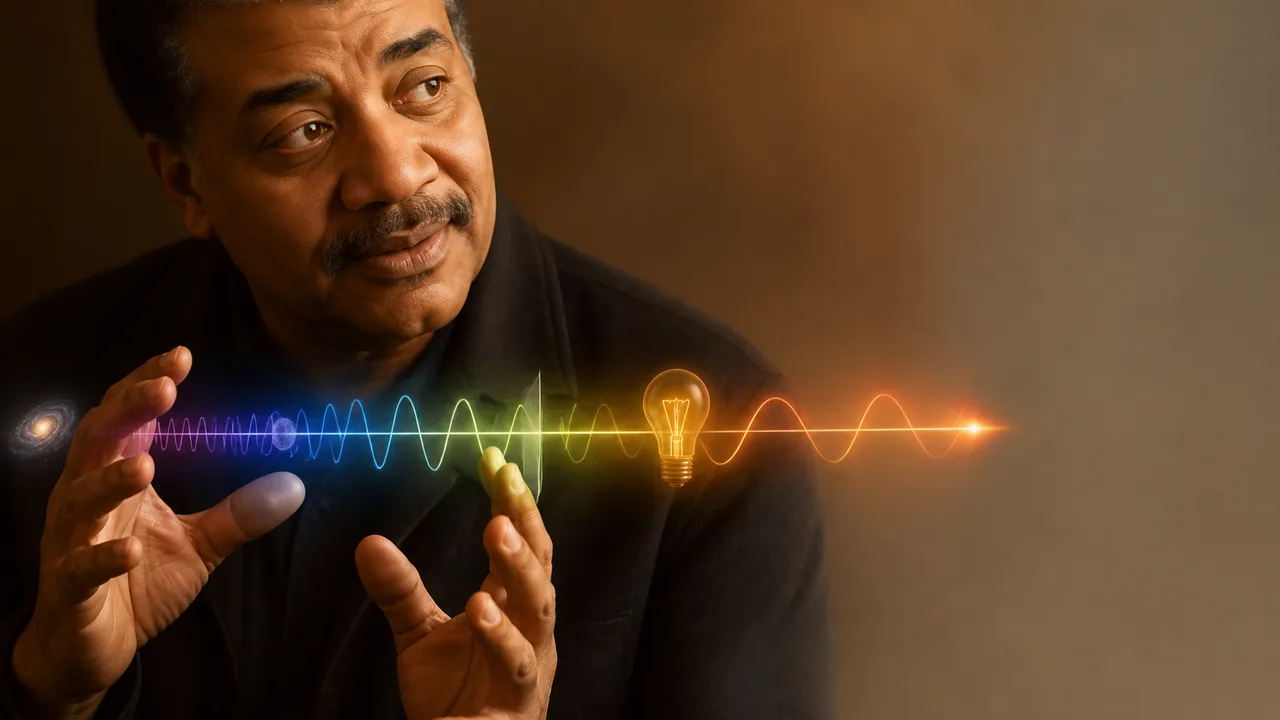
Photo: AI. Naia Iwarra
There is a version of this story that gets taught in high school physics and promptly forgotten — a list of terms, a diagram with a rainbow, maybe a mnemonic device. What Neil deGrasse Tyson does in a recent StarTalk episode is something more interesting: he treats the electromagnetic spectrum not as a taxonomy to memorize, but as the record of a slow, surprising realization that humanity stumbled into across three centuries.
The episode, framed as Tyson's most important explainer, runs through the full arc — from Ben Franklin puzzling over electricity with no concept of the electron, to modern astrophysicists reading the universe in gamma rays. Co-host Chuck Nice serves as a good-faith stand-in for the rest of us, asking the obvious questions and occasionally losing composure entirely at the answers.
The science holds up. The history is worth knowing. And some of the conceptual turns deserve more attention than a 23-minute YouTube episode can give them.
Two forces, one field
The story Tyson tells begins with a problem of unification. Through the early 19th century, electricity and magnetism were understood as separate phenomena. Franklin had studied electricity, Faraday had mapped magnetic fields — but neither had connected them into a single framework.
Michael Faraday is the pivot point Tyson returns to, and the choice is instructive. Faraday, Tyson notes, "didn't know much math" and produced almost no equations. What he had was an unusually precise intuition about fields — the idea that a force could extend through space, invisible but real, capable of acting on objects at a distance. It was Faraday who conceived the magnetic field and who observed that moving a wire through that field produced an electric current.
That observation broke the conceptual wall between the two phenomena. If a magnetic field could generate electricity, and an electric field could generate magnetism, the implication was that they were not separate forces at all. James Clerk Maxwell formalized this in the 1860s — and in doing so, predicted that oscillating electromagnetic fields would propagate through space as waves. He calculated the speed of those waves. It matched the speed of light exactly. Light, it turned out, was electromagnetic radiation. The spectrum was not a discovery of a new thing — it was the discovery of how vast the known thing actually was.
Tyson frames this as "a triumph of 19th century physics," and that framing is accurate but slightly modest. The unification of electricity, magnetism, and light into a single theoretical framework is one of the most consequential intellectual events in the history of science. Everything that followed — radio communication, X-ray imaging, microwave technology, the entire architecture of modern astrophysics — is downstream from Maxwell's equations.
What color actually is
Midway through the episode, Tyson offers a small perceptual provocation that rewards sitting with: when you look at a red apple, what you're seeing is the one color the apple rejected.
The physics is straightforward. White light contains the full visible spectrum. Materials absorb certain wavelengths and reflect others. A red apple absorbs orange, yellow, green, blue, indigo, and violet, bouncing only red back toward your eye. "We say that apple is red," Tyson observes, "when that is the only color that it rejected."
This is not just a parlor trick. It points at something genuinely strange about the relationship between physical reality and perception. The redness is not a property of the apple — it's an artifact of the interaction between the apple's molecular structure, the light source, and the particular sensory apparatus of human vision. A detector tuned to infrared would report something else entirely about the same object.
The implication Tyson draws is appropriately unsettling: "Don't believe your eyes. Don't believe your brain." That might sound like the opening of a philosophy lecture, but it's actually a physics one.
The spectrum we can't see
Infrared's discovery in the late 18th century — Tyson cites astronomer William Herschel's experiment with a thermometer placed just beyond the red end of Newton's prism spectrum — is the moment the electromagnetic spectrum began to expand beyond vision. Herschel noticed that the thermometer he had set outside the spectrum's visible range consistently read higher than the one inside it. He published a paper describing what he called "light unfit for vision." Tyson, who says he owns a copy, describes reading it the way some people describe religious experience.
What followed was two centuries of appending new bands to what had once been simply "light." Each discovery required a new detector: thermometers for infrared, antennas for radio waves, photographic plates and Geiger counters for higher-energy radiation. Tyson makes the methodological point explicit: "The detector has to be able to absorb the light and somehow record what it just absorbed." You cannot see what you have no instrument to detect — a constraint that applies well beyond physics.
The visible spectrum, by this reckoning, is a narrow slice. Tyson reaches for an analogy: "It would be like listening to Beethoven's Ninth Symphony in one octave getting played." The comparison is more precise than it sounds. The electromagnetic spectrum spans roughly 25 orders of magnitude in wavelength. Visible light occupies less than one order of magnitude of that range. Our unaided senses are, in the most literal sense, nearly blind.
The microwave oven as physics demonstration
One of the episode's more practically grounded segments concerns microwave ovens — a technology most people use daily and understand almost not at all.
Microwaves are simply short-wavelength radio waves. The reason they cook food is that water molecules — which are found in essentially everything edible — resonate at certain microwave frequencies, vibrating when they absorb the radiation. The vibration generates heat through friction. "It's friction," Tyson clarifies, "that is ultimately heating the food." Not nuclear energy. Not ionizing radiation. Friction at the molecular level.
The glass door question is satisfying in its elegance. Glass, Tyson explains, does not absorb microwaves — it is effectively transparent to them, which would seem to undermine the containment logic entirely. The solution is the metal mesh screen embedded in the glass. Each hole in the screen is smaller than the wavelength of the microwave being used to cook the food. Waves cannot pass through apertures smaller than their own wavelength. The screen blocks the microwaves; visible light, with its far shorter wavelength, passes through easily. "You can still see through it," Tyson notes, "and yet the microwaves are blocked."
The design is not intuitive. Most people have looked at that mesh screen without knowing what it does. It is the kind of detail that, once explained, makes the object feel different — more legible, more deliberate.
Resolution as a function of wavelength
The episode closes with a principle that connects across fields in ways the conversation only begins to gesture at: the resolution achievable by any imaging technology is fundamentally limited by the wavelength of the radiation it uses.
Visible light microscopes cannot resolve features smaller than visible light's wavelength. To see finer detail — the molecular architecture of a protein, the surface texture of a virus — you need shorter wavelengths. X-rays fit that requirement. Electron microscopes exploit wave-particle duality to generate effective wavelengths shorter still.
"The highest resolution pictures use the smallest wavelengths," Tyson summarizes. It is a clean principle, and it has architectural consequences: the James Webb Space Telescope's infrared sensitivity lets it see through dust clouds opaque to visible light; radio telescopes the size of continents can resolve features at cosmological distances. The universe is being read, simultaneously, in dozens of frequencies at once.
The same logic applies in reverse. Very long-wavelength radio telescope dishes do not need to be optically perfect — a segmented or even an irregularly shaped dish still works because the incoming waves are larger than the gaps and surface imperfections. The wave, as Tyson puts it, "doesn't know anything smaller than it."
What Tyson and Nice are doing in this episode is essentially restoring context to concepts that education tends to present as finished. The electromagnetic spectrum is not a chart on a wall — it is the cumulative result of people building instruments capable of detecting phenomena they did not yet know existed, discovering that those phenomena were expressions of the same underlying physics, and then building new instruments based on that understanding. The cycle is still going.
Chuck Nice, somewhere near the end of the episode, asks whether anything might exist beyond gamma rays. Tyson's answer is careful: probably, but we would likely just call it gamma rays until we found a specific reason to name it something else. A category exists when you have a use for it. Which raises the question that sits under the whole enterprise: how many categories are we still missing because we haven't built the detector yet?
More Like This
CERN's Particle Asymmetry: Cracking the Universe's Mysteries
Exploring CERN's recent findings on matter-antimatter asymmetry and their implications for understanding the universe.
The Rainbow Is Yours Alone—Here's What That Means
Neil deGrasse Tyson breaks down the optics of rainbows—why yours is private, why you can't reach its end, and why every rainbow is actually a circle.
Exploring Black Holes and Asteroids with StarTalk
Neil deGrasse Tyson delves into black holes, asteroids, and more in StarTalk's latest Cosmic Queries episode with Chuck Nice.
Why Light Beams Seem to End: Physics Explained
Discover why searchlight beams appear to stop and how physics and atmospheric conditions contribute to this phenomenon.
Cosmic Rays: What Particles From Deep Space Reveal
Cosmic rays bombard Earth constantly, yet their origins remain partly unknown. Here's what a century of detective work has—and hasn't—resolved.
Exploring the Cosmic Balance: Lagrange Points
Discover how Lagrange points revolutionize space exploration, offering energy-efficient paths and potential for space construction.
Why Finding Earth's Twin Among Exoplanets Is So Hard
The TRAPPIST-1 system looks promising—seven rocky planets, three in the habitable zone. But tidal locking and migrating gas giants make it far more complicated.
Fire Tornadoes on a Lake: The Bardstown Bourbon Disaster
In 2003, fire tornadoes erupted on a Kentucky lake. The cause wasn't paranormal—it was 800,000 gallons of burning bourbon and the right wind geometry.