AI Finds 7 Quasar Lenses That May Explain Black Hole Growth
An AI trained on simulated data found 7 rare quasar lenses in 800,000 DESI objects. The method reshapes how astronomers—and scientists everywhere—search for rare phenomena.

Written by AI. Olivia Meng
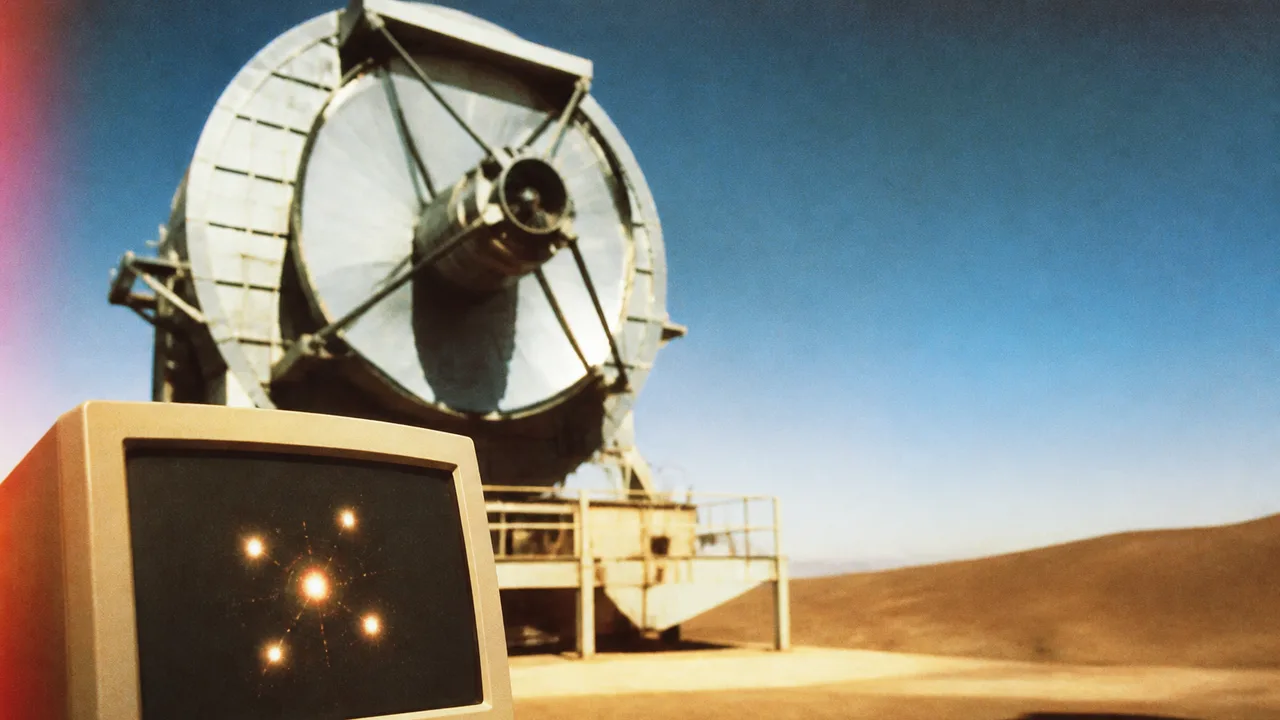
I cover climate science, not cosmology. But when I read about a team of astronomers training an AI on simulated data and deploying it across 800,000 real observations to find seven objects a human scanner would almost certainly have missed, I recognized the method immediately. It's the same template that's reshaping how we detect marine heatwaves, classify wildfire smoke plumes, and flag methane leaks from satellite imagery. The instrument changes. The underlying logic doesn't.
So: seven quasar gravitational lens candidates, identified by an international research team and published in The Astrophysical Journal on July 22, according to Memesita. Seven signals pulled from a dataset large enough to dwarf any individual astronomer's career of manual review. The findings matter for what they reveal about black hole physics. They matter equally for what they demonstrate about how science now works.
A quasar is, at its core, a supermassive black hole in active feeding mode — consuming surrounding gas with such violence that the resulting accretion disk outshines entire galaxies. Point a telescope at a distant quasar and you're watching one of the most energetic processes the universe produces. But what makes a quasar lens rare and scientifically valuable is geometry: when a galaxy falls almost precisely along the line of sight between Earth and a background quasar, the intervening galaxy's gravity bends the quasar's light, splitting or distorting it into arcs, rings, and multiple images. That gravitational lensing effect turns the foreground galaxy into a natural telescope. It also encodes, in the precise distortion geometry, measurable information about the galaxy's mass distribution — including any dark matter it contains.
These systems are hard to find not because they're theoretically unusual but because they require near-perfect cosmic alignment. As The Brighter Side of News reports, seven such signals emerged from a collection of more than 800,000 quasars. The ratio tells you everything about why this search needed automation.
The tool the researchers turned to was the Dark Energy Spectroscopic Instrument, or DESI — a survey instrument designed to map the large-scale structure of the universe by cataloging enormous numbers of galaxies and quasars. Running an exhaustive visual search across that volume of data isn't a staffing problem with a staffing solution. It's a category error. The dataset is simply too large for human pattern recognition to be the primary method.
The team's approach, as described by Phys.org and Scientific Frontline, was to train an AI model on a small sample of mock lenses — simulated, synthetic examples of what quasar lens systems should look like — and then set it loose on the real DESI catalog. The model wasn't searching for something it had seen before. It was searching for something it had been shown as an approximation, and then asked to recognize structural analogues in messy, real-world data.
This is worth dwelling on, because it's the part that the "AI finds things" headline tends to flatten. The AI didn't discover these candidates autonomously. It performed a specific triage function — reducing an unwieldy search space to a set of candidates small enough for human experts to evaluate. WOSU Public Media reports that the Ohio State-affiliated researchers were part of the international team; the human judgment about what those seven candidates actually represent — whether the lensing interpretation holds, what follow-up observations are warranted — still belongs to the scientists.
That distinction matters because it's exactly where AI deployment in climate science generates the most confusion. When machine learning models flag potential methane plumes from satellite hyperspectral data, the model isn't confirming an emission event — it's telling human analysts where to look. The scientific authority remains downstream. The AI compresses the haystack. The scientists still examine the needles.
The needles here could be particularly valuable. Quasar gravitational lenses offer two things that are genuinely difficult to obtain otherwise: a way to measure the mass of intervening galaxies with high precision, including dark matter contributions, and a window into the growth histories of supermassive black holes at cosmological distances. Space.com frames the central scientific question directly — how do supermassive black holes grow? — and it's not a settled one. The lensing systems provide an observational record that can test competing models of black hole formation and evolution across cosmic time.
The seven candidates are just that — candidates, not confirmed lenses. Follow-up observations will determine how many hold up. But even a partial confirmation would expand the known population of these systems, which Space.com notes are rare enough that each new example is scientifically significant.
The methodological trajectory here runs in one direction. As astronomical surveys grow in scale — and DESI's catalog already strains traditional search methods — the AI triage layer becomes less optional and more structural. The researchers weren't experimenting with a novel tool because it seemed interesting. They were solving a genuine capacity problem: there is more data than there are eyes, and the data keeps arriving.
I've watched this unfold in climate science in compressed form. Satellite constellations monitoring sea surface temperatures, ice extent, and vegetation cover now generate data volumes that no research team could manually analyze in anything like operational time. The AI classifiers running on top of that data aren't replacing scientific judgment — they're making it possible to exercise scientific judgment at the scale the problem demands. The alternative isn't careful human review. The alternative is not reviewing it at all.
What changes, and this is real, is where scientific creativity concentrates. The act of poring over images and data looking for anomalous patterns — the kind of serendipitous noticing that has driven discovery throughout astronomy's history — gets automated away at the search layer. The creativity migrates toward model design, toward deciding what the AI should look for and how, toward interpreting what it surfaces. That's not a diminishment of science. It's a reorganization of it. Researchers who once spent careers scanning catalogs can redirect that attention toward the harder questions the candidates raise. The method found seven possible windows into black hole growth; scientists still have to figure out what's on the other side.
The more interesting question, as DESI's catalog expands and as surveys of even greater scale come online, is whether the AI triage layer will reveal that rare phenomena like quasar lenses are less rare than the historical record suggests — or whether the historical record was simply incomplete because the search methods were too slow. Those are different answers to the same absence, and only one of them changes the physics.
Olivia Meng is a climate and environment correspondent for Buzzrag.
More Like This
Rethinking Cosmic Acceleration: A Local Illusion?
Exploring the debate on whether the universe's acceleration is a local phenomenon, challenging the concept of dark energy.
Understanding the Real Risk of Brain-Eating Amoebas
Explore the facts and myths surrounding brain-eating amoebas. How real is the threat, and can climate change affect its spread?
Subcritical Reactors: Nuclear Power's Safety Fix?
A new generation of subcritical reactors promises to make nuclear meltdowns physically impossible. But can they deliver on cost, scale, and timeline?
TON 618: The Black Hole That Defies Its Own Physics
TON 618 weighs 66 billion solar masses—more than current black hole growth models can explain. Here's what that gap in our knowledge actually means.
How the Asteroid Impact Ended the Dinosaur Era
Explore the catastrophic asteroid impact that ended the dinosaurs, its immediate aftermath, and the long-term environmental changes.
Adam Riess on the Hubble Tension and Cosmic Expansion
Nobel laureate Adam Riess explains why two precise measurements of the universe's expansion rate keep disagreeing—and what that could mean for cosmology.

Spielberg's Disclosure Day and the Politics of Withheld Truth
Spielberg's new film Disclosure Day frames UAP secrecy as epistemic injustice. A climate reporter finds the argument uncomfortably familiar.
Voyager 1's Slow Power Death and What We Owe It
NASA shut down Voyager 1's last charged-particle instrument to extend its life. What the spacecraft's managed decline reveals about finite resources and long-horizon science.