How the First Trees Conquered a Barren Earth
From acid-secreting fungi to lignin-packed wood, the 385-million-year story of how trees came to dominate Earth is stranger than most people realize.

Written by AI. Olivia Meng
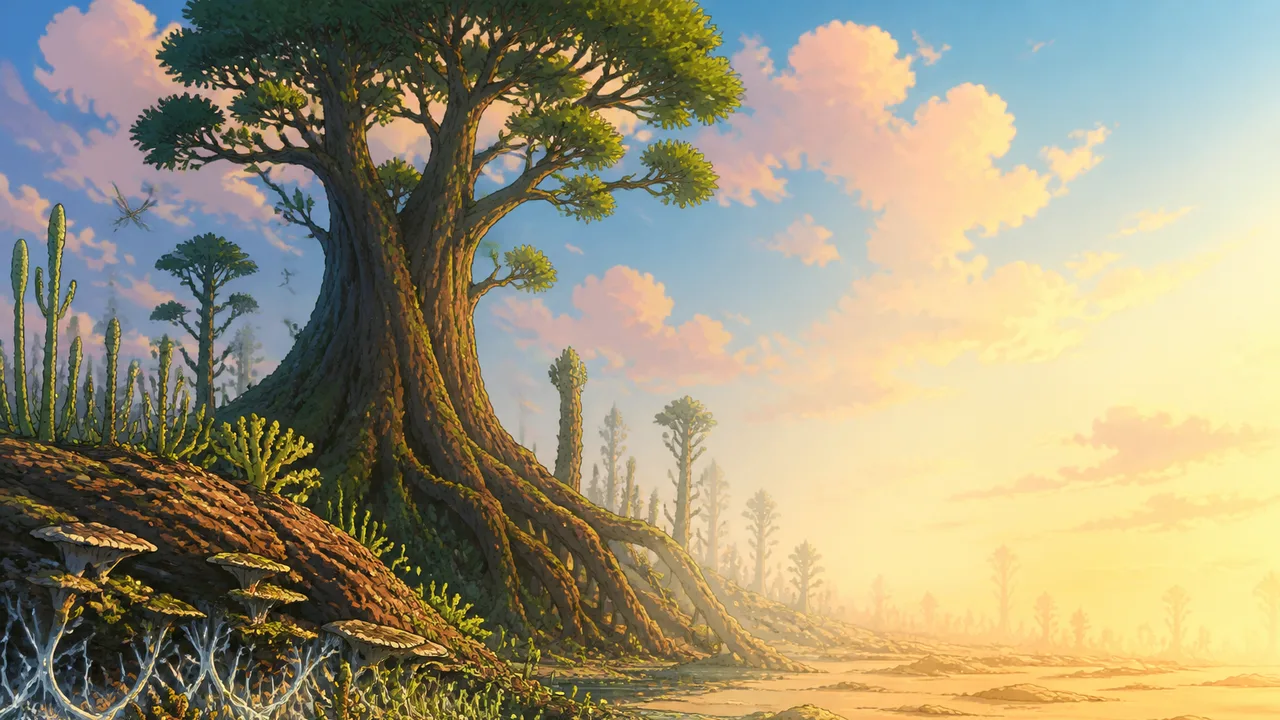
Photo: AI. Mei Fujimoto
Stand in any forest today and the scene feels permanent—the deep canopy, the layered understory, the soil rich with decades of decomposed matter underfoot. It isn't. Forests are a relatively recent invention. Wind back 400 million years and you find something almost unrecognizable: bare rock, no soil, no grass (that wouldn't arrive for another 300 million years), and a landscape that was, by nearly every measure, hostile to anything trying to live on it.
A new video from Primal Space traces the long, strange road from that barren surface to the first tree — a journey that turns out to be less a straight line of plant evolution and more a series of unlikely collaborations, dead ends, and outright biological surprises.
The creature that wasn't a tree — but acted like one
Before trees existed, something else held the vertical territory. Prototaxites — giant organisms that stood up to 25 feet tall — dominated the pre-forest landscape for millions of years. They looked, from a distance, like enormous tree trunks. They were not.
Where trees are built from organized arrays of woody fibers, Primal Space's video describes Prototaxites as having "a messy network of interwoven tubes." They didn't photosynthesize. They pulled nutrients directly from the ground. For a long time, scientists classified them as a type of giant fungus — a reasonable guess given those characteristics. Then a more recent fossil analysis threw that interpretation into doubt: the organic compounds preserved in the fossil bore no resemblance to fungal chemistry. What Prototaxites actually were remains, in a meaningful scientific sense, unresolved.
That uncertainty is worth sitting with. Here is a lifeform that dominated entire landscapes for millions of years, that independently evolved something chemically similar to lignin — the compound that would later give wood its strength — and we still cannot place it cleanly on the tree of life. Paleontology has a way of humbling confident classification.
What Prototaxites did do, whatever it was, is significant: its vast internal tube networks would have aerated and loosened the soil, and when individuals died, they decomposed enormous quantities of organic matter back into the ground. As the video puts it, they "acted as massive soil producers, laying the foundations for the forests that were about to take over." The giants that looked like trees were, in the end, building the conditions for actual trees to exist.
The partnership that made land livable
Before any of that could happen, land had to become survivable at all. The mechanism here is one of the more elegant stories in Earth's history, and it begins not with plants but with a two-organism alliance.
Waves pushed fungi and algae toward rocky shorelines. The fungi, equipped with powerful acids, broke down rock and released nutrients locked inside. The algae took those nutrients to fuel photosynthesis and, in return, shared the sugars it produced. Neither organism could have colonized the interior alone. Together, they could — and they did, spreading gradually inland, each generation dying and leaving behind a thin new layer of organic matter.
Soil, in other words, is not a given. It was made, iteratively, by organisms whose survival depended on making it. That reframing has real relevance today: soil loss and degradation are among the most underreported dimensions of the global ecological crisis, and understanding soil as a biological achievement rather than a geological backdrop changes how you think about what's at stake when it erodes.
The engineering of a plant that could stand up
Once soil existed, algae had the substrate it needed — but land still presented brutal challenges: desiccation, intense UV radiation, the absence of the buoyancy that water provides. Adapting to those conditions required a cascade of structural innovations that Primal Space walks through methodically.
Cell walls thickened. A waxy outer layer developed to reduce water loss. But the waxy coat created a new problem: it blocked carbon dioxide uptake, which algae needed for photosynthesis. The solution was the stomata — tiny pores that open and close to allow gas exchange. That same mechanism remains fundamental to how every land plant on Earth operates today.
Reproduction shifted from single eggs to wind-dispersed spores, which extended the organism's range dramatically. Roots developed to anchor the plant and access water from below. By that point, the video notes, "the algae was no longer algae" — it had crossed into a new category, the embryophyte, ancestral to every plant we know.
The next constraint was water transport. Early embryophytes had to grow directly over a moisture source. The solution, again structural, was the development of hollow vascular tubes — an internal plumbing system that could draw water from the ground and carry it upward. The Cooksonia, one of the earliest vascular plants, marks this transition. For the first time, a plant could grow away from standing water.
Vascular tubes also gave plants something unexpected: structural rigidity. And that changed everything.
The height war
"This started the height war that would eventually lead to trees," the video observes — and it's a useful frame. Once plants could grow upward at all, the logic of competition made taller growth advantageous on multiple fronts simultaneously. More sunlight. More shade cast on rivals. Wider spore dispersal. Height conferred fitness across every relevant dimension.
But the soft, thin vascular tubes that made upward growth possible were also its limiting factor. The taller the plant, the more weight those tubes had to bear. The engineering problem required a new material.
Enter lignin. Algae had been producing it long before leaving the ocean — originally, it appears, as a defense against UV radiation. On land, lignin molecules began cross-linking, transforming flexible plant stems into something rigid and load-bearing. Wood, in the functional sense, had arrived. The Wattieza tree, dated to approximately 385 million years ago and widely considered the earliest known tree, represents the point at which these adaptations converged into something we would recognize as a tree today.
Here again, Prototaxites offers a strange echo. While early vascular plants were still measuring their height in inches, Prototaxites had already independently developed "a completely separate but almost identical copy of lignin," as the video describes it. The biochemical solution to the weight-of-height problem was arrived at twice, through entirely different evolutionary lineages. Convergent evolution at work — life finding the same answer by different routes.
What the deep past illuminates
The story Primal Space tells is fundamentally about preconditions: each stage of biological complexity depended on infrastructure laid by organisms that came before, often organisms that gained nothing from the arrangement and are now extinct. Prototaxites built the soil conditions in which forests eventually thrived, then went extinct once those forests arrived. The fungi-algae partnership created the first soil and was subsumed into more complex plant forms. Cooksonia pioneered the vascular system that more advanced plants would inherit and extend.
This is not a triumphalist narrative of progress toward trees. It is something more complicated — a record of biological problem-solving in which dead ends turn out to be foundations, and the organisms that "lose" the evolutionary competition often made the winners possible.
There's a less comfortable version of that observation worth considering: the forests that Prototaxites helped build are now being cleared at rates that would have been geologically imperceptible in the Devonian. The soil those early organisms spent millions of years constructing can be degraded in a human generation. The timeline for building the preconditions of forest life and the timeline for dismantling them are not remotely symmetrical.
Three hundred and eighty-five million years to the first tree. The question of how long it takes to lose the last one is one we are, at present, actively researching.
Olivia Meng is a climate and environment correspondent for Buzzrag.
More Like This

Unveiling the Trench Effect: Lessons from King's Cross
Explore the King's Cross fire, the trench effect, and vital fire safety reforms reshaping public infrastructure.
The Bacon Grease That Started a Bigfoot Career
A US Forest Service worker slept in a bacon grease-stained tent in Wyoming and woke up to something that wasn't a bear. What our appetites summon from the dark.

Understanding the Real Risk of Brain-Eating Amoebas
Explore the facts and myths surrounding brain-eating amoebas. How real is the threat, and can climate change affect its spread?

Subcritical Reactors: Nuclear Power's Safety Fix?
A new generation of subcritical reactors promises to make nuclear meltdowns physically impossible. But can they deliver on cost, scale, and timeline?
What the Dinosaur Asteroid Actually Did to Earth
New research reframes the Chicxulub impact—not just as a mass extinction event, but as a creative force that may have built the Amazon rainforest.

How the Asteroid Impact Ended the Dinosaur Era
Explore the catastrophic asteroid impact that ended the dinosaurs, its immediate aftermath, and the long-term environmental changes.
Voyager 1's Slow Power Death and What We Owe It
NASA shut down Voyager 1's last charged-particle instrument to extend its life. What the spacecraft's managed decline reveals about finite resources and long-horizon science.

Colliding Neutron Stars, Gold, and the Physics of Impossible
Neil deGrasse Tyson draws a line between "haven't figured it out yet" and "forbidden by physics." That line matters more than most people realize.