U.S. Airlines Mishandled Over 2.4 Million Bags in 2025
U.S. airlines mishandled more than 2.4 million checked bags in 2025. The rate shows the scale of mass travel and the individual disruptions hidden in its totals.

Written by AI. Sofia Ramirez
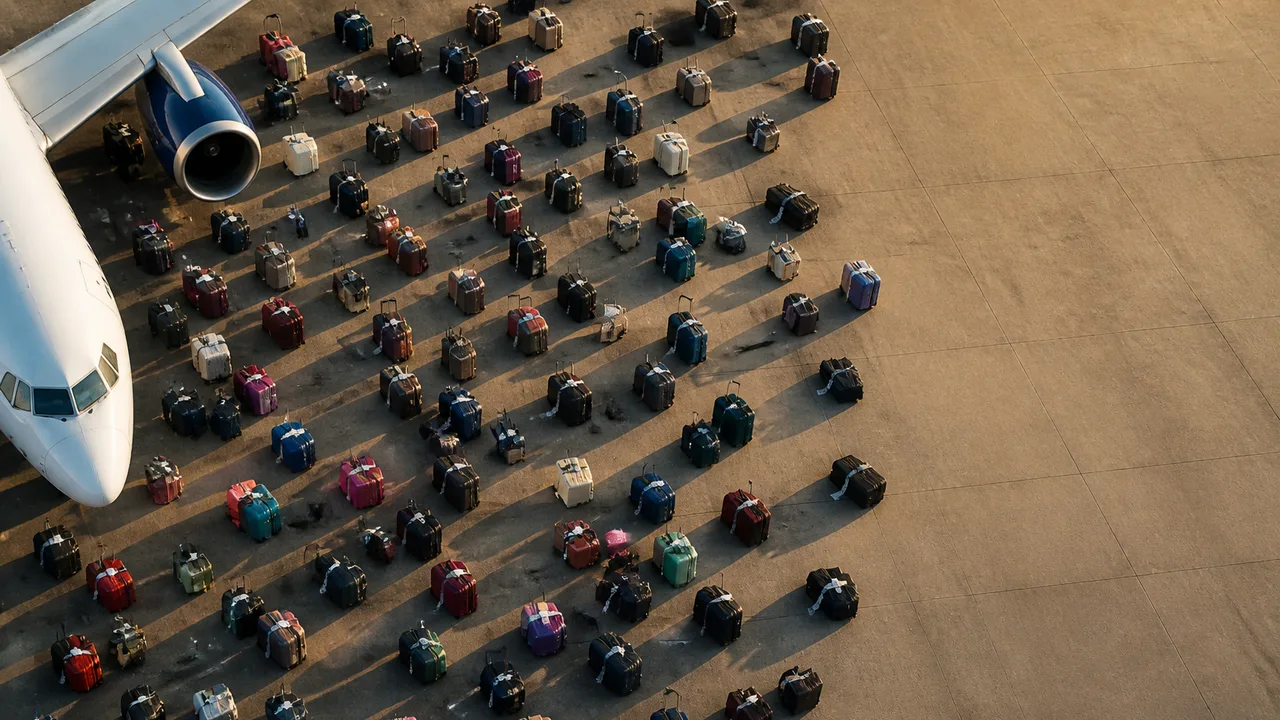
U.S. airlines mishandled more than 2.4 million checked bags in 2025. For any traveler watching a baggage carousel empty without their suitcase, that national total offers little comfort. For everyone trying to understand how air travel works at scale, it offers a useful starting point.
The Bureau of Transportation Statistics recorded 0.52 mishandled bags per 100 checked among roughly 471 million bags submitted to U.S. airlines in 2025. Multiply the rounded rate by that volume and the result is about 2.45 million bags. A rate near half a percent can describe a system that gets the overwhelming majority of bags where they belong while still producing millions of disruptions.
The tally groups bags reported lost, damaged, delayed or stolen. It does not show how many were eventually returned or which travelers bore the disruption. Those categories can describe very different experiences, from waiting for a late delivery to losing access to something that cannot easily be replaced. The common thread is simple: someone handed over a possession with the expectation of seeing it again at the other end of a trip, and the handoff went wrong.
A Small Rate Across an Enormous System
Airlines have a strong case when they point to the denominator. Roughly 471 million checked bags is an extraordinary number of separate handoffs. Each one must remain associated with a traveler and a destination while passengers and luggage move through an operation governed by schedules. Seen from that angle, 0.52 per 100 checked reflects how often the system succeeds.
Passengers have an equally concrete reason to focus on the numerator. More than 2.4 million bags required attention because something went wrong. If you are waiting for a suitcase, the fact that most other suitcases arrived offers no replacement for its contents. These are two views of the same arithmetic, and neither cancels the other.
Scale also makes improvement consequential. At 471 million checked bags, a change of 0.01 mishandled bags per 100 checked would represent about 47,100 bags over a year, assuming the volume stayed the same. It shows why a decimal point in a national rate can correspond to a great many people checking a carousel, filing a report or continuing a trip without what they packed.
The problem persisted into the following year: U.S. airlines mishandled 1.1 million bags in the first six months of 2026. That figure keeps the issue in view, but a six-month total alone cannot establish whether the per-bag risk rose or fell from 2025. The number of bags checked over the same period would be needed for that comparison.
The Passenger and the Bag Take Separate Journeys
Checked baggage asks a traveler to accept a peculiar bargain. The passenger keeps a ticket and a route; the suitcase enters a separate chain of handling. Both are supposed to reach the same destination, ideally at about the same time. A traveler can change gates or ask a question along the way. Their bag depends on the records and handoffs that connect it to them.
That arrangement has a history older than flight. Railways and steamships also moved people and possessions through networks that had to keep track of where each belonged. Aviation intensified the coordination challenge by making distant trips routine within shorter spans of time. Faster travel is useful precisely because many people can rely on the same system. It also gives a missed handoff less time to be corrected before a passenger arrives and looks for a bag that is still elsewhere.
This is one reason baggage handling deserves more attention than its reputation as a travel annoyance. It is an administrative task as well as a physical one. A suitcase has to be identified, directed and moved. A good record without the right physical handoff will not put it on the carousel; a bag moved without an accurate record may be hard to reunite with its owner. The traveler sees the outcome, while much of the work that produced it remains out of sight.
That work belongs in the conversation about performance. Airline schedules, transfers and baggage systems depend on people as well as equipment and information. Yet the national mishandling rate cannot, by itself, assign a cause to any error. It would be tempting to take the figure as a verdict on individual workers, or to assume every incident points to the same failure in airline operations. Neither follows from a count that combines several outcomes across millions of trips.
Whose Disruption Counts?
A missing bag can impose a minor inconvenience or interrupt the purpose of a journey. The contents make the difference. Clothes for a visit, equipment needed on arrival and belongings packed because replacing them would be difficult all fit into the same statistical category when their suitcase fails to appear. So do bags whose owners have very different amounts of money, time or flexibility to deal with the problem.
Consider two passengers whose bags are delayed for the same number of hours. One can buy what they need and wait. The other may have to change plans while trying to locate the bag. That is a comparison of possible consequences, not a claim about the typical mishandled bag. The airline rate counts incidents; it cannot measure the value of the time a traveler spends resolving one.
It also leaves a question for anyone assessing airlines: what should count as good performance? A traveler choosing between carriers may reasonably care about the chance that a checked bag arrives without incident. They may also care about what happens after a mistake, including how clearly they can find out where the bag is. The 2025 rate speaks directly to the first concern at the system level. A complete assessment of a traveler's experience would need to consider the second as well.
It gives the public a way to see an operation that would otherwise be experienced one suitcase at a time. It lets a reader hold two facts together: U.S. airlines handled hundreds of millions of checked bags without a reported mishap, and millions still went astray or arrived in worse condition than expected.
At the carousel, a successful system is the suitcase that comes around with everyone else's. The national figure counts the occasions when somebody keeps waiting.
More Like This

Douglas MacArthur and the People He Left Behind
MacArthur is remembered as a military legend. But what about the veterans he gassed, the soldiers he abandoned, and the Japanese citizens who built a new democracy?

California's Hidden Underground: Caves, Tunnels, and Buried History
From a buried Gold Rush city to survival tunnels built by Chinese immigrants, California's underground holds layers of geology, history, and forgotten infrastructure.

Ramstein Air Show Disaster: Response and the Long Aftermath
The 1988 Ramstein air show crash killed 70 people. Its emergency response, differing injury counts and survivors' long aftermath raise questions about public safety.

Medieval England: How Peasants and Guilds Shaped Society
A new documentary traces medieval England's social divide through two real families—one peasant, one guild merchant—and the starkly different worlds they inhabited.

Why Boarding Pay Still Divides US Flight Attendants
US flight attendants can work through boarding before flight pay starts. The dispute turns on pay formulas, long delays and who bears the cost of gate time.
U.S. Border Device Searches Climb Over 32% in Nine Months
U.S. border searches of travelers' phones and laptops rose more than 32% in the first three quarters of fiscal 2026. What that means for privacy and access.

An 11,000-Year-Old Statue of a Man Riding a Leopard
Archaeologists unearthed an 11,000-year-old statue at Karahan Tepe, Turkey, showing a man riding a leopard. What does it tell us about Neolithic power?

Coin Flipping Is Not as Random as We Thought
From Roman dispute-settling to modern physics research, coin flipping turns out to carry a measurable bias. Here's what that means for fairness.