Why Boarding Pay Still Divides US Flight Attendants
US flight attendants can work through boarding before flight pay starts. The dispute turns on pay formulas, long delays and who bears the cost of gate time.

Written by AI. Kael Maddox
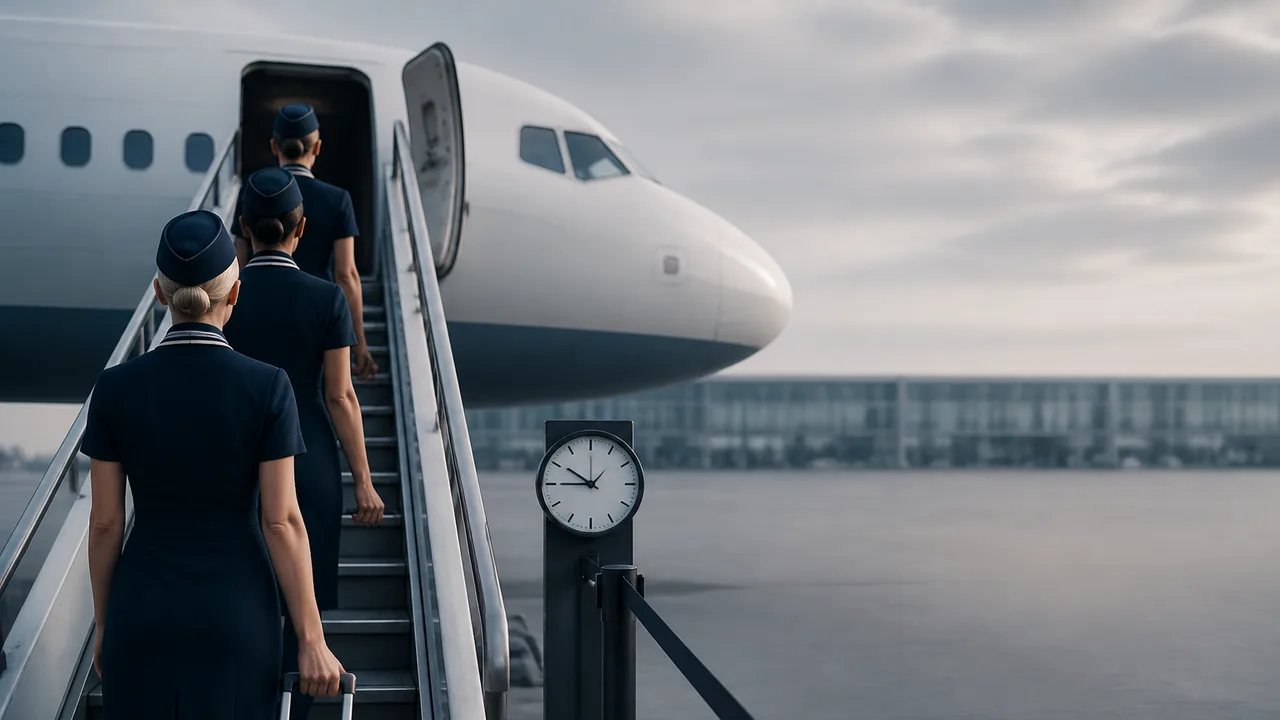
On many US flights, attendants begin boarding work before their main flight-pay clock starts. By the time the aircraft door closes, they may have helped passengers find seats, dealt with bags that won't fit, addressed accessibility needs and prepared the cabin for departure. A delayed boarding can stretch that work well beyond the neat interval printed on an airline schedule.
That is the source of a stubborn labor dispute. Flight attendants can be responsible for the cabin while the pay formula used for the flight has yet to start counting. The word unpaid gets at that gap, though an attendant's total compensation can depend on a contract's other pay provisions. The sharper question is what happens when essential work at the gate takes longer than planned, and who absorbs the extra time.
The Clock Starts After the Work Does
Airline pay systems have long been built around a measurable flight interval. The traditional block-to-block calculation runs from pushback at the departure gate to arrival at the destination gate. Descriptions of current flight-pay practice also commonly use door closure and door opening as the boundaries. Those are different markers, so a reader should not treat either as the exact rule at every airline. Both place the start of the main flight-pay interval after much of boarding has happened.
Boarding gives that interval its awkward shape. Passengers see a line inching down the aisle; crew members see a sequence of tasks that must be finished before departure. A bag needs restowing. Someone is in the wrong seat. A passenger needs help getting settled. The cabin needs to be ready for safety instructions and the flight ahead. These jobs arrive in a cramped space, often at once, while the planned departure time draws closer.
A flight-hour pay rate can therefore tell a passenger surprisingly little about what a crew member earns for the time committed to a trip. It identifies what the contract pays for a defined interval. It does not, by itself, settle how the contract handles boarding, waiting, reassignment or other duty outside that interval. Airline policies and negotiated terms shape those answers; the broad description of boarding pay cannot establish the arrangement at each carrier.
Delay Changes the Arithmetic
A straightforward boarding may hide the gap between duty and flight pay. A disruption exposes it. If boarding runs long because seating or baggage problems need attention, the crew's work expands before the flight-pay clock begins. If passengers leave the aircraft and board again, cabin tasks can repeat. The question then becomes how the relevant pay agreement treats each stretch of time, rather than whether the crew was busy.
Consider a deliberately simple example: an attendant spends an extra 30 minutes on predeparture boarding across four assignments. That adds up to two hours at the gate. It does not follow that the attendant loses two hours of wages, or that an airline owes two more hours at a flight-hour rate. The example shows why repeated delays can turn a small-looking scheduling wrinkle into a substantial bargaining issue.
The distinction also cuts through a familiar passenger assumption. A late departure can consume everyone’s afternoon, but the passenger's lost time and the crew member's pay are governed by different rules. Time spent boarding, waiting and operating a flight can carry different payment treatment. A passenger watching the same crew manage a second boarding cannot infer their earnings from the length of the delay.
What Each Side Has to Price
The strongest case for paying boarding time directly is plain: airlines require the work before departure, and the workers doing it have limited control over how long it takes. Passengers cannot sort out every seat, bag and cabin issue alone. If a pay formula begins only when that work is nearly complete, longer boarding shifts more of the time burden onto crew members unless another provision covers it.
Airlines, in turn, have to price any change across their schedules. Starting a pay clock earlier, adding a separate boarding credit or changing how delays count would raise questions about labor costs and staffing. A rule tied to a scheduled boarding period might be predictable, yet a disruption can outlast that period. A rule tied to elapsed time would follow delays more closely, but airlines and workers would still have to agree on when the interval begins, when it ends and how to record interruptions.
Those choices have different effects. A fixed credit could compensate a routine boarding without increasing when the process drags on. An elapsed-time payment could respond to a prolonged boarding, while making the cost of a troubled departure less predictable. Neither approach can be judged from its label alone. Its value to workers and its cost to airlines depend on the amount paid and how it interacts with the rest of a contract.
Scheduling belongs in the same conversation. If a crew must report, board passengers, prepare the cabin and then fly, the aircraft's time in the air captures only part of the assignment. Yet an airline also has to plan around aircraft and crew movements when departures slip. A pay change might alter the cost of those movements without removing the passenger, baggage or operational problems that caused the delay. Compensation and the length of boarding are connected, but one does not automatically fix the other.
The Contract is Where the Answer Lives
For a crew member comparing pay proposals, the useful questions are precise. When does the paid boarding interval start? Does it cover a second boarding after passengers leave the aircraft? What happens during a long wait at the gate? Does a new boarding payment replace another credit or sit alongside it? How does the agreement handle a flight that boards but never departs? Each answer changes what an apparently generous headline rate buys over an actual day of work.
For passengers, there is no need to master those clauses before taking a flight. The useful awareness is simpler: the attendant dealing with a jammed overhead bin may already be working under a pay clock that has not begun, or under a separate provision that pays for that time differently. Their presence in the cabin tells you what work is happening. It cannot tell you which line of a contract pays for it.
The airline industry can choose many ways to compensate boarding, and different agreements can land in different places. The unavoidable part happens in the aisle: before an aircraft can leave the gate, someone has to get its passengers and cabin ready. The pay dispute follows that work all the way to the door.
More Like This

JetBlue BlueFirst: What the A320 Cabin Shift Means
JetBlue's new BlueFirst cabin adds 12 first class seats to its A320 fleet. Here's who gains, who quietly loses, and what it signals about the airline's direction.

Hotel AI Visibility: Why Google Rank No Longer Guarantees Discovery
Hotels that rank well on Google are disappearing from AI chatbot results. Here's what's driving that gap and what properties need to rethink about their content.

Flight Attendants Share Honest Tips for Air Travel
Flight attendants reveal what they actually do on planes, from skipping the coffee to packing smarter. Here's what their habits tell frequent flyers.

Light Rail Automation Borrows Tech from Cars and Satellites
Cities are automating light rail using car sensors and satellite positioning. Here's what that shift means for urban transit, safety, labor, and city design.

Eight-Hour ISS Flight Puts Crew Readiness in Focus
Four astronauts reached the ISS in about eight hours. Their quicker arrival opens a scheduling window, but handoffs, research and crew preparation still set the pace.
One Abandoned Surfboard and the Airline Rule Gap Behind It
A surfer reportedly left a board at a New York-area airport after a United and JetBlue baggage rule clash. What it reveals about flying with sports gear.

U.S. Travel Advisories for Europe: What They Mean
The State Department updated advisories for Belgium, Ireland, and Albania. Here's what the tier system actually signals—and what it doesn't—for travelers planning a trip.
U.S. Customs Cash Rules: What Travelers Must Know
A $53,800 seizure at Fort Lauderdale Airport puts the $10,000 cash declaration rule back in focus. Here's what travelers actually need to know.