Light Rail Automation Borrows Tech from Cars and Satellites
Cities are automating light rail using car sensors and satellite positioning. Here's what that shift means for urban transit, safety, labor, and city design.

Written by AI. Kael Maddox
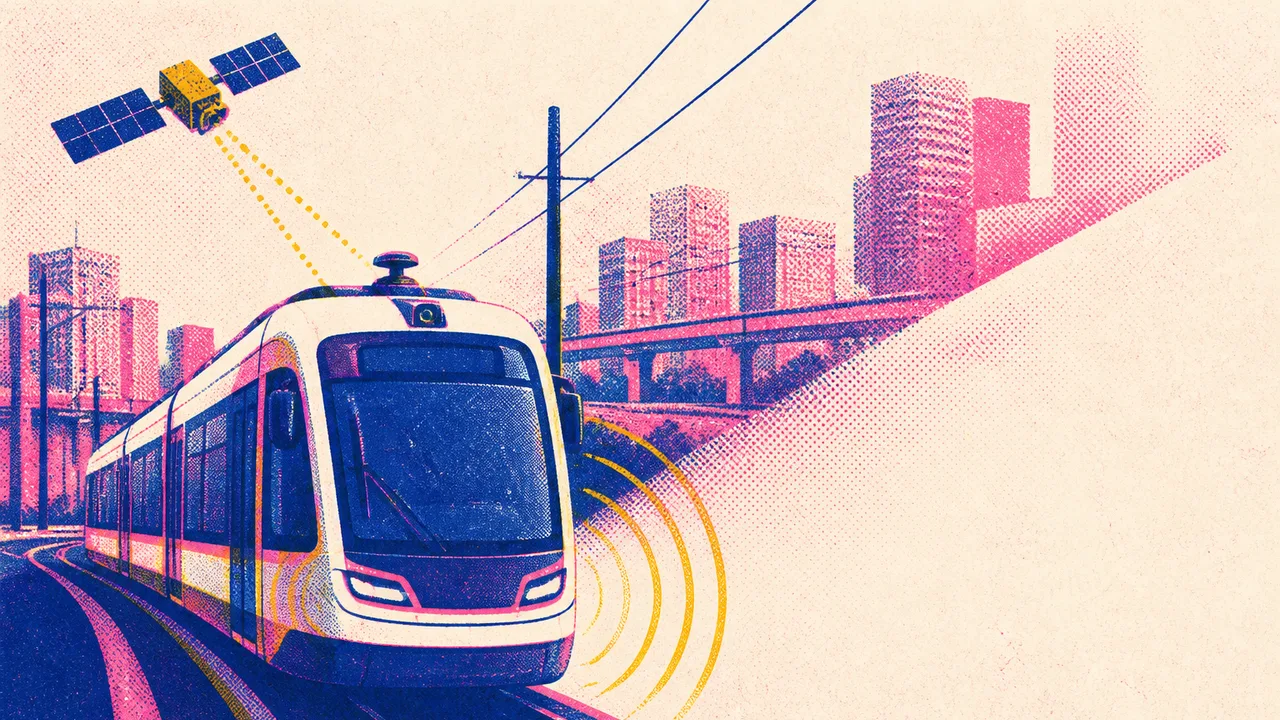
There's a tram running somewhere in the world right now that knows exactly where it is without a driver telling it. It's reading satellite signals, processing sensor data, and following a path that exists only as a line of code — a virtual track painted in software onto the physical world. No steel rail required.
That's not science fiction. It's a design architecture that researchers have actually built, and it points at something genuinely strange about where urban transit is heading.
The Technology Transfer Nobody Saw Coming
For most of its history, rail has borrowed almost nothing from automotive engineering. The two industries evolved in parallel, solving different problems with different constraints. Trains run on fixed infrastructure. Cars navigate open roads. The knowledge bases didn't have much reason to cross-pollinate.
That's changing. According to Railway Gazette, light rail automation pioneers are actively learning from the automotive sector, incorporating sensors and positioning systems that the car industry spent decades and billions of dollars developing. The initiatives include trials with satellite positioning — technology that, in automotive applications, underpins everything from adaptive cruise control to the early driverless test programs that clogged headlines for most of the 2010s.
The Traveler frames this more bluntly: light rail operators are borrowing automotive sensors and satellite positioning to cut costs and prepare networks for driverless service. That last phrase — "prepare networks for driverless service" — is doing a lot of work. It's not describing a near-term rollout. It's describing the engineering groundwork being laid right now, quietly, in cities that most travelers pass through without looking twice at the infrastructure.
The car industry's sensor stack — lidar, radar, cameras, and GPS fusion — was built to handle the most chaotic operating environment imaginable: urban streets full of unpredictable human drivers, cyclists, pedestrians, dogs, and the occasional shopping cart. Rail is a comparatively constrained environment. Trams run on fixed corridors. Their paths are known. The unpredictability is lower. If that sensor stack can manage a four-way intersection in San Francisco, the argument goes, it can manage a tram corridor in Lyon.
The argument has genuine force. The complications come in the translation.
What a Virtual Track Actually Is
The most striking piece of engineering in this space comes from research published in ScienceDirect on what's called an autonomous-rail rapid transit tram. The primary innovation: the vehicle autonomously tracks a virtual centerline — a path marked not in steel but in fused sensor perception — and maintains six-axle alignment with it. The system reads the ground, constructs its own understanding of where the track is, and steers accordingly.
This is a tram that doesn't need a rail. It follows a line that only it can see.
The implications for urban design are significant. Traditional light rail requires tearing up streets, embedding infrastructure, and committing a corridor to fixed use for decades. A system that navigates by virtual track can, at least in theory, be rerouted more flexibly — the physical modification to the street is minimal compared to laying steel. For cities trying to expand transit coverage without decade-long construction projects, that flexibility is a serious draw.
But flexibility cuts both ways. The reliability of physical rail comes precisely from its rigidity. A steel track is hard to fake and hard to hack. A virtual track is a data system, and data systems have failure modes that civil engineering does not.
The Cybersecurity Problem Nobody Likes to Say Out Loud
When transit engineers talk about automation, they spend most of the conversation on sensor accuracy, positioning precision, and fail-safe protocols. Cybersecurity tends to get quieter treatment, partly because the attack surface question is uncomfortable and partly because the industry is still figuring out its own exposure.
Here's the uncomfortable version: an automated light rail vehicle running on satellite positioning and sensor fusion is, by definition, a networked system. It receives data from external sources — GPS satellites, ground-based beacons, potentially real-time traffic management feeds — and acts on that data at speed. Light rail vehicles, according to ScienceDirect Topics, typically weigh 40 to 60 tonnes. At that mass, stopping distance is long, swerving is not an option, and the consequences of a navigation error are not abstract.
Automotive cybersecurity researchers spent years demonstrating that connected cars could be manipulated remotely — steering, braking, acceleration all reachable via software vulnerabilities. Rail systems are not immune to the same class of problems. The more automation you add, the more entry points you create.
None of this means automated light rail is inherently unsafe. It means the security architecture needs to be part of the engineering conversation from the start, not bolted on after the positioning system is already running. The record on connected vehicles suggests the industry doesn't always get that sequencing right.
The Labor Question That Isn't Really a Question
Let's be direct about what "preparing networks for driverless service" means for transit workers. Automation in this context is explicitly designed, among other goals, to reduce the operational cost of running trams. The largest single operational cost is labor. Transit workforces in cities like Lyon, Zurich, and Kansas City — where these conversations are already happening — are watching this particular development with focused attention.
The standard reassurance is that automation creates new jobs in maintenance, monitoring, and system management. That's probably true in aggregate, nationally, over a long time horizon. It is not necessarily true for the specific train driver in a specific city whose skills are being engineered around. These are not interchangeable concerns, and presenting them as equivalent doesn't serve the people most directly affected.
What's genuinely unclear is what the governance structure looks like for managing that transition. Automated subway systems — like those running in cities including Paris, Singapore, and Dubai — offer some precedent, but light rail operates in shared street environments with fundamentally different safety requirements and regulatory frameworks. The precedents don't translate cleanly.
The automotive industry's automation arc is instructive and not entirely reassuring. Decades of promises about retraining programs, transition support, and new job creation accompanied each wave of factory automation. The outcomes were real but unevenly distributed, geographically concentrated, and often slower to materialize than the displacement they were meant to offset.
Rail automation advocates will argue their situation is different — and in some ways it is. But "different" doesn't automatically mean "better managed."
What the Pilots Will Actually Tell Us
Right now, the honest answer about how well any of this works at scale is that we don't fully know yet. The trials are underway. The architecture is being tested. The satellite positioning data is being validated against real-world corridor conditions.
What the pilots will determine is not just whether the technology functions — it probably will, under controlled conditions — but whether it functions reliably enough to earn the public trust that transit systems run on. Automated metro systems took years to establish that trust, and they operate in sealed, grade-separated environments. Light rail shares space with pedestrians, cyclists, and cars. The failure modes are more visible and more consequential.
The automotive industry offers a cautionary data point here. Years of public testing, enormous investment, and genuine technical progress didn't produce the mass driverless deployment that was confidently predicted by 2020. The gap between a system that works in trials and a system that works everywhere, for everyone, in all conditions, turned out to be wider than the early projections acknowledged.
Rail automation advocates will argue the operating environment is more constrained and therefore more tractable. They're probably right that the problem is simpler. Whether it's simple enough, and fast enough to prove, depends on trials that are still accumulating data.
Cities need transit that works. They need it to be affordable to operate, reliable to ride, and honest about what it can and can't do. The automotive sensor stack, the satellite positioning, the virtual track — these are tools. Whether they add up to a transit transformation or an expensive pilot program that generates papers and then stalls depends less on the engineering than on the political will, the regulatory frameworks, and the governance structures that haven't been built yet.
The tram following a line only it can see is genuinely impressive. The question is who decides where that line goes.
More Like This
Flock Cameras Track Far More Than License Plates
Flock Safety's AI-powered cameras are spreading fast across U.S. cities—and they're capturing far more than license plates. Here's what's at stake.
Luxury Train Journey Across Australia: Worth the Cost?
Explore a luxurious 80-hour train journey across Australia and its opulent offerings.

The World's Longest Domestic Flights, Explained
From Boston to Honolulu to Paris to Réunion, the world's longest domestic flights reveal how borders, customs zones, and sovereignty really work.
Toronto's Ontario Line: $27B Gamble on Transit's Future
Toronto's Ontario Line has ballooned from $10.9B to $27B with no opening date in sight. Here's what's at stake—and why the city's skepticism is entirely earned.

What to Expect When Staying in European Hotels
European hotels operate by different rules than North American ones. Here's what actually differs—room size, beds, breakfast pricing, accessibility, and more.

What Experienced Cruisers Know Before They Board
Professor Melissa's 14-minute cruise guide distills hard-won tips on packing, pricing, seasickness, and gratuities that first-timers rarely hear before embarkation day.
AI Agents Need DMVs: A Reality Check on Autonomous Systems
IBM's Jeff Crume argues AI agents need governance infrastructure like cars. But the analogy reveals more about the problem than the solution.
European Train Travel Etiquette Every Tourist Should Know
From seat reservations to strike days, here's what experienced rail travelers know about navigating Europe's train systems without friction.