Eight-Hour ISS Flight Puts Crew Readiness in Focus
Four astronauts reached the ISS in about eight hours. Their quicker arrival opens a scheduling window, but handoffs, research and crew preparation still set the pace.

Written by AI. Mei Zhang
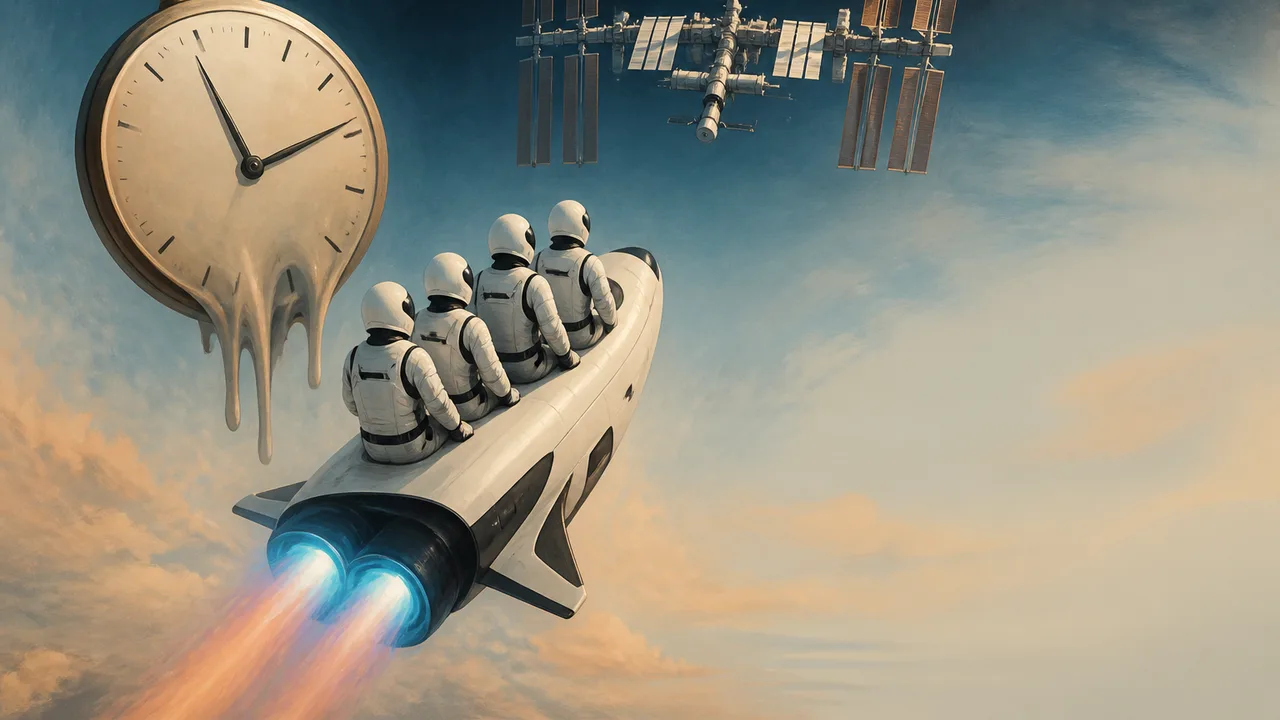
Four astronauts reached the International Space Station on Thursday, October 1, after a journey of about eight hours, described as the quickest U.S. express flight to the orbiting laboratory. Eight hours is an easy number to picture: roughly a workday between launch and arrival. What can a newly arrived crew safely and usefully do with the time it has gained?
NASA identified the launch as its SpaceX Crew-13 mission. Before arrival, the possibility of a record-speed trip was already part of the mission's public outlook. Thursday's arrival turns that prospect into an observed journey time. The available account does not give a detailed flight profile or spell out the comparison behind the record description, so the roughly eight-hour figure supports a narrower conclusion: this crew reached the station quickly. It does not, on its own, establish that every future crew can follow the same timetable.
That timetable has a second half. Docking brings four people into an occupied workplace where they have to learn the current state of equipment, share limited space and take on tasks that may include research and maintenance. For a biotech experiment, arriving earlier can create a useful opening. It cannot make a sample ready, a procedure familiar or a tired person better at following a checklist. 🧬
How an Express Trip Works
A spacecraft heading to the station must reach the right orbit and meet a moving destination. The station keeps circling Earth while the crew travels toward it; the launch time and subsequent maneuvers determine whether the two meet soon or after a longer chase. Think of joining a train already running around a circular track. A fast connection depends on entering at a favorable time, then matching the train's path and speed. Starting with a faster sprint is a poor substitute for getting the timing right.
That is why an eight-hour journey reflects coordination across the flight, rather than a single number on a spacecraft's speedometer. Launch timing, orbital mechanics and spacecraft operations all have to line up. A later mission could take longer for sound operational reasons. To judge whether short transfers can become routine, readers would need more than arrival times: the conditions that made each transfer possible, how often crews can use them and what the shorter transit requires of the people managing it.
The record label also needs a defined comparison group. “Quickest U.S. express flight” says more than “quickest trip to the station,” and the available account does not lay out the flights included in that comparison. The flight's roughly eight-hour duration remains the useful fact. Ranking it more precisely would require the underlying criteria.
The Biotech Clock Starts at Arrival
Station research can involve living systems whose responses change over time. A biological sample is more informative when researchers know when it was collected, what happened before collection and how it was handled afterward. With blood or saliva, for example, the collection time can affect how researchers interpret a measurement. If an experiment calls for preserving a sample, delays or inconsistent handling can complicate comparisons. These are general considerations for biological research, not a claim that Crew-13 performed a particular procedure on Thursday.
Now put the eight-hour flight next to that workflow. An earlier arrival could let planners place a time-sensitive task sooner in the station day, or give a crew more room to prepare before it begins. Either benefit depends on the experiment's protocol and on who is available to carry it out. A sample scheduled for a defined time cannot simply move forward because the spacecraft docked early. Nor should someone assume that four arrivals translate into four immediately available laboratory workers.
The food metaphor practically serves itself: reaching the kitchen early doesn't mean dinner is ready. Someone still has to check the recipe, locate the ingredients and keep the food at the right temperature. In a laboratory, the equivalents are procedures, supplies, timing records and conditions that protect the integrity of a sample. A shortcut through any of those steps can cost more than the travel time saved.
This is where readiness becomes more useful than speed as an operational question. Crews need time to orient themselves to the station's current arrangements and coordinate with the people already aboard. For research, that can mean knowing which task comes next, which equipment is available and whether a procedure can proceed as planned. For maintenance, it means understanding the status of the system before touching it. The shorter flight may create a window for those conversations. Filling the window with work is a separate decision.
What Eight Hours Can Buy
The strongest practical case for a rapid transfer is flexibility. If arrival comes earlier than it would on a longer route, planners may have more choices about when to begin a handoff, prepare equipment or protect a block of rest. That flexibility could help when a research protocol has a narrow timing requirement. It could also be spent on orientation rather than on adding tasks to the first shift.
Those choices have human limits. The newly arrived astronauts have just completed launch and orbital travel, then entered a crowded microgravity workplace. The public information supplied here does not establish how this crew felt on arrival, what duties they took on first or whether anyone needed extra adjustment time. A responsible schedule would leave room to assess readiness rather than treating the docking time as proof of it.
There is a trade-off for the crew already on the station, too. A handoff uses their attention: they may need to explain equipment status, pass along plans and coordinate access to shared work areas. Moving that exchange earlier could be helpful if it fits the station's workday. It could also interrupt work already under way. The benefit comes from where the freed hours land in the schedule, not merely from their appearance on a flight timeline.
This raises an equity question within the research program. Station time is limited, and experiments compete for crew attention and equipment access. If quicker arrivals eventually give planners more usable time, who gets that time: a sample-handling task with a strict deadline, routine maintenance, crew orientation or rest? Speed cannot choose among them. The research value of any extra window depends on how it is allocated and whether the people doing the work have enough preparation to do it well.
Crew-13 has supplied one visible result: four astronauts arrived in about eight hours. Future missions could show whether comparable transfers remain practical under different launch opportunities and station schedules. The more immediate planning question is concrete. If an early docking leaves an open block on the calendar, should the station use it for a first experiment, or reserve it for the handoff and preparation that make the experiment reliable?
More Like This

Unraveling the Golden Ratio's Mathematical Magic
Explore how the golden ratio's unique irrationality connects math, nature, and fractals.

How Maxwell Unified Electricity and Magnetism
A compass needle twitched in 1820 and set off a chain of discoveries that now powers every wireless signal in your life. Here's the physics behind it.

August's 96% Blood Moon Lunar Eclipse Explained
A 96% partial lunar eclipse turns the moon deep red on Aug. 27-28. Here's when to watch, why it happens, and what's threatening our view of it.

SpaceX Rocket Team Wins First Neil Armstrong Prize
SpaceX's Falcon 9 landing team won the first Neil Armstrong Space Prize, spotlighting reusable rocket engineering, costs, climate and access to orbit.

ISS Antenna Replaced in Two-Spacewalk Operation
NASA's Anil Menon and ESA's Sophie Adenot completed a two-part spacewalk operation to replace a failed Ku-band antenna on the ISS, restoring full communication redundancy.
ISS Antenna Spacewalk Reveals a Station Past Its Prime
Menon and Adenot spent 6 hours outside the ISS and still couldn't finish the job. The real story is what that says about a 25-year-old station we can't yet replace.

The Feynman Trick That Stumped a Math Competition
Richard Behiel's competition integral uses the Feynman trick to reach a surprisingly clean answer. Here's what the footage reveals about math, pressure, and access.

The Two Poles Theorem Solves a Geometry Puzzle
A geometry puzzle about two walls and a man's height reveals a classical theorem — and a surprising connection to teamwork math. Here's what's actually going on.