ISS Antenna Spacewalk Reveals a Station Past Its Prime
Menon and Adenot spent 6 hours outside the ISS and still couldn't finish the job. The real story is what that says about a 25-year-old station we can't yet replace.

Written by AI. Olivia Meng
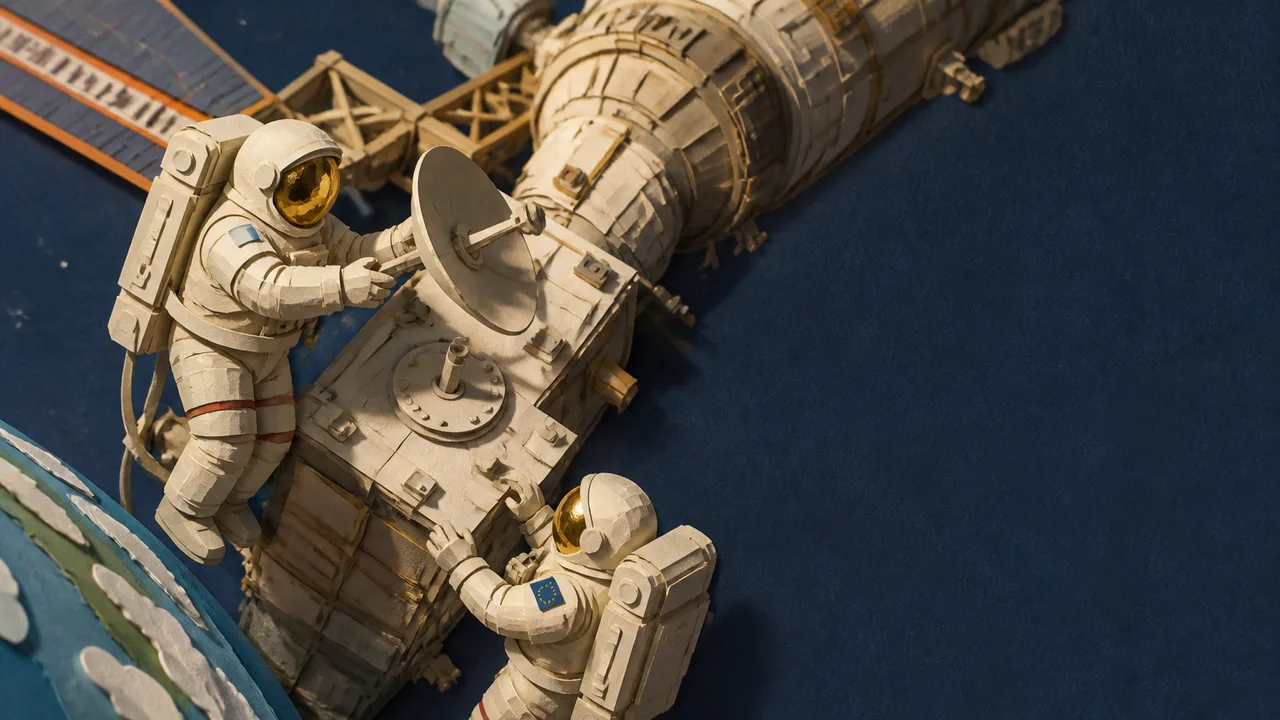
Six hours and twenty-three minutes is a long time to be outside a spacecraft. It is also, it turns out, not quite long enough.
On August 18, NASA astronaut Anil Menon and European Space Agency astronaut Sophie Adenot completed what Firstpost called a 6-hour, 23-minute spacewalk outside the International Space Station — removing a failed communications antenna, but running out of time to install its replacement. According to Spaceflight Now, flight controllers ultimately decided there wasn't enough time remaining for the crew to move the failed antenna to its permanent storage location or to retrieve the spare and mount it. The old antenna was lashed down near its boom. The new one stayed where it was. A future spacewalk will have to finish the job.
I cover infrastructure that is being asked to do more than it was designed to do, under conditions it was not designed for, on timelines that keep getting extended because replacing it is politically or financially inconvenient. I cover that on Earth, where the systems in question are power grids and coastal seawalls and natural gas pipelines grandfathered past their service lives. Occasionally, it turns out, I also cover it in low Earth orbit.
The ISS is 25 years old. It was designed with a lifespan in mind — and that lifespan has been revised, extended, and revised again. Congress approved an extension of the station's operations through 2030, as Space.com reported, which means NASA is now maintaining a structure well into a fourth decade it was never engineered to occupy. Every replaced antenna, every patched module, every spacewalk to address a failed component is, at some level, a negotiation with physics that the original designers didn't expect anyone to be having.
That context doesn't make Tuesday's EVA less impressive. It makes it more so — and also more clarifying.
A Difficult Job, Made Harder by Time
What Menon and Adenot accomplished was not nothing. Removing a failed antenna from the exterior of a spacecraft moving at roughly 17,500 miles per hour, while suited in hardware that limits dexterity and tethered to a structure you cannot afford to damage, is a task that requires precision, coordination with ground controllers, and the ability to adapt when the plan meets the reality of the hardware.
Hindustan Times reported that mission control made the call: there wasn't enough time for the astronauts to move the failed antenna to its permanent storage location or to retrieve and install the spare. The decision reflects standard EVA protocol — safety margins are not negotiable, and forcing a complex installation in the final minutes of a spacewalk is exactly the kind of calculated risk that mission controllers exist to prevent.
But the fact that six-plus hours wasn't enough to complete a two-part task — removal and replacement — is worth sitting with. Spacewalks are meticulously planned, task-timed, and rehearsed. When they run long, it usually means the hardware was harder to work with than anticipated, or that some element of the environment introduced friction the simulations didn't capture. The sources available don't specify which factor caused the delay here, so I won't speculate on the mechanism. What the outcome does tell us is that the margin between what was planned and what was achievable was thin enough that a single scheduling shortfall cascaded into an incomplete mission.
That is a pattern worth watching on aging infrastructure, wherever it lives.
Two Astronauts Worth Knowing
Menon's presence on this mission carries its own significance. Ars Technica described him as a most improbable astronaut — a characterization that speaks to a career path that defied the conventional NASA pipeline. Whatever the specifics of that path, the description suggests someone who arrived at this work by a route the agency doesn't often produce.
Sophie Adenot's milestone is more straightforwardly historic: Space.com confirmed that she became the first French woman to conduct a spacewalk. That's not incidental. It took France — a founding ESA member nation with a long history of human spaceflight participation — until 2026 to put a woman outside the station. Progress in representation moves slowly in institutions that move slowly everywhere. That Adenot's historic EVA also happened to be a partial success on an aging piece of infrastructure is not ironic so much as it is honest: milestones in complex systems rarely arrive in clean circumstances.
The Maintenance Problem Nobody Wants to Name
The ISS is an extraordinary achievement — scientifically, diplomatically, and operationally. It has hosted continuous human presence since November 2000. It has been the site of research that would be impossible to conduct on the ground. Its multinational structure, through all the political turbulence of the past two decades, has functioned more durably than many observers expected.
It is also a machine, and machines degrade. The thermal control systems, the solar arrays, the communications equipment — all of it ages in an environment that is uniquely brutal. Micrometeorites. Temperature swings of more than 300 degrees Fahrenheit between sunlight and shadow on every 90-minute orbit. Radiation that would be lethal without the station's shielding. The ISS weathers all of this, continuously, and it shows.
Failed antennas are not a crisis. But they are data. Every component that requires emergency removal and replacement is a signal about what it costs to keep a 25-year-old station operational in a regime it was not designed to inhabit indefinitely. NASA and its partners have managed that maintenance with considerable skill — but maintenance is not the same as renewal, and there is a point at which the gap between them becomes operationally significant.
The station is funded and authorized through 2030, per Space.com's coverage of the Congressional approval. After that, the plan — such as it currently exists — involves a controlled deorbit and the emergence of commercial successors that are, at this moment, variously underfunded, behind schedule, and architecturally unproven at scale. The transition from ISS to whatever comes next is not a foregone conclusion. It is a gap that someone will have to manage, and the decisions being made right now — including decisions about how hard to push maintenance operations on a station that was supposed to be retired years ago — will shape what that gap looks like.
Somewhere above the Pacific right now, a failed communications antenna is lashed to a boom, waiting. The crew will go back out. The spare will be installed. The station will continue its 90-minute laps.
The question that doesn't have a tidy answer is how many more of these laps the ISS can reasonably sustain — and whether the systems meant to follow it will be ready when the math finally runs out.
More Like This

How the Asteroid Impact Ended the Dinosaur Era
Explore the catastrophic asteroid impact that ended the dinosaurs, its immediate aftermath, and the long-term environmental changes.
Space Stations Beyond the ISS: A Forgotten History
From a Cold War spy base to a Soviet ice rescue to China's chicken-wing oven in orbit — the real history of space stations is wilder than you think.
Anil Menon Reaches the ISS on His First Spaceflight
NASA astronaut Anil Menon launched to the ISS on July 14 aboard Soyuz MS-29. His eight-month mission raises questions about what space cooperation looks like next.

Subcritical Reactors: Nuclear Power's Safety Fix?
A new generation of subcritical reactors promises to make nuclear meltdowns physically impossible. But can they deliver on cost, scale, and timeline?

Understanding the Real Risk of Brain-Eating Amoebas
Explore the facts and myths surrounding brain-eating amoebas. How real is the threat, and can climate change affect its spread?

NASA's Crew-12 Mission: A Leap Towards Mars
Crew-12 mission advances space exploration, featuring ISS experiments and spacecraft upgrades for future Mars missions.

How Humidity Makes Extreme Heat Deadly
Wet bulb temperature, not air temperature, determines when heat kills. Joe Hanson's lab experiment reveals what our bodies face in a hotter, more humid world.

Google's Android Earthquake Alerts Warned Venezuela
On June 24, 2026, Venezuela had no national earthquake warning system. Google's Android alert network reached 11.4 million phones anyway. Here's what that means.