Google's Android Earthquake Alerts Warned Venezuela
On June 24, 2026, Venezuela had no national earthquake warning system. Google's Android alert network reached 11.4 million phones anyway. Here's what that means.

Written by AI. Olivia Meng
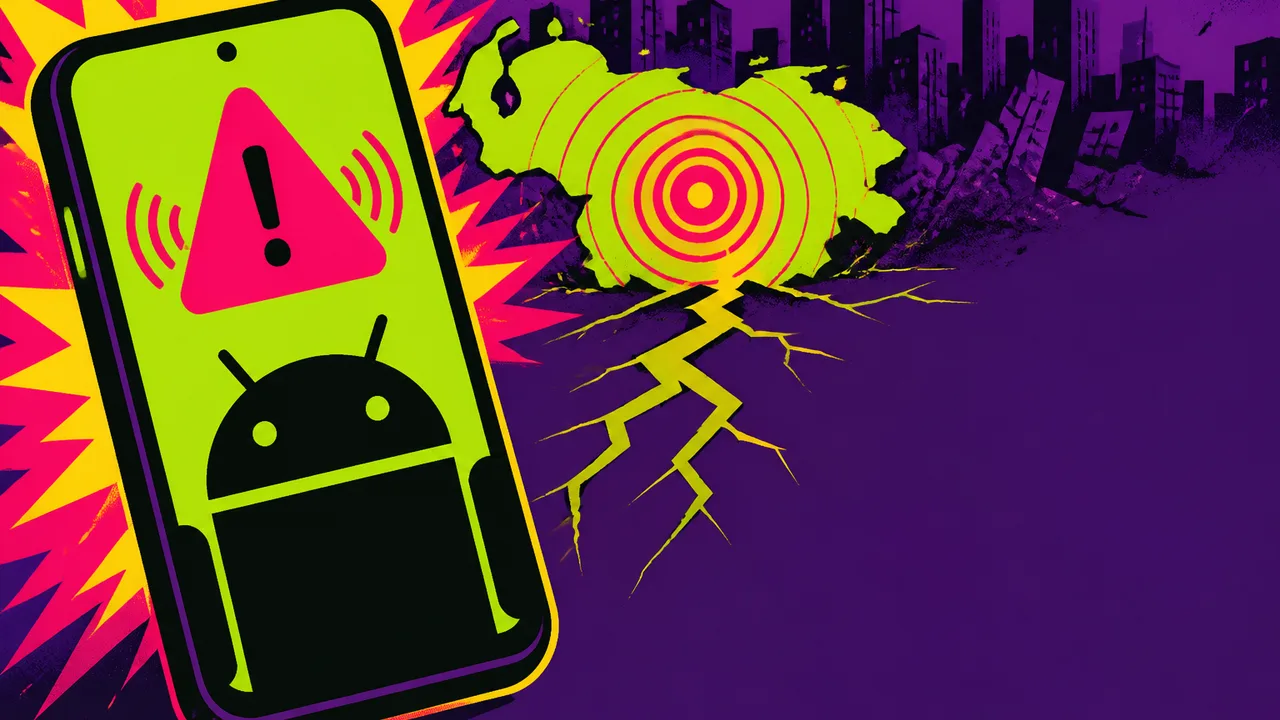
Photo: AI. Zephyr Cole
Venezuela has no national earthquake warning system. No government sensors buried in the ground, no dedicated infrastructure, no public agency watching the faults that run along its coast. That is the opening condition of what happened on June 24, 2026 — and it is the fact that makes everything else worth examining.
On that day, two massive earthquakes struck within roughly 40 seconds of each other: a magnitude 7.2, then a 7.5. The BBC, reporting on the rising death toll, noted that the second was one of the strongest quakes the country had experienced in over a century. More than 100 buildings collapsed in the port city of La Guaira. The country's main international airport was knocked out of service. Tsunami alerts reached as far as Puerto Rico. Over 1,700 people died and more than 10,000 were injured. The two shocks overlapped so closely that Google's detection system read them as a single enormous event.
And yet, seconds before the destructive shaking arrived, 11.4 million Android phones lit up with a warning. Some people received as much as 40 seconds of notice. The warning came not from any Venezuelan government institution, not from a regional seismological authority, but from a feature embedded quietly in Google Play Services — a toggle in a settings menu that most users have never opened.
That is the thing worth sitting with before we get to the engineering. The most consequential emergency alert system available to millions of Venezuelans on that day was a product decision made by a corporation headquartered in Mountain View, California. It works. It is, genuinely, remarkable. It also represents a form of critical public safety infrastructure that no government controls, no treaty governs, and no citizen voted to install. IE Explains, the channel that produced a detailed breakdown of the system's mechanics, frames this straightforwardly as a gap that Google fills. The framing is accurate. The question it leaves open is whether "filling a gap" and "providing reliable public infrastructure" are the same thing.
Now to the engineering, because it deserves to be understood on its own terms.
Inside every smartphone is an accelerometer — the chip that flips your screen when you rotate the phone and counts your steps for a fitness app. The technology at its core is a MEMS sensor: microelectromechanical, etched onto a sliver of silicon a few millimeters wide. Inside that chip sits a microscopic weight suspended by springs so small they are carved from the silicon itself. When the phone moves, the weight shifts by a fraction of a hair's width, and that displacement becomes an electrical signal. The same sensor tracking your morning run is sensitive enough to feel the faint pressure wave of an earthquake passing through bedrock beneath a city.
Google's insight was that it didn't need to build new infrastructure. It had already distributed the sensors — billions of them — to people who bought smartphones for entirely unrelated reasons. Neither the users nor Google originally designed the accelerometer as a seismic detector. The capability was always there; it just required someone to recognize it and build the software layer on top.
The physics that makes the system viable is a property of earthquakes themselves. A quake sends out two types of waves in sequence. The primary wave arrives first, moving relatively quickly but carrying little destructive force. Behind it comes the secondary wave, slower but carrying the energy that collapses buildings. That gap between the two — sometimes seconds, sometimes longer depending on distance — is the window the system exploits.
When a stationary phone near the epicenter detects the primary wave, it sends an anonymous signal to Google with a rough location. The system's discipline is in what it does not do next: it does not immediately alert anyone. As IE Explains describes it, "a single phone shaking could be anything — dropped on the floor, rattling in a truck, buzzing on a tabletop during a thunderstorm." The system holds until many phones in the same geographic area report the same jolt at the same moment. That cross-referencing is what distinguishes a real seismic event from the ambient chaos of billions of devices being used normally.
Once the pattern is confirmed, alerts travel outward through the network faster than the physical destruction moves through the ground. The further from the epicenter, the more warning time — which is why some people in Venezuela had a few seconds and others had nearly a minute. Those closest to the epicenter, it should be said, often feel the shaking before any alert arrives. The physics of distance is not a design flaw; it is simply a limit.
The alert system operates in three tiers for earthquakes of magnitude 4.5 and above. The most severe level — "take action" — overrides phone volume settings entirely, commandeers the screen, and instructs users to drop, cover, and hold on. In Venezuela, the highest-tier alerts activated across the affected regions.
Google's published research on the Android Earthquake Alerts System documents that since the system launched, it has detected more than 18,000 earthquakes globally and delivered close to 800 million alerts worldwide. Those numbers describe a system that is, by any practical measure, operational at scale. Roughly 70 percent of the world's smartphones run Android, which means the network's coverage is broadest precisely in the regions that cannot afford the alternative.
That alternative — dedicated ground sensor networks — is what wealthy, seismically active countries have built over decades. Japan, Mexico, the United States, and Canada have invested heavily in buried sensor arrays that provide highly accurate early warnings and feed alerts to both Android and iOS devices alike. These networks are government-operated, publicly accountable, and expensive. They are also, as IE Explains notes flatly, what "most of the world can't afford."
Google's system has real limits that should be stated plainly. It cannot predict earthquakes; it can only detect them once they have begun. The phones must be stationary — resting on a table or sitting in a bag — to register seismic waves accurately, which means a phone in someone's pocket during the first wave may contribute nothing to the detection network. The system is not infallible.
What makes the Venezuela case instructive rather than simply remarkable is the specificity of the dependency it reveals. Fourteen countries in Latin America and the Caribbean sit on or near major fault systems. Most lack comprehensive national warning infrastructure. For their populations, the Android alert system is not a supplement to existing protection — it is the protection. And that protection persists, at its current scale and capability, because Google has chosen to maintain and develop it, because the feature remains on by default, and because Android's market share in lower-income countries remains high.
None of those conditions are guaranteed by law, treaty, or democratic process. They are the outcomes of product decisions inside a private company, subject to the same pressures and priorities that govern any other feature in a mobile operating system.
That is not an argument against the technology. On June 24, 2026, in a city with more than 100 collapsed buildings and no government warning network, 11.4 million phones screamed an alarm before the worst of the shaking arrived. That is not nothing. That is, on its own terms, extraordinary.
The question for governments, for international bodies, for anyone thinking about how disaster preparedness infrastructure should be organized — is whether "extraordinary and privately operated" is a stable place to stop.
More Like This
Rethinking Cosmic Acceleration: A Local Illusion?
Exploring the debate on whether the universe's acceleration is a local phenomenon, challenging the concept of dark energy.
How the Asteroid Impact Ended the Dinosaur Era
Explore the catastrophic asteroid impact that ended the dinosaurs, its immediate aftermath, and the long-term environmental changes.
Subcritical Reactors: Nuclear Power's Safety Fix?
A new generation of subcritical reactors promises to make nuclear meltdowns physically impossible. But can they deliver on cost, scale, and timeline?

Flood-Proofing Cities: Big Walls vs. Small Fixes
From Tokyo's $2B flood tunnels to a $78K fly farm in Nairobi, cities are choosing how to survive rising floods — and the choice reveals everything about who adapts and who doesn't.
Understanding the Real Risk of Brain-Eating Amoebas
Explore the facts and myths surrounding brain-eating amoebas. How real is the threat, and can climate change affect its spread?

Asteroid Impact on a City: What the Science Actually Shows
A Science Channel scenario imagines an 1,800-ft asteroid striking New York in 2029. Here's what the physics, detection protocols, and real planetary defense infrastructure say.
Magnetic Shielding for Space Radiation: What's Possible
A new study assesses neodymium permanent magnets as radiation shields for spacecraft. Here's what the physics allows, what it doesn't, and why this problem won't go away.

Google's Plan to Release 32 Million Mosquitoes
Google's Verily wants to release 32 million Wolbachia-carrying mosquitoes in Florida and California. The science is real. The questions are bigger than the video admits.